
The first time I noticed the overlap, I was reading a forum thread where someone was asking for advice on their first van build. They wanted to know the bare minimum they’d actually need. And the most useful answers weren’t coming from full-time van lifers or experienced builders with years on the road. They were coming from thru-hikers, people who’d walked the Appalachian Trail or the Pacific Crest Trail, sometimes both, and who had spent more time thinking about the practical weight of a single object than most of us ever spend thinking about our entire living spaces.
That thread stuck with me for weeks.
Because the insight these hikers were bringing wasn’t just “carry less stuff.” It was something more specific, a whole different relationship with possessions that gets built very gradually over months of carrying everything you own on your back. They weren’t arguing from theory. They were arguing from the kind of real, physical, consequence-bearing experience that makes someone’s advice worth actually listening to.
The thru-hiking and van life communities don’t overlap as much as they probably should. And I think van lifers are the ones missing out.
1. What a Loaded Pack Actually Teaches You
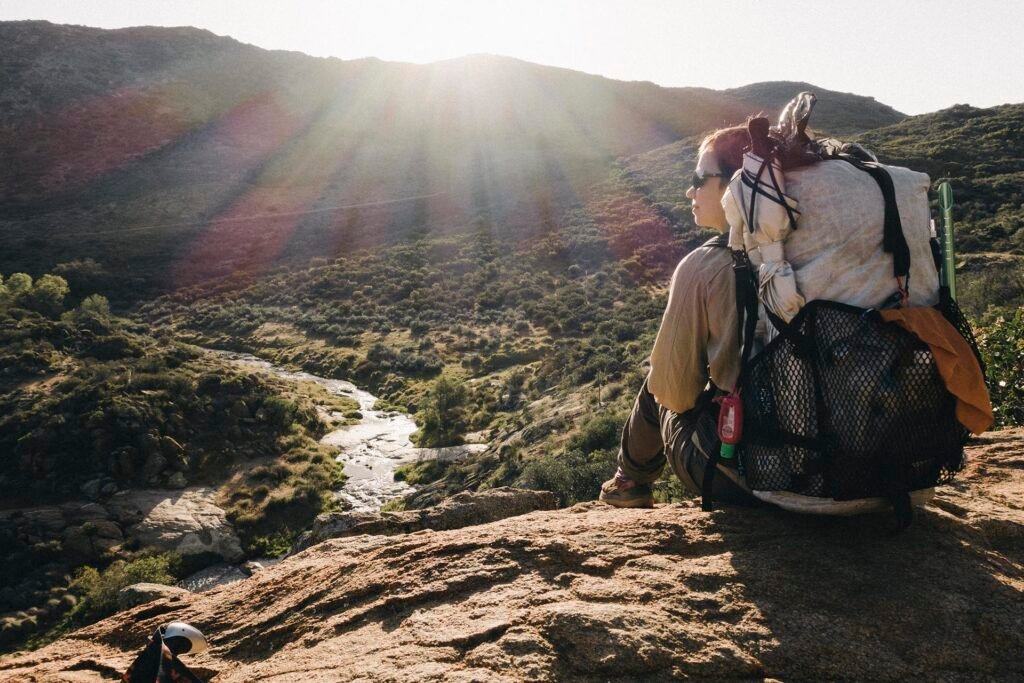
Thru-hikers have a term for the obsession that defines early trail preparation: base weight. This is everything in your pack except food, water, and fuel. The average beginner starts somewhere around 25 to 35 pounds total carry weight. An experienced ultralight hiker gets that base weight down to 7 or 8 pounds. The difference between those two numbers is entirely about learning what you actually use versus what you imagine you’ll use, and no one believes the experienced hikers until they’ve lived through a long trail themselves.
Someone tells you that you don’t need the folding camp chair. You think they’re being extreme. Then you’re 40 miles in, your shoulders ache, and you post the chair home at the next trail town because a log works just as well.
Van lifers go through an almost identical arc. Not with weight, exactly, but with space and money. You build out the van with everything you imagine you’ll want. A full kitchen setup, a dedicated workspace, storage for the mountain bike you’ve used twice in the last year. Then six months in, you’re annoyed by how cluttered the van feels, and you start pulling things out.
The thru-hiker gets to that realization much faster. A 2,650-mile trail forces the lesson in weeks rather than years.
If you’re still in the planning stage, the question worth asking yourself isn’t “what might I need?” It’s “what do I know I use at least once a week?” That second question produces a much shorter, more honest list. It also tends to produce a simpler build, which is part of why a functional van setup under $5,000 is more achievable than most first-timers think.
2. The Shakedown Trip Van Lifers Skip
Before a major thru-hike, experienced hikers do what’s called a shakedown trip. A long weekend in the mountains with your full pack, carrying everything you plan to use on the trail. Anything you don’t touch is a candidate for removal, anything that causes unexpected problems gets replaced or eliminated before the real journey begins. It’s a ruthlessly practical system.
And most van lifers don’t have an equivalent.
What they have instead is buying things in advance, guessing what they’ll need based on what looks useful in other people’s builds on YouTube, and then discovering six months in that three of those purchases have been sitting untouched in the back storage since week two. The kitchenware that was going to make van cooking exciting. The second lantern. The extra sleeping bag stuffed next to the first one.
The shakedown principle translates directly to van life. Before committing to any permanent storage system or built-in feature, spend a month or two living in the van without it. Use temporary solutions. Pay attention to what you actually reach for. Build permanent fixtures around real patterns, not imagined ones.
Thru-hikers also use what they call bounce boxes, a box of optional extras mailed to a town further up the trail, available if needed, sent home if not. Van lifers have a near-identical equivalent in the form of storage units, parents’ spare rooms, and garage shelves full of objects they removed from the van and never quite got around to selling. It’s the same instinct. Both represent real money sitting completely unused.
The parallel that strikes me most is this: thru-hikers learn to distinguish between comfort and actual need. A sleeping pad is need. A pillow is comfort. You can substitute. Van living forces the same renegotiation, and people who’ve done long trail sections often arrive at it with much less friction than those who haven’t.
3. Gear Creep: The Problem No One Plans For
Every experienced thru-hiker knows about gear creep. You start the trail lean and intentional. Then you hit a cold spell and buy a warmer jacket than you need. Then someone at a hostel swears by their trekking poles and you pick up a pair. Then a hiker you trust talks you into upgrading your cook system. Week by week, your pack gets heavier, and you’re not entirely sure how it happened.
Van life has a version of this that Budget Van Journeys readers have written to me about more than almost any other topic. The build starts with a clear plan, and the plan expands. A basic electrical system becomes a more complex solar setup because you meet someone at a campsite who makes a convincing case for it. Storage that seemed sufficient in the design phase gets supplemented by cargo nets, hanging organisers, and a ceiling rail. None of the individual additions seem wrong in isolation. Each one solves a real problem. But the cumulative effect is a van that costs more than planned and feels denser than it needs to be, and that’s before you’ve even been on the road for three months.
I’ve written before about why first-time van builders tend to overspend, and gear creep appears in almost every single case.
The thru-hiker’s remedy is simple if harsh: anything you haven’t used in five days gets mailed home at the next town. The van equivalent is harder to enforce because there’s no convenient post office in your daily routine. But a version of it works. Every three months or so, go through everything in the van and ask whether each item has genuinely earned its space. Here’s a framework for that audit:
| Item Category | Keep It If… | Consider Removing If… |
|---|---|---|
| Cooking equipment | Used at least three times a week | Only used on “special” occasions |
| Clothing | Worn within the last two weeks | Kept for “just in case” or seasonal overlap |
| Tools and spare parts | Vehicle-specific or safety-critical | General purpose, already covered by another item |
| Hobby or outdoor gear | Actively used every week | Not touched since you left |
| Comfort items | Genuinely improves daily life | Adds bulk but rarely used in practice |
The thru-hiking community has a blunter version of this table. They call it the “will I regret not having this at 3am?” test. If the answer is no, the item doesn’t make the cut.

4. The Psychological Shift Nobody Warns You About
Something happens to thru-hikers when they come off the trail after four or five months of walking. They step into a supermarket and feel genuinely overwhelmed. Seventeen types of toothpaste on a single shelf, and they stand there in something close to distress, when for months there was one option, or none at all. The simplification was uncomfortable initially and then, gradually, became a relief. Being forced back into the normal world returns them to a volume of choice they no longer know how to process.
I know something about this feeling myself. After a long solo trip with just a backpack, there’s a weird two-week window when coming home where supermarkets feel almost hostile and rooms feel cluttered even when they’re not. Then it fades, and you gradually accept it again, and six months later you’ve accumulated things and you barely notice. But I keep thinking about that window. It tells you something real about how your brain recalibrates when you remove the noise.
Van life produces a version of this. People who’ve spent six or more months in a small van often describe a real resistance to returning to a conventional home. Not because the van is objectively better, it usually isn’t, at least not by every measure. But because the constraints of a small space enforce a clarity that a larger home doesn’t offer. You know where everything is. You own what you use. Nothing is lost in a cupboard you haven’t opened in a year.
This is what thru-hikers mean when they say trail life is simpler. Not easier or more comfortable. Simpler.
For van lifers, the practical implication is this: if your van feels stressful rather than freeing, the answer is rarely “add more storage.” It’s almost always “own less.” And making better use of tiny storage spaces becomes a much more satisfying problem to solve once the total volume of stuff is already manageable.
I’m aware that’s the kind of advice that sounds easier in writing than in practice. But it’s also the thing I hear back from people who’ve been doing this for two or three years, the observation that keeps coming up regardless of where they’re based or how they started. Less wasn’t the sacrifice. Less was the point.
There’s also a financial argument that Budget Van Journeys comes back to regularly: living with less costs less to begin with, and continues to cost less over time. Fewer things bought, fewer things to replace, fewer things to store. The person who builds their van around what they’ve verified they actually need, rather than what they imagine they might need, consistently spends less over the long run. That connection between simplicity and real savings isn’t a lifestyle philosophy. It’s just maths.
Thru-hikers figured it out decades before van life became a thing. And the trail taught them what most of us have to learn the slow way.
FAQs
How many things does an ultralight thru-hiker typically carry?
An experienced ultralight hiker on a trail like the PCT carries around 50 to 70 distinct items in total, including all clothing, shelter, navigation tools, and cooking equipment. A heavier traditional setup might include 100 to 120 items. The difference isn’t about enduring hardship. It’s about having thought carefully and honestly about what actually gets used when conditions vary.
What is “base weight” and why would a van lifer care about it?
Base weight is a hiker’s total pack weight minus food, water, and fuel. It’s the number that reveals how clearly someone has thought through actual needs versus projected ones. Van lifers don’t use the term, but the underlying concept applies directly: how much of what’s in your van do you actively use, versus how much did you bring because it seemed like it might be useful? The more honestly you can answer that question, the better your build decisions tend to be from the outset.
Does van life naturally lead to owning less, or does it depend on the person?
It depends mainly on the space and the willingness to edit. People who stay in a consistent small van for more than a year almost always end up owning significantly less than when they started. The van space acts as the constraint, and constraints clarify. People who keep upgrading to larger vans tend to fill the new space rather than reduce what they own. The physical limits of a Transit or a Sprinter turn out to be one of their more practically useful features.
Why is the cooking setup one of the areas where van lifers most often over-build?
Because the aspirational version of van cooking involves elaborate meals and a full kitchen, while the practical version usually involves one pot, a two-burner stove, and a cutting board. Thru-hikers are ruthless about cook systems because weight and fuel consumption are immediate, physical consequences they carry with them every mile. Van lifers don’t face those same immediate costs, so the tendency is to over-equip and then gradually simplify. Starting smaller is almost always the right call, and cooking real food in a van on a tight daily budget is evidence that simpler setups work fine.
Is it worth talking to thru-hikers before planning a van build?
More than most people realise. Specifically on cooking systems, storage philosophy, and the psychological side of living in a genuinely small space with everything you own. The two communities are solving similar problems from different angles, and the overlap tends to produce useful, grounded perspectives. Any active long-distance hiking forum will have threads on simplification and packing philosophy that van lifers would find directly relevant, even if the terminology is different.