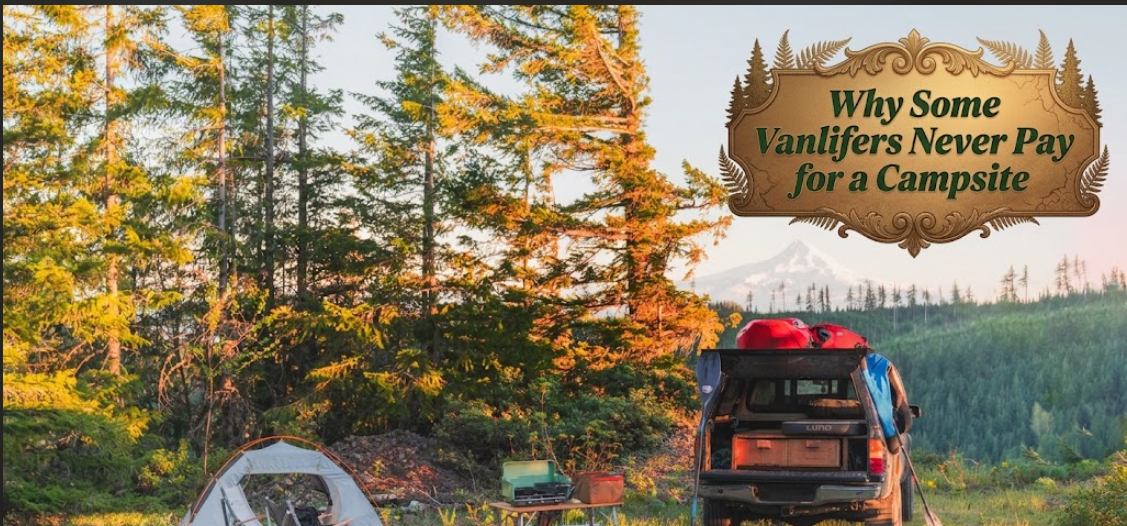
Forty-two nights on the road, one paid campsite.
That was a trip report shared in a van life group a few months back, and the numbers stuck with me because they weren’t unusual. Plenty of experienced vanlifers operate this way routinely, and it’s not because they’ve stumbled onto some private knowledge the rest of the community lacks. It’s because they understand the rules, know the tools, and apply both before they need them, not after.
The paid campsite doesn’t disappear entirely. But it becomes a choice, not a default.
1. Where Free Overnight Stays Are Actually Legal
This is where most people get confused, and the confusion makes sense because the rules vary enormously depending on where you are. Blanket statements like “wild camping is illegal” or “you can park anywhere for the night” are both wrong in ways that matter.
In the United States, the Bureau of Land Management administers roughly 245 million acres of public land where dispersed camping is permitted at no cost, for up to 14 consecutive days in most areas before you’re required to move on. National Forests operate on similar rules across most regions. The practical catch is that this land is concentrated heavily in the western states: Nevada, Utah, Arizona, Colorado, Montana, New Mexico, Wyoming. Vanlifers doing east coast routes will find the free public land picture considerably thinner, and that’s worth knowing before you plan a route assuming free nights everywhere. The best states for free overnight van camping maps this out in actual detail rather than general terms.
In the UK, the situation splits along national lines. Scotland has the right of responsible access under the 2003 Land Reform Act, which includes wild camping on most unenclosed land provided you behave responsibly and move on within a reasonable timeframe. England and Wales have no equivalent right, and technically overnight camping without landowner permission is trespass in most situations. In practice, remote upland areas are used regularly without incident, but that’s different from it being legally permitted, and knowing that distinction matters if things go wrong. Across continental Europe, France, Spain, and Portugal tend toward tolerance for discreet overnight van stops in rural areas; Germany and the Netherlands enforce prohibitions more actively.
Where people go consistently wrong is treating all free overnight stops as the same category. Sleeping in a supermarket car park in a town, parking on a residential street, and dispersed camping on BLM land in Utah are three completely different situations with different legal standing, different community impacts, and different risk profiles. Treating them as interchangeable creates a muddled approach that doesn’t hold up.
2. How to Find Free Spots Before You Actually Need Them
The vanlifers who rarely pay for a campsite are almost never finding spots spontaneously at 9pm. They’ve already identified two or three options for each night before that morning’s drive, or they’ve built a system for identifying them quickly when plans change mid-route.
iOverlander and park4night are the two most used community-sourced databases for off-grid overnight spots. iOverlander covers the Americas and remote regions better; park4night tends to be stronger across Europe. Both are free, both run on user submissions, and both will have entries that are outdated or inaccurate, so always check the most recent reviews rather than the location pin alone.
FreeCampsites.net and the Dyrt are US-specific and cover BLM dispersed areas alongside free campsite facilities. The Dyrt’s paid tier adds offline maps, which becomes worth it quickly when you’re in areas without reliable signal. Budget Van Journeys tested four of the major free camping apps and ranked them for actual usability in the field, and that review is a more efficient starting point than downloading all of them and figuring it out yourself: Budget Van Journeys tested 4 free camping apps.
Satellite imagery is underused by people newer to this. Google Earth or the satellite layer in Maps lets you assess a potential overnight spot from above before you’re anywhere near it: check for vehicle-accessible pull-offs, distance from the main road, whether the terrain actually suits a van your size, and whether there are other vehicles already there. A lot of what looks promising from a map pin looks far less promising from above, and vice versa.
And the most reliable spot recommendations, honestly, come from active van life communities on Facebook and in subreddits. A specific question about a region or a stretch of road will get current answers from people who were there last week, which no app can match.
3. The Low-Visibility Approach for Urban Stops
Not every free overnight is in a national forest or on open moorland. Plenty of vanlifers spend nights in or around towns, either because that’s where work or errands take them, or because the route runs through populated areas with no BLM land nearby.
Urban overnight stops operate on different principles than wild camping. The goal is simply not giving anyone a reason to knock on your door at midnight, or to call in a complaint at 11pm. Arrive late, leave early. In residential areas and retail car parks, arriving after dark (say, 8 or 9pm) and leaving by 7am covers most situations without issue. Keep the van quiet and still: generator noise, lights showing through curtains, cooking smells after midnight, and visible movement in the back are all things that draw attention when you’d rather have none.
Van choice and presentation matter here. A plain white panel van parked on a high street reads as a tradesperson’s vehicle to anyone walking past. A high-roof camper conversion with aftermarket vents, curtained windows, and roof additions on the same street is immediately legible as a lived-in vehicle, which changes how people respond to it. That’s not a reason to avoid converting your van well, it’s a reason to think about where you park it. Or, well. Maybe that framing’s slightly off. It’s less about hiding what you’re doing and more about matching the vehicle to the environment. A properly built camper van in a rural layby is entirely unremarkable. The same van squeezed into a residential side street at 10pm is a different story.
None of this changes the legal picture. There are plenty of places where overnight van parking is completely legal and discretion still makes the practical difference between a peaceful night and a disrupted one.
4. Building Free Nights Into the Route Before You Leave
The vanlifer who pays for a campsite every night is almost always the one who didn’t think about accommodation as part of route planning. The ones who rarely pay treat overnight stops the same way they treat fuel: you identify them before you need them, and you have a backup. It’s a pattern that comes up across most of the practical van life content on Budget Van Journeys, and it’s consistent enough to be worth taking seriously.
Here’s a checklist that most experienced vanlifers run through, consciously or by habit, when planning a night’s stop:
OVERNIGHT STOP PLANNING CHECKLIST
- Check if location falls within BLM/National Forest/legal public land
- Confirm no posted regulations against overnight stays (check apps + field office info)
- Read recent reviews, not just the pin
- Assess terrain via satellite view before arriving
- Identify a backup option 20-30 minutes away
- Check arrival time: will you reach the spot in daylight or after dark?
- Consider what’s nearby: early morning vehicle activity, noise, footfall?
- Check weather: is the spot exposed?
- Confirm ground conditions for the season (mud, snow, accessibility)
Five minutes per planned night, and you’re not caught out. Not every box needs to be perfect, but working through it means nothing is a surprise when you arrive.
Building a full low-cost route around free nights is a more involved process, covered step by step in the route planning guide for near-zero-cost van travel. What’s worth saying here is that one paid campsite night doesn’t compromise a budget. The problem is the default pattern of paid-every-night that develops when free stops aren’t planned in advance.
The specific pattern that comes up repeatedly in common van life budget mistakes isn’t paying for the occasional campsite, it’s paying because you left it too late to find a free option and ended up at an expensive private site by default. That’s a planning problem, not a spending problem, and it has a planning solution.
FAQs
Is sleeping in a van overnight legal in the UK? There’s no specific law in England and Wales against sleeping in your vehicle. The issue arises if you’re on private land without permission, which is trespass, or if local parking restrictions or byelaws prohibit overnight stays. Scotland’s Land Reform Act 2003 grants broader access rights, including camping on most unenclosed land. The practical situation in towns and cities depends on local rules rather than national law.
How does the 14-day limit work on BLM land in the US? The standard rule across most BLM land is 14 consecutive days in one location within any 28-day period. After 14 days, you need to move at least 25 miles before returning to the same area. Some high-use areas have shorter limits, and specific regions have their own posted rules. Always check the relevant BLM field office website for the area you’re traveling through rather than assuming the standard rule applies universally.
Do the free camping apps actually show current conditions, or are the listings outdated? Both, depending on the app and the entry. The better apps (iOverlander, park4night, the Dyrt) show when the most recent review or visit was logged, and an entry with activity from last month is considerably more reliable than one last updated three years ago. For less-traveled routes, community sources like van life forums often have more current information than apps.
What ruins access to free camping spots? Misuse by previous visitors, consistently. Rubbish left behind, fire damage in no-fire areas, human waste not properly managed, and vegetation damage are the most common reasons popular free spots get posted or gated off permanently. This is the practical argument for leave-no-trace principles: it isn’t abstract environmental ethics, it’s whether the spot remains available for the next person, including you on the return trip.
How many free nights is realistically achievable per month? It varies substantially by region and route. In the western US, hitting 20-25 free nights per month out of 30 is achievable with planning. In the UK and northern Europe, the number is lower because legal free camping is more restricted, but 10-15 nights per month is realistic for someone who researches well. The free camping vs. paid sites cost breakdown runs the actual numbers across different scenarios.
The vanlifers who consistently skip the campsite fee aren’t doing anything dramatic. They planned the night before it arrived, they know which apps to trust, and they’ve built the habit of treating accommodation as a logistics question rather than something to sort out at dusk. That’s about it.