A reader left a comment a few months ago asking whether you actually need a second burner, a proper grill attachment, or at minimum a flat griddle pan before cooking real meals on a tight van budget becomes possible.
The answer is no to all three.
But the question is worth unpacking properly, because it points to a belief that’s genuinely widespread and costs people money: the idea that budget van cooking is constrained by equipment, and that a better-equipped kitchen unlocks better affordable meals.
It doesn’t. The relationship runs the other way.
1. The Kitchen Myth That Costs People Before They Even Start
Here’s what actually happens. Someone planning a van build watches a few hours of YouTube content, sees a nicely fitted double-burner setup with a side counter and a pull-out pantry drawer, and concludes that’s the baseline requirement for cooking properly on the road. So they spend $300-400 building a kitchen before they’ve learned what they actually need to cook.
Then they end up with a setup that’s too large for the meals they make, too expensive to maintain, and a propane consumption rate that quietly eats into the daily budget.
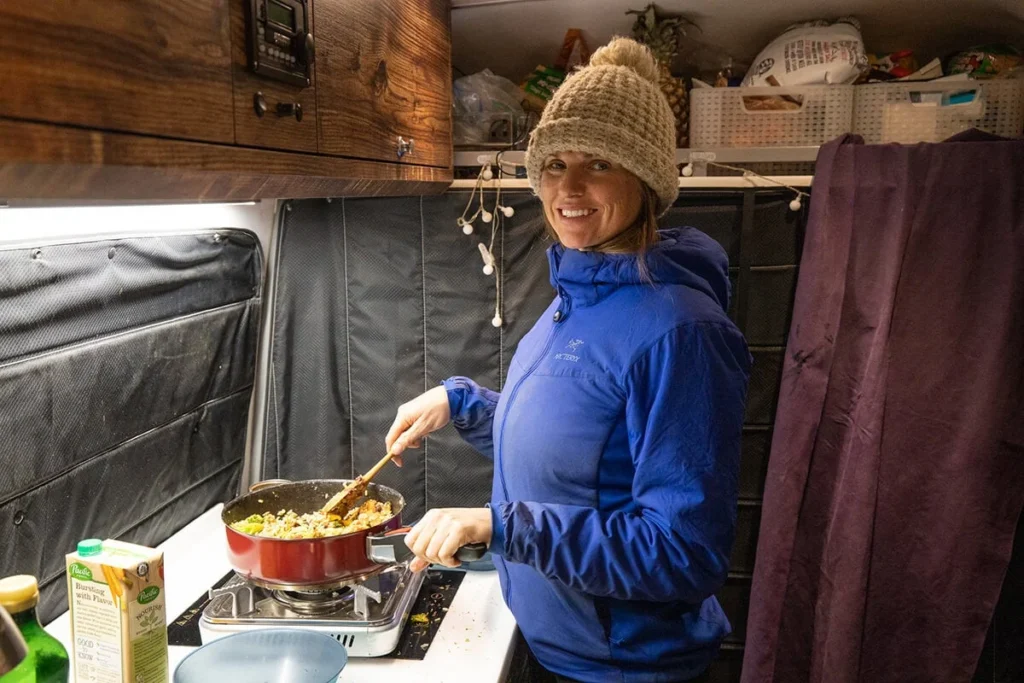
A single-burner propane stove costing $25-35 is fully sufficient for every meal in a $10/day cooking plan. That’s not a compromise position.
The meals that make the budget work, rice dishes, pasta, fried eggs, stewed lentils, tinned chickpea curries, all require heat from one source at a time. A second burner adds occasional convenience and consistent cost. Until you’ve lived in a van for several months and identified a specific cooking problem that a second burner would solve, don’t buy one.
Budget Van Journeys has covered van kitchen build decisions in more detail elsewhere, but from a purely budget-cooking standpoint: resist equipment upgrades until you have a specific real-world reason for them. Most people cooking on $10/day never find that reason.
2. How Your Heat Source Affects the Budget Directly
Not all cooking setups are equal once fuel cost enters the calculation. The way you generate heat directly affects how far $10 actually goes per day.
| Cooking Method | Upfront Cost | Fuel Cost Per Day (approx) | Portability | Limitations |
|---|---|---|---|---|
| Single burner propane stove (refillable cylinder) | $25-35 | $0.30-0.50 | Excellent | Sequential cooking only |
| Two-burner propane stove (refillable) | $50-80 | $0.50-0.90 | Good | Larger storage footprint |
| 12V induction plate | $35-60 | Draws 60-120W per use | Van-dependent | Struggles on low-battery days |
| Alcohol stove (TOAKS, Trangia) | $15-25 | $0.20-0.40 | Ultralight | Slow; poor in wind |
| Backpacker gas stove (isobutane canisters) | $40-50 | $0.60-0.90 | Ultralight | Canisters expensive per BTU |
The single-burner propane stove connected to a refillable cylinder is the clear winner for anyone van living for more than a few weeks. Disposable 1lb canisters look cheap at $2-3 each, but at one canister per 8-10 days of active cooking, the per-BTU cost runs significantly higher than a refillable tank exchange. Running disposable canisters as a daily cooking habit costs roughly $15-20 per week in fuel alone, which is already over the total food and cooking budget before a single ingredient appears.
The 12V induction plate is genuinely practical when solar is strong and the battery is healthy. The problem is that those conditions are least reliable exactly when you most want a hot meal, on cold, parked, overcast days when the battery hasn’t topped up properly. It works well as a supplementary option rather than the primary heat source for most setups.
3. One-Pot Cooking and Why It Changes the Maths
Cooking one pot of something and eating from it across two or three meals is the most powerful cost reduction in a van kitchen. Not because repetitive meals are the goal, but because the unit economics shift entirely when you cook once and eat twice.
A pot of red lentil dal, made with red lentils, one tin of chopped tomatoes, garlic, cumin, and turmeric, costs about $1.80 in ingredients and produces four solid portions. That’s $0.45 per portion. Eaten across lunch and dinner for two days with rice or flatbread, that covers four out of six meals for $3.50 total. That’s the budget working correctly.
The same principle holds for any scalable base: rice and fried vegetables, pasta with garlic and olive oil, bean soups, spiced chickpeas. Chickpeas with cumin, lemon, and yogurt over rice on Monday tastes genuinely different from chickpeas with smoked paprika and sweet potato on Tuesday. Same tin, $0.80, two distinct meals.
A tight-fitting pan lid is the one piece of equipment that genuinely improves one-pot cooking on a budget. It keeps heat in, reduces cooking time, and cuts fuel use on anything that simmers, particularly lentils and rice. It’s not an exciting upgrade but it produces a measurable difference over a week of cooking.
What makes this approach hard for people moving from a house kitchen is the mental shift around cooking for more than one meal at once. In a house with a full fridge and infinite shelf space, variety feels automatic. In a van, the constraint becomes an efficiency advantage once the framing clicks.
4. Fuel Is a Budget Line, Not a Footnote
Most van food budget posts leave fuel costs out. It’s a real omission because propane is a genuine daily expense, and on a tight $10 figure it belongs in the calculation.
Here’s the actual maths for a single-burner setup running a refillable cylinder. A standard 1lb propane cylinder holds 16oz of gas. At a medium flame, a single burner uses approximately 1.5-2oz per 10 minutes of cooking. Two meals a day with 20-25 minutes of total active cooking uses roughly 3-5oz of propane. A 1lb cylinder lasts 3-5 days of consistent cooking on that basis.
Cylinder exchange at a hardware store or campsite runs $4-6. That’s $0.80-1.50 per day in fuel costs.
Over a month: $24-45.
Over a month of van life on a $10/day total budget, that fuel cost is the difference between managing the number and not. The practical implication is to cook less frequently by cooking more per session, which is exactly what the one-pot approach produces. Two meals from one cooking event halves the fuel cost per meal. It’s a compounding saving across weeks.
Budget Van Journeys readers who’ve run the actual numbers on their van spending almost always find fuel is higher than expected and food is lower than they feared.
5. Where Van Cooking Actually Falls Apart
A few specific failure patterns show up consistently. None of them are about cooking skill.
Choosing recipes that don’t match the van’s time and format. A 45-minute recipe requiring constant attention is a problem when you’re parked for 20 minutes before needing to move. Van cooking rewards simple meals cooked without urgency over complex recipes requiring precise timing. Everything in the $10/day cooking plan is under 30 minutes of active cooking. That’s not a hardship, it’s a design feature of the budget.
Buying dried pulses without factoring in soaking. Red lentils and split peas cook in 20-30 minutes without soaking. Dried chickpeas and black beans need 8+ hours of soaking followed by 1-2 hours of boiling at high heat. That’s a lot of fuel and a lot of forward planning. Tinned pulses cost more per gram but are far more practical for a van kitchen. When fuel is part of the daily budget, tinned chickpeas win the actual calculation even though dried chickpeas look cheaper on the shelf.
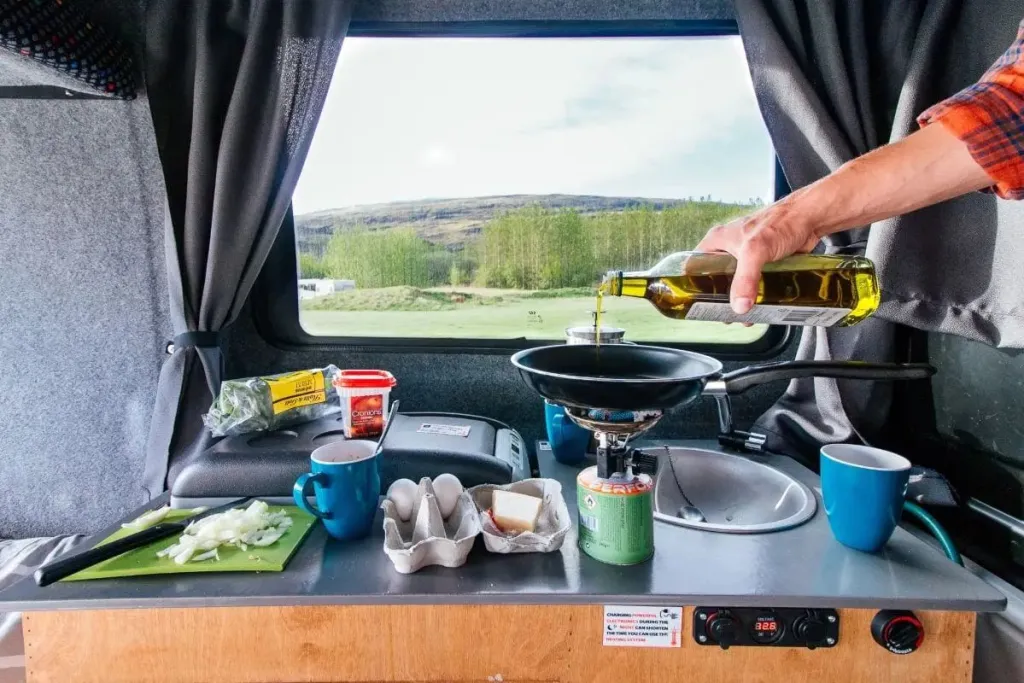
Cooking with no ventilation. Fish cooked inside a sealed van on a grey afternoon produces a smell that lingers for the rest of the day. Strong frying smells accumulate in fabric surfaces. Cooking with the sliding door open and a window cracked on the opposite side costs nothing and solves a problem that causes a lot of people to give up on van cooking entirely.
Trying to run house recipes in a van kitchen. A shepherd’s pie that works perfectly in a house oven has no van equivalent. Adapting house recipes that require an oven, multiple hobs, or extended baking times is a guaranteed path to frustration. The meals that work well in a van are the meals designed for one heat source, which describes most of the world’s traditional cooking anyway.
FAQs
Can you actually cook every meal on one burner without it getting frustrating? Yes. One burner means sequential cooking rather than simultaneous, which adds a few minutes to anything with multiple components. For the one-pot meals that make a $10/day budget work, this is irrelevant because everything goes into the same pan anyway. The frustration people describe is almost always about trying to cook house-style meals on a van setup, not about the burner itself.
What’s the cheapest fuel option for van cooking? A refillable propane cylinder with a single-burner adapter is the lowest cost per meal for most van lifers cooking daily. Alcohol stoves are cheaper per BTU on paper but slower and more weather-sensitive, which can increase total fuel use on longer cooks. Disposable isobutane canisters are the most expensive option per cook once you calculate actual volume delivered versus price paid.
Does cooking your own food in a van actually save meaningful money versus eating out? The gap is large. $10 in ingredients produces 8-12 meals cooked in the van. The same $10 spent eating out produces one meal, maybe two from a budget counter. Over a month of van life, cooking two meals a day versus eating out saves several hundred dollars, not tens of dollars. The savings compound significantly over a longer trip.
How do you manage washing up when water access is limited? Scraping food residue while the pan is still warm dramatically reduces the water needed for cleaning. A small washing bowl with 2-3 litres handles a day’s dishes for one person. Cooking with enough fat so food doesn’t stick reduces cleaning time further. The minimal gear principle helps here too: one pan, one pot, one plate, one bowl, one set of utensils per person means very little to wash.
Is $10/day per person harder for solo van lifers or couples? Slightly harder solo, because the economies of scale on bulk ingredients work less well for one person. A pot of dal that feeds four portions is ideal for two people over two days and slightly awkward for one person who’s eating the same thing four meals running. For couples cooking together, the per-person cost on a $10/day budget often drops a little below $10 because base ingredients scale favourably.
The people who cook genuinely good food in a van on a tight budget aren’t using special techniques or unusual ingredients. They’re using one reliable heat source, simple base ingredients, a cooking approach that matches what the van actually supports, and they’ve stopped measuring the kitchen against a house standard that was never the right comparison.
$10/day works. The methods here are why.