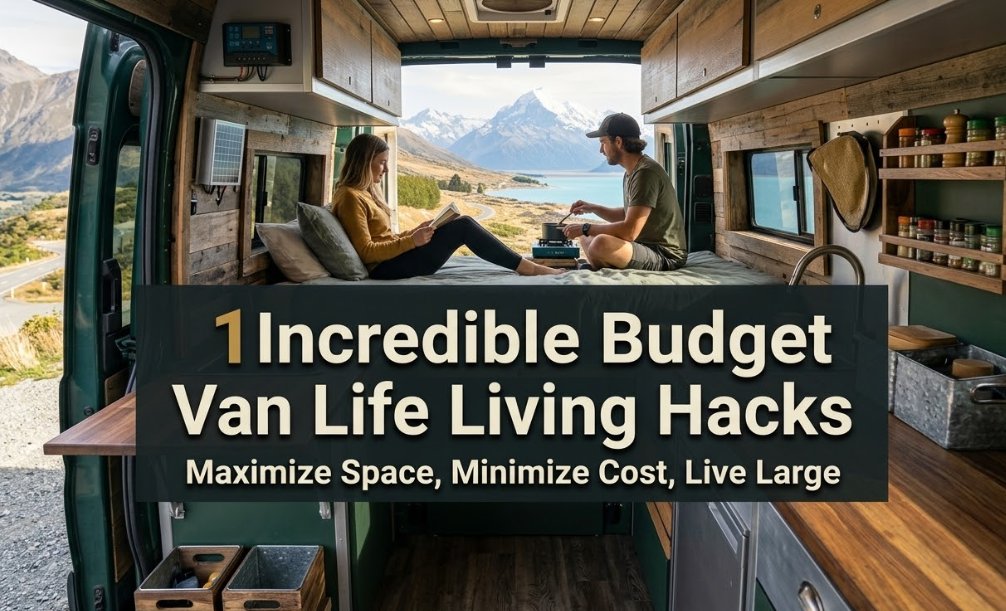
Living in a van sounds poetic — wide-open roads, beautiful sunsets, no rent. But the reality? Tight spaces can feel claustrophobic quickly. And particularly when you’re on a tight budget.
The good news is: thousands are doing it beautifully. They’re sleeping well, cooking real meals, staying organized and spending less than $800 a month to do it.
This guide deconstructs 8 genius budget van journey living hacks that really deliver when it comes to small spaces. Whether you’re just getting started or are already on the road, these hacks will change everything you thought you knew about van life.
1. Modular Setup Hack — Build Smarter, Not Bigger
The most common blunder made by beginners. They attempt to replicate Instagram-worthy vans. Those were $20,000 builds and up. That’s not budget living — that’s a mortgage on wheels.
Instead, go modular.
What Is a Modular Van Setup?
A modular setup means that every piece of furniture or storage can be taken out, moved around and repurposed. Everything isn’t permanently bolted down (or at least most things aren’t). Think IKEA-based thinking but for your van floor plan.
Here’s why it works on a budget:
- You buy cheap, flexible pieces
- Adjust as your needs change
- You do not spend cash on blunders
Begin with these three modular segments:
| Item | Budget Option | Estimated Cost |
|---|---|---|
| Sleeping platform | Plywood + folding legs | $40–$80 |
| Storage crates | Stackable plastic bins | $15–$30 |
| Seating/workspace | Folding camp table + stool | $25–$50 |
Total? Less than $160 for a fully operational home.
The best trick is to make everything dual-purpose. Your bed frame is also storage. Your cooler also works as a step stool. Your cutting board is your desk. Everything has to earn its keep.
2. The “Dark Store” Grocery Hack That Can Cut Your Food Bill
Food is an enormous budget killer on the road. Dining out twice a day can easily cost $30–$50. Over a month? That’s $900–$1,500 just on food.
Van lifers who stay on a budget swear by one tactic: shop like you work for a dark store.
What Does That Mean?
Dark stores are grocery fulfillment centers in warehouse format. They buy in bulk, prefer shelf-stable items and do not waste a dollar. The same approach can be applied.
Here’s the system:
Step 1 — Purchase the “boring five” in bulk: Rice, lentils, oats, canned beans and pasta. These five foods can sustain you for days at a near-zero cost.
Step 2 — Go to ethnic grocery stores, avoid chains. Spices, grains, and produce consistently retail 30–50% cheaper at Indian, Asian, and Latin grocery stores than mainstream supermarkets.
Step 3 — Master the “manager’s special” timing. 6–8 PM is when the majority of grocery stores discount meat and fresh produce. Show up then. Buy what’s marked down. Prepare it that night or the following morning.
Step 4 — Use a one-burner propane stove. A decent one costs $20–$35. A small propane canister lasts a week of daily cooking. That’s about $5–$8 per week on fuel — crazily cheaper than eating out.
Estimated monthly food cost using this method: $120–$180.
3. Free Parking Is Everywhere — You Just Have to Know the Code
Ask any van lifer what most stresses them out, and every single time it’s parking. Hotels charge $20–$40 a night just for parking. Campgrounds can run $35–$60. That comes to over $1,000 a month.
But here’s what veteran van dwellers already know: free, legal overnight parking can be found in almost every town in America.
The Free Parking Cheat Sheet
Bureau of Land Management (BLM) land — Over millions of acres of public land throughout the western U.S. permit free dispersed camping for 14 days or more. Apps like iOverlander and Freecampsites.net map these spots.
Walmart and Cracker Barrel lots — Many locations allow overnight parking. Always call first or check the store’s policy posted at its door. Don’t assume — confirm.
Casino parking lots — Casinos want you inside spending money, so many have free overnight parking to lure visitors. You’re not required to gamble.
Truck stops — Open arms for overnight visitors. Clean restrooms are often available. Some will even offer showers for $12–$15.
Residential streets — In most American cities, it’s perfectly legal to park on a public street for three days without getting a ticket. Just move every two days, and you’re golden.
Industrial parks on weekends — Business parks and light industrial areas are deserted Saturday and Sunday nights. Quiet, safe, and free.
| Parking Type | Cost | Best For |
|---|---|---|
| BLM Land | Free | Nature lovers, western U.S. |
| Walmart/Cracker Barrel | Free | Quick stopovers |
| Casino Lots | Free | Urban areas |
| Truck Stops | Free | Safety, amenities nearby |
| Residential Streets | Free | City dwellers |
For more insider tips on where to park and how to plan your route on a tight budget, check out Budget Van Journeys — a great resource built specifically for van life travelers.
4. Stay Fresh Without a Gym Membership — The Zero Dollar Hygiene Routine
Which leads to the question everyone thinks about but nobody asks out loud: how do van lifers stay clean?
The answer is surprisingly simple. And very cheap.
The No-Gym Shower System
Option 1 — Planet Fitness ($10/month) This is the most popular option for those in van life. For $10 a month, you can access showers at thousands of locations nationwide. Some van lifers route their trips around Planet Fitness locations.
Option 2 — Truck Stop Showers Pilot Flying J, Love’s Travel Stops, and TA Travel Centers all provide showers. Cost is typically $12–$15. They have clean, private stalls and in some places include towels.
Option 3 — The Solar Shower Bag A solar camp shower bag available on Amazon for $10–$20. Fill it with water, place it on your van roof in the sun for 2–3 hours, hang it from a tree or your van door and you’ve got yourself a hot shower anywhere.
DIY Van Hygiene Essentials
- Baby wipes — An 80-pack costs around $2. Van lifers use these to make do briefly in between real showers. Unscented are the best type for sensitive skin.
- Dry shampoo — Allows you to go 2–3 days without having to wash your hair.
- Collapsible water jug — A 5-gallon collapsible jug ($8–$15) can hold enough to brush your teeth, wash your face and clean up dishes for 2–3 days.
- Portable toilet — A basic camping toilet costs $25–$40. Composting toilet bags allow for easy, odorless disposal.
Monthly hygiene budget: $20–$35 (including the Planet Fitness membership)
5. Power Up for Almost Nothing — The Off-Grid Energy Hack
Running out of power in a van is worse than inconvenient. If you’re a remote worker, that could cost you your income. If you need a CPAP machine or medical device, it becomes dangerous.
Beginners — almost all of them — spend too much on solar setups, buying $1,500+ systems they don’t actually need.
The One Simple Power System That Actually Works
This is what a reasonable van power setup looks like:
Tier 1 — The $150 Setup (Casual Users)
- 1 x 100W solar panel: ~$80–$100
- 1 x 20Ah portable power station or USB battery bank: ~$40–$60
- Best for: Phone charging, LED lights, small fan, a laptop for a couple of hours
Tier 2 — The $350 Setup (Remote Workers)
- 1–2 x 100W solar panels: ~$160–$200
- 1 x 200–300Wh portable power station (e.g., Jackery 240): ~$150–$200
- Good for: Laptop all day, phone, LED lights, small appliances, CPAP at night
Power-Saving Tips That Cost Nothing
- LED lighting only. LED strip lights consume very low power compared to ordinary bulbs. A complete van lighting setup runs around $15–$25.
- Download everything offline. Netflix, Spotify, and maps — before the signal fades. This saves both battery and data.
- Charge while driving. Your van’s alternator charges your battery while you’re on the move. A $15–$25 battery-to-battery charger cable maximizes this.
- Cook with propane, not electricity. On a small system, never use an electric hot plate off-grid. Propane is far more efficient.
6. The Space Multiplier Method — Shrink Your Stuff
Here’s a harsh reality about van life: you will overpack in the beginning. Everyone does. And then you will spend three months purging one item at a time.
Save yourself the hassle. Start lean.
The “Three Box” Declutter System Before You Hit the Road
Before you pack anything in your van, lay it all out and divide into three boxes:
Box 1 — Daily Use: Items you use every day. Phone, toothbrush, one cup, one bowl, one set of utensils, clothes you wear most often.
Box 2 — Weekly Use: Items you use several times a week. Laptop, cooking gear, one backup outfit, first aid kit.
Box 3 — Rarely Use: Anything you haven’t touched in the last 30 days. Sell it, donate it or have family members store it. Don’t bring it.
It turns out that most people only need Box 1 and Box 2. Everything else is clutter.
Vertical Space Is Your New Best Friend
The floor space in a van fills up quickly. The ceiling is your unused real estate.
- Bungee cord nets on the ceiling store pillows, bags and light items. Cost: $8–$15.
- Magnetic strip on the wall holds knives, scissors and metal tools. Cost: $6–$12.
- Over-door shoe organizers mounted on cabinet doors hold anything from spices to charging cables. Cost: $8–$15.
- Cargo bars that run the width of the van allow clothing to be hung on hangers. Cost: $15–$25.
| Storage Hack | Space Created | Cost |
|---|---|---|
| Ceiling bungee net | 3–5 cubic feet | $8–$15 |
| Magnetic wall strip | Counter space freed | $6–$12 |
| Over-door organizer | 12–20 pockets | $8–$15 |
| Cargo bar clothing | Full wardrobe hung | $15–$25 |
7. Stay Connected on the Road Without Blowing Your Data Budget
Remote work or simply keeping in touch with family — internet access in a van is something most people can’t do without. But paying for multiple data plans or relying on sketchy campground WiFi is both expensive and unreliable.
Here’s how savvy van lifers handle connectivity on a budget.
The Three-Layer Internet Strategy
Layer 1 — Your Main Phone Plan Mint Mobile, Visible, or T-Mobile Magenta has unlimited plans that start at $25–$45/month. These are your everyday web browsing, maps and messaging.
Layer 2 — A Hotspot Backup Device A dedicated mobile hotspot device (not on your phone) with a different carrier provides a backup when your primary signal drops. MVNO carriers such as US Mobile or Tello have flexible, pay-as-you-go plans that can go as low as $10–$20 a month when you really need them.
Layer 3 — Free WiFi Mapping Apps WiFi Map, Wiffinity and similar apps crowdsource free WiFi locations. Libraries, fast food chains, coffee shops and laundromats are all mapped. If you need to download large files or hold a video call, drive up to a library parking lot. It’s free, fast and entirely lawful.
Bonus: The WiFi Extender Hack
A $25–$45 travel router with an external antenna will boost weak campground or library WiFi signals into your van. Brands like GL.iNet make compact routers that are perfect for van life. That alone has spared many remote-working van lifers the hassle of hotel-hopping just to get a solid connection.
8. The Hack No One Talks About — Van Life Mental Health
Budget hacks, storage tricks and parking tips — they are all significant. But this is the one that divides those who thrive in van life from those who give up after two months.
Coping with the mental and emotional weight of small-space living.
It’s not glamorous. It doesn’t get many Instagram posts. But it is, indeed, a “living hack” in every sense of the word.
The Real Challenges of Living in a Tiny Space
- Social isolation creeps in, especially for solo travelers.
- Decision fatigue is real when every single day you need to solve parking, water, food and power again.
- Bad weather days trapped in a small van can feel claustrophobic and demoralizing.
Mental Health Hacks Van Dwellers Will Actually Find Useful
Create a routine. Having a set wake-up time, morning walk, and evening wind-down routine dramatically reduces anxiety even on the road. Structure creates calm.
Join van life communities. Facebook groups, Reddit’s r/vandwellers and regular in-person van life meetups (known as “van gatherings”) happen all the time. The community is huge and very supportive.
Give yourself permission to stop. Not every week has to be a new location. Staying in one place for a week or two drastically lessens stress and decision fatigue. It also saves gas money.
Have a “bad day plan.” Know in advance where to find the nearest coffee shop, library or community centre. When the van gets too small, you have somewhere to go.
Build in people time. When mapping a route, make sure it goes through cities where you have friends or family. Human connection isn’t a nice-to-have — it’s essential.
All 8 Hacks at a Glance — Quick Summary
| Hack | Core Idea | Estimated Monthly Savings |
|---|---|---|
| Modular Setup | Affordable, flexible furniture | $500–$2,000 upfront savings |
| Dark Store Food System | Bulk + discount shopping | $300–$700/month |
| Free Parking Network | BLM, lots, residential streets | $400–$1,000/month |
| Zero-Cost Hygiene Routine | Solar showers + Planet Fitness | $100–$200/month |
| Minimalist Power System | Solar + propane combo | $50–$150/month |
| Space Multiplier Method | Vertical + modular storage | Reduces clutter costs |
| Three-Layer Internet Strategy | Multi-carrier + free WiFi | $50–$100/month |
| Mental Health Routines | Community + structure | Prevents costly quitting |
Frequently Asked Questions (FAQs)
Q1: How much does it truly cost to live in a van on a monthly basis? The average total cost for solo van lifers is around $700 to $1,500 a month — which includes food, gas, insurance and personal expenses. Couples often spend $1,200–$2,000. The hacks in this guide can pull those numbers down toward the lower end.
Q2: Is van life illegal in the United States? There is nothing illegal about living in a van. But some cities have laws banning sleeping in a vehicle within designated areas. Knowing where to park legally (BLM land, truck stops, etc.) helps keep you safe. Always check local rules before moving to a new area.
Q3: What is the best type of van for a beginner on a budget? The most common choices are a Ford Transit, Ram ProMaster, or Mercedes Sprinter. For tight budgets, a used cargo van in the $5,000–$12,000 range is the sweet spot. Watch out for overpriced fully converted vans — you can build your own for a fraction of the cost.
Q4: What do van lifers do about laundry? Most use coin-operated laundromats ($3–$6 per load) every 7–10 days. Some hand-wash small items in a collapsible bucket. Packing quick-dry merino wool clothes means you need to do laundry less often.
Q5: Is it possible to work a remote job while living in a van? Absolutely. Thousands of van lifers hold full-time remote jobs in tech, writing, design, customer service and more. A solid mobile data plan and a portable power system are the two non-negotiables for remote work on the road.
Q6: How do van lifers handle healthcare and emergencies? Many rely on health-sharing plans or marketplace insurance plans that cater to self-employed individuals. Apps such as GoodRx slash prescription costs dramatically. Urgent care centers exist in almost every city and cost a fraction of an ER visit.
Q7: How do you handle extreme weather in a van? In summer, insulation, ventilation fans (such as the Maxxair or Fan-Tastic Vent, available used for $80–$150), and parking in shaded or high-altitude areas keeps things bearable. In winter, proper insulation and wool blankets handle the cold, along with a small propane or diesel heater. Most van lifers simply “chase” nice weather by moving seasonally.
The Bottom Line — Free-Range Living in Tight Quarters
Budget van journey living hacks are not about suffering through discomfort. They’re about being clever with what you have so you can live more freely.
Every single hack in this guide has been tried by real people on real roads. No specialized equipment or years of experience required. They just require a shift in mindset — from “how do I fit my old life into a van?” to “how do I build a better life from scratch?”
The open road doesn’t care how nice your closet is. It rewards preparation, adaptability and creativity.
Start with one hack. Master it. Add another. In one month’s time, you’ll have a working van life system — and a monthly budget that should leave your apartment-dwelling friends at least somewhat envious.
The road is waiting. Pack light. Drive smart. Live better.