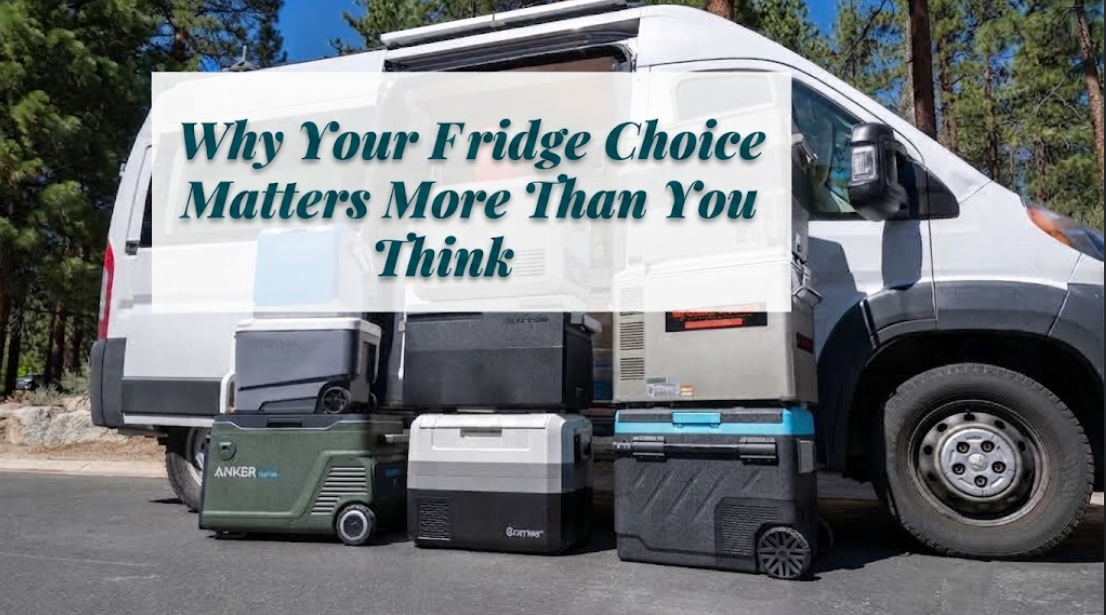
Most people planning a van build treat the fridge like a checkbox. Pick something that fits the cabinet, order it, move on to the exciting stuff like the bed platform or the shower. That’s backwards. The fridge is one of the few appliances running every single hour of every single day, and the decision you make here quietly determines your battery size, your solar array, your generator needs, and how often you’re doing math in a grocery store parking lot instead of just shopping.
Get it wrong and you’re not just uncomfortable. You’re rebuilding your entire electrical system eighteen months later because the fridge you picked draws more than your setup can realistically supply.
1. The Myth: “A Fridge Is a Fridge”
The belief that trips up a lot of first-time builders is that fridges are basically interchangeable, just pick the one that’s cheapest or the one that looks nicest on Instagram. It’s an understandable assumption. In a house, that’s roughly true, since house fridges all plug into an outlet with effectively unlimited power behind it.
A van doesn’t work that way. Every watt your fridge pulls has to come from a battery bank you charged yourself, off solar panels the size of a door or an alternator running while you drive. The fridge isn’t just an appliance in a van. It’s a load your entire power system has to be built around, and that changes which unit actually makes sense.
2. What’s Actually True: Three Fridge Types, Three Very Different Power Profiles
There are really three categories worth considering for a budget-conscious build, and they behave nothing alike.
Compressor fridges (Dometic CFX, Alpicool, similar brands) work like a scaled-down version of a home fridge. They’re efficient, they hold temperature well even in hot weather, and they can be mounted at an angle without issue. They also draw real power, typically 40 to 60 watts when the compressor is actively running, cycling on and off through the day.
Absorption fridges, the kind found in a lot of older RVs, run off propane or a combination of propane and electric. They use almost no battery power, which sounds great until you factor in they perform poorly in hot climates, need to sit level to work correctly, and require you to carry and manage propane, which adds its own cost and complexity.
12V coolers, the cheapest option, are really just insulated boxes with a small compressor. They work fine for short trips but struggle to hold consistent temperature in real heat, and the cheaper models tend to fail within a year or two of daily use.
| Fridge Type | Typical Daily Power Draw | Upfront Cost | Best For |
|---|---|---|---|
| Compressor (12V) | 300-600 Wh/day | $$$ | Full-time living, hot climates |
| Absorption (propane) | Minimal electric, propane cost instead | $$$$ | Traditional RVs, flat parking |
| 12V cooler | 200-500 Wh/day, inconsistent | $ | Weekend trips, mild climates |
That daily watt-hour number is the one that actually matters, because it’s what your solar and battery system has to replace every single day, rain or shine, parked in shade or sun.
3. Where the Math Actually Breaks Down
Here’s the mistake that trips up nearly every new van builder. They size their battery and solar system around their laptop, phone chargers, and maybe a fan, then add the fridge as an afterthought. But the fridge often uses more power over 24 hours than everything else in the van combined.
A compressor fridge running 400 watt-hours a day needs, at minimum, a 100 amp-hour battery just to cover the fridge alone with a comfortable buffer, before you’ve added lights, water pump, laptop charging, or anything else. Skimp on the battery to save money upfront, and you’ll be running your engine or a generator far more often than you budgeted for, which quietly erases whatever you saved on the fridge itself.
If you’ve read our piece on how much it really costs to live in a van, this is exactly the kind of hidden cost that doesn’t show up until month two or three. The $300 you saved buying a bargain fridge turns into $600 in extra battery capacity you didn’t plan for, plus the frustration of babysitting your power levels every afternoon.
And it’s not only about the battery. Undersized solar means you’re never fully recovering what the fridge used overnight, so you start every day a little further behind, a slow leak that eventually forces a generator purchase or a lot of unplanned RV park stays just to plug in and recharge.
4. Picking the Right One for Your Actual Trip
Not everyone needs the same fridge, and that’s worth saying plainly. Someone doing weekend trips a few times a month in a mild climate can get by with a decent 12V cooler and save real money upfront. Someone living full-time, especially anywhere that sees summer heat over 90 degrees regularly, needs a proper compressor fridge or they’ll be pouring out spoiled food and buying ice constantly, which costs more over a season than the better fridge would have.
A few practical steps that make the decision easier:
- Estimate your actual daily driving. Compressor fridges get a real assist from alternator charging while the engine runs, so heavy drivers can get away with a smaller battery than someone who’s stationary for a week at a time.
- Check the fridge’s rated watt-hours per day at a realistic ambient temperature, not the manufacturer’s best-case number measured in a cool test lab.
- Size your battery to cover at least two full days without any charging input, since weather and parking spots don’t always cooperate with your solar panels.
- Budget separately for the electrical system and the fridge itself. Treating them as one combined line item is how people end up underfunding the part that actually keeps the system running.
This ties directly into a point we’ve made before about how van life isn’t as cheap as Instagram shows. The glossy build videos rarely mention the electrical system sizing headaches that come from an underplanned fridge purchase, because it’s not a fun thing to film.
The Part People Skip: Maintenance and Real-World Failure Rates
Compressor fridges are generally reliable but not indestructible. Vibration over rough roads is the most common cause of early failure, so mounting matters as much as the fridge itself, strap it down properly and add some vibration dampening if your build involves a lot of dirt roads. Cheaper 12V coolers fail more often, usually the compressor giving out within twelve to eighteen months of daily use, which is worth factoring into the true cost comparison even when the sticker price looks appealing.
Budget Van Journeys hears from readers fairly often who bought the cheapest fridge available, had it fail nine months in, and ended up spending more total than if they’d bought the mid-range compressor unit from the start. It’s not a universal outcome, some cheap units last fine, but it’s common enough to plan around.
Getting the fridge decision right early saves you from rebuilding your electrical system later, and it’s worth pairing with a real look at why your van life budget never survives week one, since fridge-driven power upgrades are one of the more common budget-busters new full-timers run into.
Frequently Asked Questions
Can I run a compressor fridge off solar alone with no driving? Yes, as long as your solar array and battery bank are sized correctly for your daily watt-hour usage plus a buffer for cloudy days. Two 100-watt panels and a 100 amp-hour battery is a workable starting point for one compressor fridge in decent sun, though northern climates or heavy cloud cover will need more.
Is a 12V cooler really worth the money I’d save? For occasional weekend use in mild weather, yes, the savings are real and the performance is usually adequate. For full-time living or hot climates, the shorter lifespan and inconsistent cooling tend to cost more in the long run than buying the better unit upfront.
How loud are compressor fridges when they’re running? Most modern compressor fridges run around 40 to 50 decibels, roughly comparable to a quiet conversation, and it’s rarely a dealbreaker once you’re used to the sound. Cheaper units and older absorption fridges tend to run louder or with more noticeable cycling.
Do I need propane if I go with an absorption fridge? Most absorption fridges are designed to run on propane, electric, or both, but propane is usually the primary source since it’s far more efficient for that fridge type than electric. That means budgeting for propane refills and storage, plus keeping the van reasonably level for the fridge to function correctly.
What size battery bank should I start with if the fridge is my main power draw? A common starting point is 100 to 200 amp-hours of lithium battery capacity paired with 200 to 400 watts of solar, though your actual number depends on climate, driving habits, and what else you’re running off the same system.
For a deeper look at the full financial picture before you commit to a build, our breakdown of why van life isn’t as cheap as it looks on Instagram is worth reading before you finalize your fridge budget.