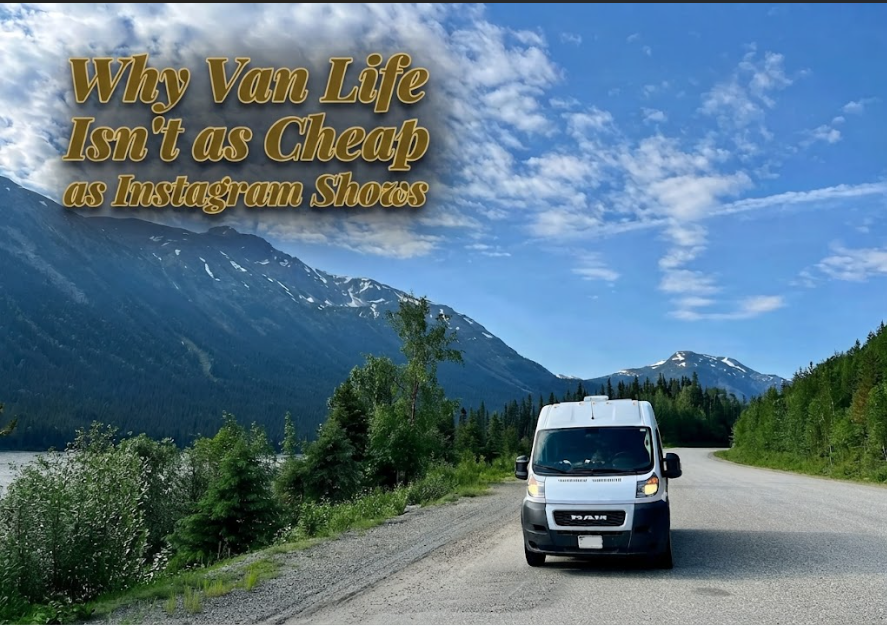
A friend of mine spent eleven thousand dollars in her first four months on the road. She had budgeted for three thousand, total, for the whole first year. Her van looked identical to the ones with the “$40 a month to live like this!” captions. The math simply never matched the pictures.
That gap between what gets posted and what actually gets spent is the reason this article exists. Not to talk anyone out of van life. It’s to explain, plainly, where the money actually goes, and why the cheapest-looking version of this lifestyle is usually the most expensive one to maintain.
1. The Build Cost Nobody Photographs
The build is the first place the numbers fall apart. A “budget build” video will show reclaimed wood, a $200 solar kit, and a finished interior that looks like a cabin. What it won’t show is the failed first attempt at wiring, the insulation that had to be redone because condensation got behind it, or the three trips to the hardware store for parts that weren’t in the shot.
A realistic self-build, done properly, runs somewhere between $8,000 and $25,000 depending on the van’s condition going in and how much of the electrical and plumbing work you’re doing yourself versus paying someone. Vans purchased already converted are almost always priced above that range, sometimes well above it, because the labor and expertise get baked into the sale price.
| Build Approach | Typical Cost Range | What’s Usually Missing From the Estimate |
|---|---|---|
| DIY from a cargo van | $8,000 – $18,000 | Tools you don’t already own, redo work, permits in some states |
| DIY from a used camper base | $5,000 – $12,000 | Deferred maintenance on the vehicle itself |
| Professionally converted, pre-built | $35,000 – $90,000+ | Financing costs, depreciation |
| Semi-DIY with hired electrical/plumbing | $15,000 – $30,000 | Scheduling delays, change orders |
That range isn’t a scare number. It’s what shows up on receipts once someone actually tracks every purchase for a full build, instead of remembering the highlights.
2. Insurance Isn’t What People Assume It Is
Here’s where people usually go wrong. They insure the van like a regular vehicle and assume the conversion and its contents are covered. Standard auto policies often don’t cover the build-out, the appliances, or personal property inside. Some insurers won’t even write a policy on a van used as a full-time residence without a specialty rider, and that rider costs more, sometimes considerably more, than a standard policy would.
Full-timers frequently end up paying for two things at once: an auto policy for the vehicle and a separate personal property or RV-specific policy for everything built into it. Depending on the state and the insurer, that combination can land anywhere from $900 to $2,400 a year. Skip it, and one break-in or one electrical fire wipes out the entire build with nothing to show for it afterward.
3. Fuel and Maintenance Scale With How You Actually Live
The Instagram version of van life shows long, scenic stretches of highway. The real version, for most people, involves a lot more short-distance driving than expected. Finding water. Finding a place to park overnight that won’t get a knock on the window at 2 a.m. Driving to a laundromat, then a grocery store, then back out of town because the free overnight spot was thirty minutes from either.
A gas or diesel van gets driven far more than the trip-planning montage suggests, and mid-size vans built on a Sprinter or Transit chassis aren’t cheap on fuel to begin with. Maintenance follows the same pattern. Full-time driving on a van that’s also carrying an extra 1,500 to 3,000 pounds of build materials, water, and gear wears differently than a commuter vehicle. Tires go faster. Suspension components wear sooner. None of that shows up in a caption that says the whole month cost $600.
4. Campgrounds, Permits, and the Myth of Free Camping Everywhere
Free dispersed camping exists, and it’s genuinely wonderful when it’s available. But it isn’t available everywhere, and it isn’t available indefinitely in most of the places it does exist. Federal land often caps stays at 14 days before you’re required to move a set distance away. National parks, popular coastal areas, and most of the West Coast during peak season simply don’t have much free public land left within a reasonable driving distance of towns.
That pushes a lot of people toward paid camping more often than the free-camping influencers let on. And weather, work schedules, or just needing a hookup to run a laptop for actual paid work push people toward paid sites even more.
Budget Van Journey hears this constantly from readers who assumed free camping would cover most nights and found it covering maybe half.
5. Health Insurance and the Cost of Being Off a Traditional Payroll
This one rarely comes up in van life content at all, and it’s often the single largest line item after the vehicle itself. Leaving a job that included employer-sponsored health coverage means shopping for a marketplace plan, and premiums for a healthy adult in their thirties or forties commonly run $300 to $600 a month depending on state and plan tier, before any deductible gets touched.
People who skip this step, going uninsured to save money short term, are making a real financial bet. It’s one that occasionally pays off and occasionally ends a person’s van life plans entirely when an unexpected ER visit lands a five-figure bill.
What a More Honest Monthly Budget Looks Like
Rough numbers, for one person, living reasonably but not luxuriously:
- Fuel: $250–$500, depending on how much moving happens that month
- Food: $350–$600
- Campgrounds and paid parking, mixed with free sites: $150–$450
- Insurance (auto plus specialty rider): $100–$200
- Health insurance: $300–$600
- Propane, water refills, laundry, incidentals: $80–$150
- Maintenance fund, set aside monthly: $100–$200
Add that up and a realistic range for one person sits closer to $1,300–$2,700 a month, not counting the upfront build. That’s a wide range, and it depends heavily on region, season, and how much paid work someone’s doing along the way. But it’s a very different number from the “we live on $400 a month” posts that tend to circulate, which frequently exclude insurance, maintenance funds, and the build cost that made everything else possible.
Where People Actually Save Money
This isn’t meant to talk anyone out of it. There are real savings, just not always where the internet says they are.
Rent or mortgage disappearing is the biggest one, obviously. Utility bills mostly vanish too. And for people who genuinely embrace a smaller footprint, spending on stuff (furniture, decor, the general accumulation that comes with a fixed address) drops off almost entirely. Those savings are real. They’re just usually offset by the categories above that don’t make it into a thirty-second video.
A Few Questions Worth Asking Before You Commit
Is it possible to do van life for under $1,000 a month? Yes, but it usually requires either free or very cheap camping most nights, minimal driving, and going without private health insurance, which carries real financial risk. It’s achievable, not typical.
How much should I set aside before I even start the build? A reasonable starting point is the full build budget plus three months of living expenses in cash, separate from the build fund. That buffer covers the inevitable first-month surprises.
Do I need specialty van insurance if I built it myself? In most cases, yes. Standard policies were written with commercial cargo use in mind, not residential conversions, and a DIY build often needs the same rider a professional build would.
What’s the single most underestimated cost? Health insurance, consistently. It’s the expense people budget for last, if at all, and it’s often the largest recurring bill after camping and fuel combined.
Is buying an already-converted van actually more expensive in the long run? Usually not, once labor time is factored in properly. It’s more expensive upfront, cheaper in hours spent, and the total cost of ownership tends to land in a similar place either way.
For anyone building out their own budget before committing to a build, it’s worth running these numbers against your own region and season rather than a national average, since campground costs and fuel prices swing more than people expect between, say, coastal California and the Midwest.