Moving the van is expensive. Parking the van is almost free.
That sounds obvious written out like that, but it’s the single most useful frame for building a cheap van route, and it’s the thing most people do the opposite of when they sit down to plan. They build a route that moves constantly. They treat the van like a flight itinerary, place to place, landmark to landmark, covering ground because covering ground feels like the point. And then they’re three weeks in, the fuel line in their budget has eaten everything, and the van hasn’t stopped anywhere long enough to feel like a real experience.
Routes that cost almost nothing aren’t the ones with the most destinations. They’re built around knowing where you can stop for free, and then connecting those places with as little fuel burned between them as possible.
1. Why Most Route Plans End Up Costing More Than They Should
There’s a pattern in how people approach van route planning for the first time. They start with a list of places worth seeing and work backwards to figure out the driving. This feels logical. It also produces expensive routes because interesting places tend to sit at the tips of branch roads rather than along efficient corridors.
A practical example: someone planning a six-week southwest US trip marks Moab, Zion, the Grand Canyon South Rim, and Joshua Tree on a map and draws lines between them. All four are genuinely worth visiting. But the distances involved, once you account for the non-linear roads that terrain requires, produce somewhere between 1,800 and 2,200 miles of actual driving. At 18 mpg in a full-size van and $3.50/gallon, that’s $220-300 in fuel just for the connections. A $40-per-night National Park campsite adds another $280-350 for the nights actually inside those parks. The total cost of the route before food, propane, or any paid activity reaches $500-650 on a plan that looked cheap because the parks themselves are beautiful rather than because the logistics were thought through.
The route that costs almost nothing looks structurally different from the drawing stage.
2. Where Free Overnight Parking Actually Exists
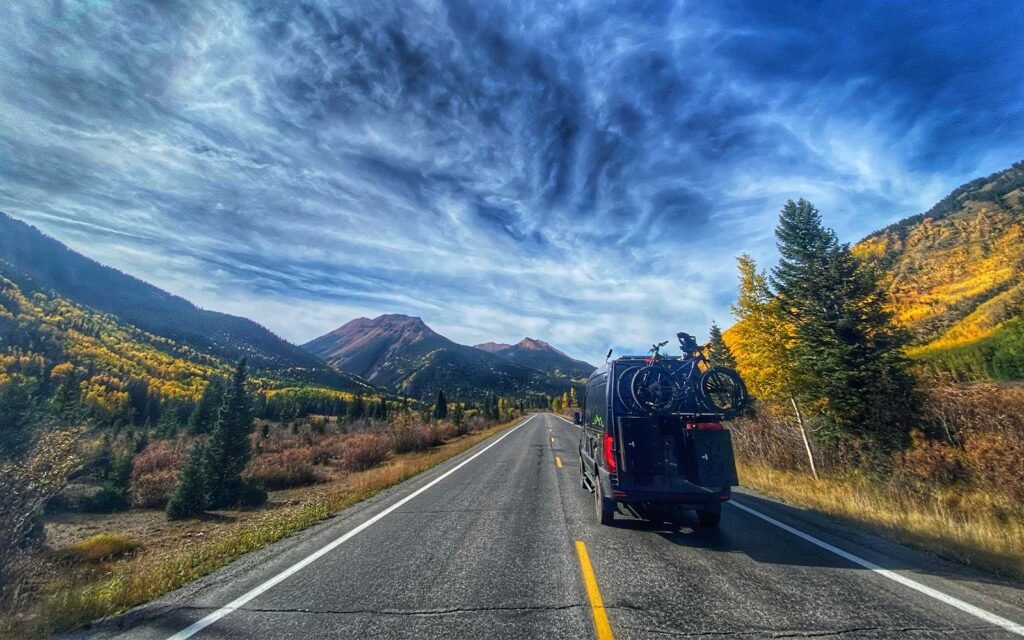
In the US, the largest source of genuinely free overnight camping is Bureau of Land Management land and National Forest dispersed camping. These are federal public lands permitting overnight stays without a fee in most areas, typically for up to 14 consecutive days at a single location. The combined coverage is substantial, particularly across the western states where the free-camping map density is high enough to anchor entire long-distance routes without a single paid night.
Dispersed camping means no facilities. No water, no toilets, no hookups. For a self-contained van setup with an onboard water tank and a toilet solution sorted, this is completely workable. For a van that’s still mid-build on the basics, it gets more complicated, but that’s a preparation issue rather than a camping access issue.
The apps that surface these sites: Campendium has the most detailed user reviews and recent condition notes. The Dyrt has the clearest map interface. FreeCampsites.net and iOverlander are both useful secondary sources, particularly for international routes. Using any two of these together covers most gaps.
Harvest Hosts is worth mentioning separately. It’s a paid membership program, around $99/year, that provides overnight access to wineries, farms, breweries, and other private properties. Not technically free, but at $99 covering unlimited nights across several thousand locations, the per-night cost rounds to nothing once you’ve used it ten or twelve times. It also tends to produce nights in agricultural areas that sit off the standard van life circuit entirely, which is a welcome change from competing for the same five BLM spots everyone else has bookmarked.
For urban gaps, Walmart parking lots remain broadly accepted as overnight stops in most states. Not scenic. Entirely practical.
Budget Van Journeys has more detailed region-specific guides on finding and vetting free camping spots, but the framework is consistent: know which land category allows overnight stays, cross-reference with an app carrying verified recent reports, check road conditions before committing anything with low clearance to a remote track at dusk.
3. What Fuel Actually Costs, Per Decision
A full-size van at 18 mpg, with fuel at $3.50/gallon, spends $0.194 per mile. Every 100 miles costs $19.40. This is a fixed calculation, not a rough estimate, and you can run it precisely for your actual vehicle and current regional prices in about 30 seconds.
The part of route planning people consistently undervalue is how individual driving decisions compound. A scenic overlook that’s 25 miles off the main corridor costs $9.70 to reach and $9.70 to leave. A supply run into a town that’s 20 miles from camp costs $7.76 round trip. A spontaneous decision to check out a canyon that “seemed close on the map” costs $15 before you’ve confirmed it was worth the detour. None of these feel significant at the time. Across a six-week trip with four or five such decisions per week, the total adds $300-500 to the fuel line on what looked like a cheap route.
The strategy that genuinely cuts this is something long-term van lifers call hub and spoke: park the van in a central free location and stay for several days, exploring the area from a fixed base rather than moving the van to each new thing. The Grand Staircase-Escalante area in southern Utah has dense BLM land where you can park for free and access dozens of trails and slot canyons within a short drive or walk, without moving camp at all for three or four days. The fuel cost for that section of a trip is the drive in and the drive out. Compare that with driving individually to each trailhead on separate days from a campground 40 miles away.
Same experience. A third of the fuel cost.
4. How to Actually Build the Route
The method I’ve settled on is unglamorous but reliable. It takes about an hour before a trip and consistently produces routes that stay within budget.
Start by mapping free camping density rather than destinations. Open Campendium or FreeCampsites.net and look at a broad corridor, not a fixed list of stops. Where free well-reviewed spots cluster, plan to spend time. Where they’re sparse, plan to pass through without lingering. This inverts the usual planning logic and it produces an entirely different route shape: less linear, more regional, with the itinerary built around where you can affordably stay rather than where you feel obligated to stop.
Calculate travel days with actual numbers. A 350-mile day costs $68 in fuel and is genuinely tiring in a large van on two-lane roads. A 120-mile day costs $23 and leaves most of the day free. Capping yourself to two travel days per week, with five days in a stayed position, keeps both the fuel budget and the energy levels manageable over a trip longer than two weeks. Three travel days per week sounds minor but produces a noticeably different fuel bill at the end of a month.
Budget explicitly for two or three paid camping nights per trip segment. Trying to achieve zero paid nights produces route distortions that often cost more in fuel than the campsite fee would have. A $30-35 National Park or state park night, planned deliberately and enjoyed fully, is a legitimate budget item. The problem is the $30 campsite that happens because the free option didn’t work out and there was no backup plan.
Here’s the planning reference I run through before committing to any route:
AT-A-GLANCE ROUTE COST CHECKLIST

FREE CAMPING
[ ] Free spots identified within 50 miles of each main stop
[ ] Reviews checked: at least one from within the last 6 months
[ ] Road access confirmed suitable for van height and clearance
[ ] 14-day limit noted if planning extended stay in one area

FUEL
[ ] Total route miles estimated (realistically, including detours)
[ ] Cost per mile calculated: fuel price ÷ actual mpg
[ ] Weekly travel days capped at 2, with rationale for any exceptions
[ ] Significant off-route detours identified and costed individually

PAID NIGHTS
[ ] Paid stops identified and priced
[ ] Total paid camping confirmed as affordable % of weekly budget
[ ] Harvest Hosts stops mapped if membership active

SUPPLIES
[ ] Grocery store access confirmed along route, not detour-dependent
[ ] Water fill points identified: campgrounds, truck stops, public parks
[ ] Propane exchange locations noted for trip length

CONTINGENCY
[ ] One backup free site identified per travel segment
[ ] Urban overnight fallback noted for weather nights or supply stops
It looks like more work than it is. Running through it once before a trip takes 45 minutes and regularly flags one or two expensive gaps that weren’t obvious from a first-pass map view. Budget Van Journeys readers who’ve tracked their actual van spending consistently find that unplanned supply detours and fuel decisions made on the road account for a larger share of total trip cost than they expected when planning.
5. The Seasonal Factor That Changes Everything
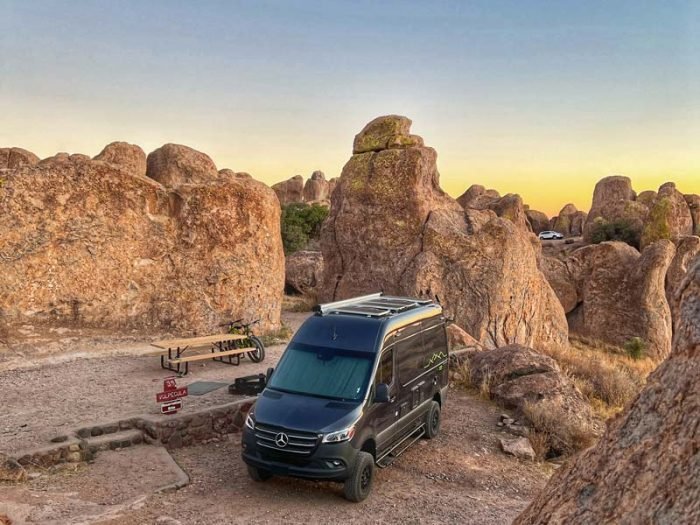
Free dispersed camping on BLM land and National Forest land is technically available year-round. But the well-reviewed spots along popular corridors fill on summer weekends, and they fill early. Arriving at 2pm on a Friday in July at a popular free site in the Utah desert or near a popular Colorado trailhead often means no space and a $40-50 paid campground as the backup.
The free spots don’t disappear in shoulder season. They empty.
April, May, October, and early November in the American Southwest and Rockies produce the same quality of free dispersed camping with dramatically less competition. High-elevation sites have seasonal closures until snowmelt, yes, and weather is less predictable, but the practical route-planning freedom is substantially better than the summer picture when free site availability tightens and half the van life community is competing for the same spots.
This variable doesn’t appear in any app interface. It shows up in current-season trip reports on Campendium review threads and forums like r/vandwellers, which makes reading recent activity on the specific spots you’re targeting a genuinely useful planning step, not just an optional extra.
FAQs
Is a full route with mostly free camping genuinely achievable, or does it mean constant detours to find free spots? In the western US, mostly free routes are realistic because BLM and National Forest coverage is broad and distributed rather than concentrated in isolated pockets. Along the coasts and in the Southeast and Midwest the picture is patchier, and a realistic budget route in those areas probably combines 60-65% free nights with low-cost paid options like county parks, state forest permits, or Harvest Hosts stays. Targeting 100% free in low-coverage areas is what produces the expensive detour problem.
The 14-day BLM limit comes up a lot. How does it work practically? The limit applies to a specific campsite location, not to BLM land as a category. Moving 25 miles or more resets the clock at a new site. Most van lifers on a moving route don’t stay 14 days in a single spot anyway, so this constraint rarely causes real problems. It becomes relevant when someone wants to base in one region for an extended stretch, in which case a monthly-rate campground or a private land arrangement is a more practical solution.
Does a heavier, older van make the fuel calculation significantly worse? Yes, meaningfully so. A high-roof extended Transit getting 20 mpg versus a Chevy Express 3500 getting 14 mpg is a 43% difference in fuel cost per mile at the same gas price. Across a 3,000-mile route at $3.50/gallon, that’s roughly $175 versus $250 in total fuel. Not catastrophic, but the planning spreadsheet needs to reflect the actual vehicle’s real-world consumption rather than a generic van figure pulled from a review site.
Are there tools that combine route planning with free campsite discovery? FreeRoam and The Dyrt both offer map interfaces where you can see free and low-cost camping density along any corridor. Neither is a full navigation tool, so most people use them alongside Google Maps: one to plan the overnight stops and one to handle the actual driving. The combination covers the main planning needs without requiring a paid route-planning subscription.
What does a genuinely cheap van route cost per day, all in? For a solo van lifer with a fuel-efficient vehicle, working solar, and a self-contained setup, $25-40 per day total including fuel, food, camping, and propane is realistic on a well-planned route prioritising free camping and slow movement. Travel days push that to $50-60. Fully stationary days in a free spot drop it below $20. The weekly average is what matters for the overall budget, and the route planning decisions here are what determine where that average lands.
The best budget van routes aren’t complicated. They’re built on knowing that the least expensive decision is usually not moving, the second least expensive decision is knowing where you’re going before you leave, and that the van is cheapest to operate when it’s parked somewhere worth being.
I’ve read trip reports from people who found a canyon in New Mexico or a stretch of Oregon coast and stayed for ten days because the camping was free, the surrounding area was genuinely absorbing, and there was no logistical reason to leave. Those trips cost almost nothing. And they tend to be the ones people write about for years after.