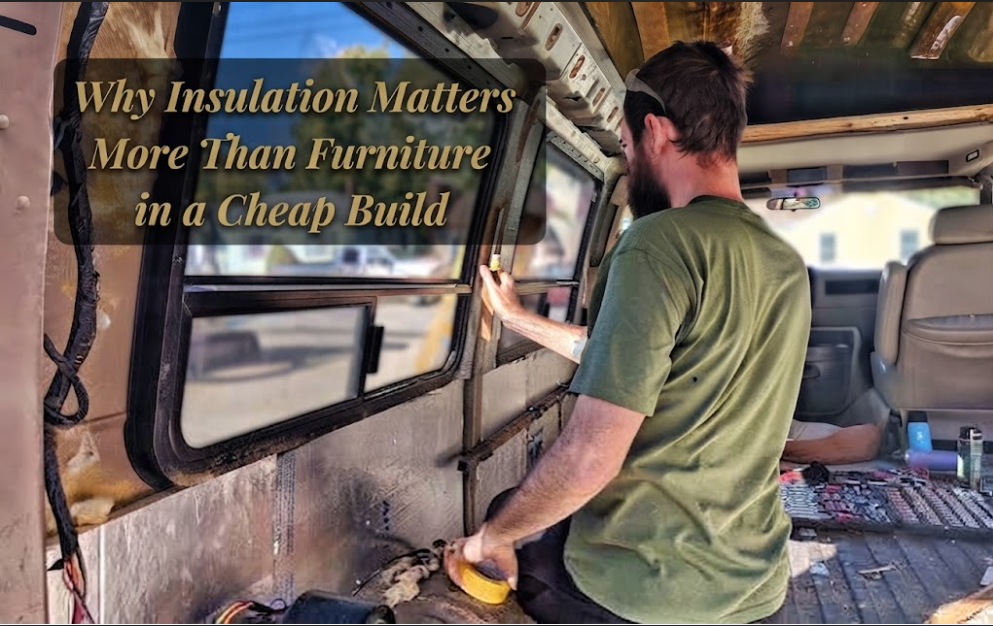
The first van build I ever watched go wrong wasn’t because of a bad electrical setup or a leaky roof vent. It was a guy who spent nearly $3,000 on a fold-out dinette, a butcher block counter, and reclaimed barn wood paneling, then insulated the whole rig with a single roll of the cheapest foam board he could find at the hardware store. By November he was running a space heater nonstop and still waking up to condensation dripping off the ceiling ribs onto his sleeping bag. The furniture looked incredible in his Instagram posts. The van itself was miserable to live in.
That’s the trade-off nobody warns you about early enough. Insulation doesn’t photograph well. Nobody scrolls past a wall of Havelock wool batting and stops to double-tap it. But it’s the one system in your build that determines whether the van is actually livable in April, in August, and in the middle of a January cold snap in the mountains.
1. What Insulation Actually Does in a Van
A van is a metal box. Metal conducts heat fast, in both directions, which means without insulation your interior temperature tracks the outside temperature almost exactly, just with a delay of an hour or two. Insulation slows that transfer down. It doesn’t make your van warm or cool on its own; it just buys you time and reduces how hard your heating or cooling system has to work to hold a comfortable temperature.
There’s also the condensation problem, which matters more than most first-time builders expect. Warm, moist air from your breath, your cooking, and your body meets cold metal and turns to liquid water on contact. That water runs down the walls, pools under your subfloor, and eventually shows up as mold and rust you can’t see until you’re tearing out finished panels two years later. Good insulation, paired with a vapor barrier done correctly, keeps that dew point away from your metal skin instead of right against it.
2. Why Furniture Feels More Urgent Than It Is
I get why furniture wins the budget fight. It’s visible. It’s satisfying to build. You can post progress photos of a bed platform and get a hundred likes; nobody’s hyping your rockwool batts. There’s also a practical logic trap: you need somewhere to sit, somewhere to sleep, somewhere to cook, so those items feel non-negotiable from day one.
But here’s where people usually go wrong. They treat insulation as a line item they’ll “get to properly” on the next build, and just wing it this time with whatever’s leftover in the budget. Then they spend their first cold weekend parked at a trailhead burning through propane trying to keep the cabin above 50 degrees, wondering why the $400 heater they bought isn’t doing its job. The heater was never the problem. The shell was.
If you’ve read our piece on why van life isn’t as cheap as Instagram shows, you already know the gap between the curated version of this lifestyle and the actual mechanics of it. Insulation is one of those unglamorous mechanics. It’s also one of the few build decisions that’s genuinely difficult and expensive to fix after the interior is finished, unlike furniture, which you can always swap, rebuild, or upgrade down the line.
3. A Real Comparison: Insulation Budget vs. Furniture Budget
Here’s roughly how a $6,000 total build budget plays out under two different priority orders, based on builds I’ve tracked and my own experience refitting a Ford Transit.
| Approach | Insulation Spend | Furniture Spend | Winter Comfort | Long-Term Risk |
|---|---|---|---|---|
| Furniture-first | $300–$500 (minimal foam board) | $2,500–$3,000 | Poor below 40°F outside | High (moisture, rust, mold) |
| Insulation-first | $800–$1,200 (wool or spray foam + proper vapor barrier) | $1,500–$2,000 (simpler, functional builds) | Solid down to 20°F with a small heater | Low, if installed correctly |
Notice the furniture-first approach doesn’t actually save you money. It just shifts the cost forward into propane bills, a bigger heater than you needed, and eventually a rebuild when the moisture damage shows up. Money spent chasing a Pinterest-worthy kitchen before the walls are sealed properly is money you’ll likely spend twice.
4. What a Reasonable Insulation Setup Actually Costs
You don’t need the most expensive material on the market to do this right. Sheep’s wool insulation like Havelock is popular for good reason. It handles moisture without losing its insulating properties the way fiberglass does when it gets damp, and it doesn’t off-gas the way some spray foams can in a small enclosed space. It’s not the cheapest option, but for a vehicle you’re sleeping in every night, that’s not where I’d cut corners.
Rigid foam board (XPS or polyiso) works well in flat areas like the floor and ceiling, where you can get a clean, continuous layer without gaps. The tricky part is always the wall cavities and rib channels, where irregular shapes leave gaps that foam board can’t fill well. That’s usually where I’d bring in a spray foam or a flexible batt material, even if the rest of the van uses rigid board.
And regardless of material, don’t skip the vapor barrier. This is the step people rush, or skip entirely, because it’s tedious and doesn’t feel like “real” progress. A poorly taped or missing vapor barrier can undo a lot of the benefit of good insulation, because moisture finds its way to the metal anyway.
If you’re still working out how insulation fits into your overall numbers, our guide on setting a realistic van life budget for 2026 breaks down where most first-time builders underestimate costs, and insulation is consistently on that list.
5. When Furniture Actually Should Come First
I don’t want to overcorrect here. There are cases where furniture-first makes sense. If you’re doing a short summer test run before committing to a full build, or you’re in a climate that rarely drops below 60 degrees, the insulation stakes are lower and you can reasonably prioritize a working kitchen and a comfortable bed. Not every build needs to be engineered for a Colorado winter.
But if you’re planning to live in the van full time, or you’re chasing seasons across different climates the way a lot of our readers do, insulation isn’t optional groundwork you can revisit later. It’s the foundation everything else sits on top of. Building furniture into a poorly insulated shell is a bit like renovating a kitchen in a house with no roof.
At Budget Van Journeys, we hear from readers constantly who regret their furniture-first builds, and almost never hear the opposite complaint. Nobody writes in saying they wish they’d bought a nicer countertop instead of proper wall insulation.
Common Mistakes Worth Naming Directly
Skipping the floor. People insulate walls and ceiling and forget the floor is losing heat straight into the ground or the road surface underneath you.
Using fiberglass batts without protecting them from moisture. Fiberglass loses most of its R-value once it gets wet, and in a van, it will get wet eventually.
Taping the vapor barrier seams with regular duct tape instead of a proper vapor barrier tape, which fails within a year in a vehicle that flexes and vibrates constantly.
Assuming a thicker layer always wins. Wall cavities in most vans are only 1 to 2 inches deep. Cramming in more material than the cavity allows just compresses it and reduces its effectiveness, it doesn’t improve it.
For more on where budgets tend to break down early in a build, take a look at why your van life budget never survives week one, which covers a lot of the same “invisible cost” pattern insulation falls into.
If you’re planning your own build right now and staring at a spreadsheet trying to decide what gets the bigger line item, put the insulation number in first. Build the furniture around whatever’s left. It’s less exciting to plan, and it won’t get you as many comments on a build photo, but it’s the difference between a van you tolerate through one winter and a van you actually want to live in.
Frequently Asked Questions
Is spray foam or wool insulation better for a van build? Both work well; the right choice depends on your cavities and budget. Spray foam fills irregular gaps completely and adds some structural rigidity, but it’s harder to remove later and can be more expensive to have professionally installed. Wool is flexible, handles moisture better over time, and is easier to work with as a DIYer, though it requires more careful vapor barrier work.
How much does proper insulation typically add to a build budget? Expect somewhere between $800 and $1,500 for a full van depending on size and material choice. It’s a meaningful chunk of a budget build, but it’s a one-time cost compared to years of higher propane or electricity use from a poorly insulated shell.
Can I insulate a van without removing the interior panels? Not effectively. You need access to the bare metal and the wall cavities to install material and seal a vapor barrier properly. Insulating over existing panels traps moisture behind them instead of managing it.
Do I need insulation if I’m only doing weekend trips in mild weather? It still helps with condensation control and temperature swings, but you can reasonably spend less and use simpler materials if you’re not living in the van full time or facing serious cold.
What R-value should I be aiming for in van walls? Most builders land somewhere around R-7 to R-13 in the walls given the shallow cavity depth, and R-13 or higher in the floor and ceiling where there’s more room to work with. It’s a modest number compared to a house, which is exactly why sealing gaps and managing moisture matters as much as the material’s raw R-value.
If you want a deeper walkthrough of how insulation choices tie into overall build costs, our full breakdown of how much it really costs to live in a van is worth reading before you finalize your budget.