The first time I added up the numbers properly, I genuinely thought I’d made an error. The total sitting at the bottom of my spreadsheet was lower than I’d expected, so I went back through the fuel estimate, rechecked the food column, went over the camping figure a second time, and came out with basically the same answer. A cross-country van trip, across two thousand miles of road, can realistically come in around $500. Sometimes under.
It sounds like the kind of claim someone throws out on the internet without having actually done the math. But the math holds, and it holds in a pretty specific way once you see what it’s built on.
The thing is, most people overestimate this because they start from the wrong assumption. They imagine paying for accommodation every night. That one assumption doubles or triples the budget before the trip has even started. Take it out of the equation, and suddenly the whole picture shifts.
Here’s what the $500 cross-country trip actually looks like when you break it apart.
- What $500 Has to Cover (and Where It Goes Wrong)
Before anything else, it helps to see the numbers laid out by category rather than as one intimidating total. A lot of people abandon the idea of a budget trip because they imagine everything costing simultaneously, rather than thinking about each line as something that can be managed.
The table below models a 2,000-mile cross-country route run lean. This is a realistic estimate, not a best-case scenario.
CategoryEstimated CostNotesFuel (19 MPG, $3.50/gal avg)$3682,000 miles, highway mixFood (10-11 days at $10-11/day)$110-125Cooking in van, bulk grocery shoppingCamping fees$0-25Mostly free, 1-2 paid nights maxParking, tolls, misc$15-30City stops, unexpected route changesTotal$493-548
That fuel figure is the one that causes the most stress, and also the one that’s most controllable. A van running 15 MPG instead of 19 across the same route adds roughly $55 to the fuel line, which tips the total over $500 before a single night’s accommodation or meal has been accounted for. Van type, load weight, and driving habits all matter here.
The camping number is the one that looks suspicious. Zero to twenty-five dollars for ten or eleven nights. It’s not a typo. It’s what happens when free camping is the default strategy, not the fallback option.
Budget Van Journeys covers real monthly van life cost numbers for 2026 in more detail if you want a wider frame for how these figures sit within longer-term van living, rather than just a single trip.
- Free Camping Is the Engine, Not the Safety Net
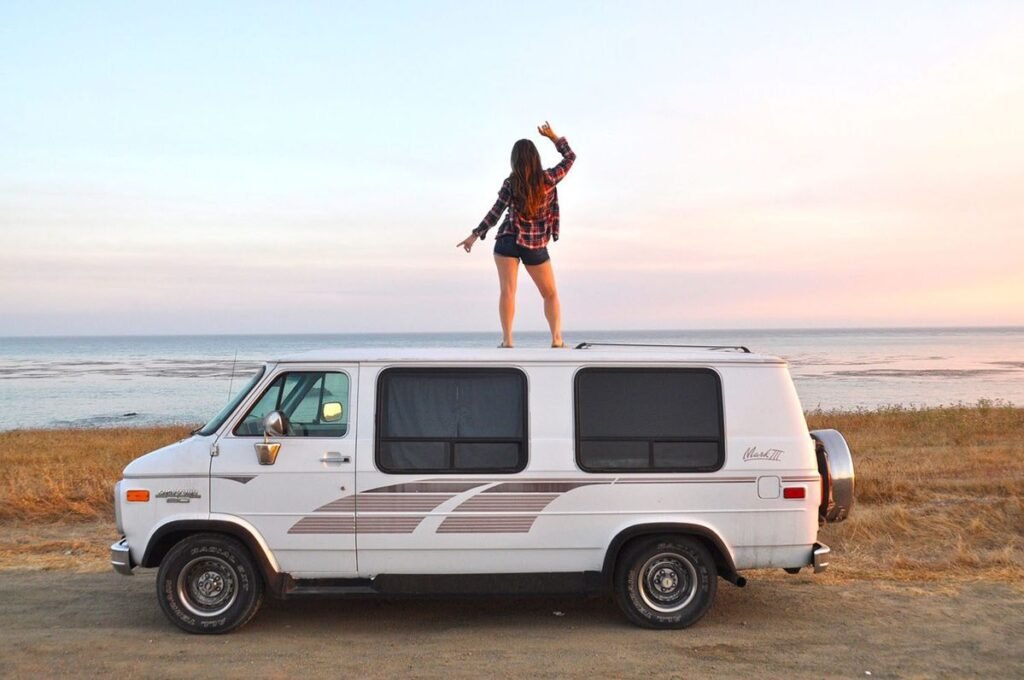
Most people treat free camping as the option you fall back on when things go sideways. Didn’t book in time. Ran out of budget. Ended up somewhere unexpected at 10pm. But on a $500 cross-country trip, free camping isn’t the backup plan. It’s the structural foundation the whole budget is built on.
Pay for four or five nights of accommodation across a ten-day trip and you’ve spent $80 to $120, maybe more, before you’ve bought a single meal. That money doesn’t come back. The budget doesn’t absorb it. It simply puts you over.
The honest good news is that the options for legal, free overnight van stays in the US are broader than most people realise. Bureau of Land Management land covers roughly 245 million acres, primarily across the western states, and permits dispersed camping for free with a 14-day stay limit in most areas. National forests follow a similar structure. Walmart and truck stop parking handles urban stretches. Casino lots, which tend to be busy enough to feel safe, cover another useful category.
The practical challenge isn’t finding that these options exist. It’s knowing which specific sites are actually accessible for a van, reasonably safe, and not already full when you show up. That’s where camping apps do most of the work. The quality varies a lot between apps, and it matters more than people expect. Budget Van Journeys tested four free camping apps in practice, so you can see which ones hold up before committing to one on a trip where getting it wrong costs time and frustration.
One thing that shapes this entire strategy: the western US is dramatically better suited to free camping than the east. If you’re going coast to coast, lean hard on free camping through the western stretch and plan for more paid nights as you move eastward. The best states for free overnight van camping breaks down the regional differences properly, and it changes how you think about your route direction.
Build in a small buffer, maybe $15-20, for nights where free camping genuinely isn’t accessible. You’ll be glad it’s there. But free comes first, every time.
- Fuel: The Calculation Most People Get Wrong
Fuel will be the largest single cost on this trip. There’s no way around that.
But it’s also the most controllable variable, which people don’t always appreciate until they’ve looked at the levers properly.
The basic math is: miles divided by real-world MPG, multiplied by average fuel price along the route. Simple. The error comes in two places. First, people use manufacturer MPG figures rather than the lower real-world numbers a loaded van returns on the highway, typically 10-15% less than the spec sheet suggests. Second, they apply one fuel price to the entire route, when state averages vary by $0.60 to $1.00 per gallon depending on where you’re crossing.
Those two errors together can inflate the fuel estimate by $50 to $70 on a 2,000-mile trip. Which, on a $500 budget, is significant.
The things that actually move the fuel number:
Routing through lower-price states is the biggest lever. Texas, New Mexico, and Oklahoma consistently sit cheaper than California, the Pacific Northwest, and most of the Northeast. If the route has flexibility, planning the higher-mileage sections through those states costs less than taking the most direct path through expensive fuel country.
Speed is the one people resist. Driving at 65 mph instead of 75 mph improves fuel efficiency meaningfully for most vans, somewhere in the 8-12% range. Across 2,000 miles at current prices, that difference translates to roughly $15-25 back in the budget. The trip takes an extra hour or two. Whether that trade-off makes sense depends on your schedule, but it’s a real number.
Cruise control on flat highway stretches. Unconscious speed variation, the kind of light accelerating and braking most drivers do on long flat roads, burns more fuel than a steady pace. Small difference per tank, but it adds up over ten days.
For a more detailed look at how route strategy and driving habits interact on a long van trip, cutting fuel costs on a long van road trip covers the specifics well.
- Food: The Budget That Erodes Without Warning
Food is the category most people lose quietly. Fuel shows up as one large transaction at a gas station. Camping is a clear yes-or-no decision. Food disappears in small amounts, three times a day, across ten days, without any single moment feeling like a real expense.
The pattern is almost always the same. The first couple of days go well. Groceries get bought, meals get cooked. By day four or five, someone has done a long drive and it’s late, and cooking feels like too much, so there’s a quick stop somewhere. It happens once. Then twice. And the $10/day food budget has quietly drifted to $20/day without a single meal that felt like a splurge.
The thing that holds the food budget in place is buying from larger supermarkets every three or four days, not convenience stores or gas stations. Walmart, Aldi, and Kroger affiliates appear consistently across most cross-country routes and allow you to buy sensibly in small quantities. A $30 shop from one of those stores covers four days of eating without requiring much cooking skill or equipment.
What that looks like practically: oats or eggs in the mornings, rice or pasta with canned protein most evenings, something simple from the cooler for lunch. Not exciting food, but it’s not miserable either. The eating on $15 a day van life grocery strategy has good variety ideas if you want to eat better without spending more.
The silent budget killer that rarely gets mentioned: bought coffee. Two coffees a day from a gas station or drive-through adds $7-10 to the daily food cost before a single meal. A small French press and a bag of grocery store ground coffee runs about $3-4 and lasts a week. That single swap saves $50-60 across the trip. It’s a minor inconvenience for a meaningful number.
- Where the Budget Collapses (and How to Stop It)
Looking back at the people I know who’ve tried a strict-budget cross-country trip and gone over, the breakdown almost never comes from one large unexpected expense. It comes from a slow drift over three or four days, where each individual decision felt fine in the moment.
The most common version: the first two days are solid, the budget feels comfortable, and things loosen slightly. A campsite gets paid for when a free spot was nearby but felt like too much effort to find. Convenience store food fills a gap because grocery shopping didn’t happen before the shops closed. Fuel goes in at the nearest station instead of waiting for a cheaper one a few miles ahead. None of it registers as a mistake, and none of it is a mistake, it just compounds across ten days into a budget that’s 20% over.
There’s also the beginning and end of the trip, which people consistently forget to account for. If you’re starting and finishing near a city, you’ll likely need one or two paid overnight spots before reaching open BLM land, and a day’s city parking during any urban stop adds up. That’s a real $30-50 that can disappear from the budget before the trip has properly started.
And then the thing everyone knows they should plan for but often doesn’t: genuine unexpected costs. A toll road that wasn’t on the route app. A windshield chip that needs attention before it spreads. A minor mechanical issue at a bad moment. Keeping $50-75 mentally ring-fenced as a true emergency buffer doesn’t blow the $500 budget if you don’t use it. But if something does come up, it’s the difference between an annoying afternoon and a trip-ending problem.
The $500 budget works. It just doesn’t forgive drift as easily as a $1,000 budget does.
FAQs
Does the $500 budget cover the whole trip including van setup, or just the road expenses?
Just the road. The $500 covers fuel, food, and incidental costs while you’re actually travelling. It assumes the van already has basic gear: a cooler, something to cook on, and bedding. Van build costs are a separate consideration entirely, and Budget Van Journeys has a full breakdown of what a beginner build actually requires if you’re still in the setup phase.
What if my van only gets 14-15 MPG on the highway?
At 15 MPG across 2,000 miles at $3.50 per gallon, fuel alone comes to roughly $467. That’s nearly the whole budget before a single meal or campsite. A 14-15 MPG van on a $500 cross-country trip needs either a shorter route, cheaper fuel states, or a slightly higher total budget. It’s not impossible, but the margins get uncomfortably thin.
Is it actually safe to rely on free camping every night?
It depends heavily on which options you’re using and how you vet them. Well-trafficked Walmart lots and busy truck stops feel very different to remote dispersed sites at the end of a dirt track. Reading recent app reviews before committing to a spot gives you a realistic picture of what you’re actually arriving at. For urban stretches, stealth parking is a separate skill with its own set of considerations from remote dispersed camping.
Does the route direction matter for the $500 budget?
It does. West to east tends to be slightly easier for free camping because the BLM land density is higher in the western states. East to west means you spend your first few days in the harder free-camping territory. Neither direction makes the budget impossible, but knowing the regional difference lets you front-load the free camping stretch rather than arriving in cheap-camping country at the end when the budget is already dented.
What’s the biggest single mistake people make on a budget like this?
Underestimating how much small purchases cost across ten days. One convenience store snack, one fast food stop, one impulse gas station coffee, a campsite chosen for convenience rather than necessity. Each one is $3-8 and feels inconsequential. Across ten days with three daily opportunities, those small choices can add $80-100 to the trip without a single decision that felt like overspending.
There’s nothing complicated at the centre of this. A $500 cross-country van trip comes down to three decisions made before you leave: free camping as the default, cooking as the standard, and a route planned around fuel prices rather than just distance. The people who stay under budget aren’t doing anything unusual. They’re just consistent about those three things across the whole trip.
Which, as it turns out, is harder than it sounds on day seven when you’re tired and the nearest BLM land is forty minutes off-route. But that’s a different article.