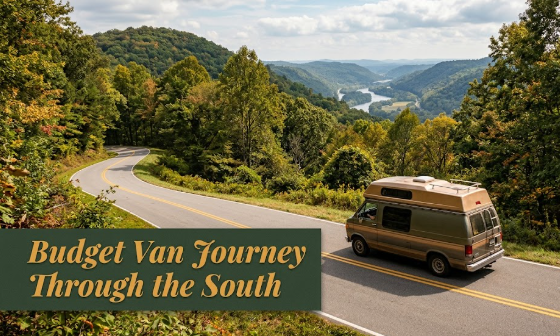
The Walmart car park in Natchitoches, Louisiana sits at the edge of a strip of fast food restaurants and a dollar store, which is exactly as unglamorous as it sounds. I’d planned to sleep there. Free, legal at that location, and after six hours driving through central Louisiana I was too tired to debate other options. What I hadn’t planned for was waking at 4am with the van feeling like a greenhouse, a humidity level that left condensation on every surface I touched, and the slow understanding that everything I thought I knew about free overnight van camping had been learned in the wrong part of the country entirely.
The American South is not the American West. That sounds obvious, but the majority of budget van content out there is built around BLM land, and BLM land is almost entirely a western phenomenon. Arrive in the South expecting the dispersed camping freedoms that exist in Nevada or New Mexico, and you will be frustrated and underequipped for most of the trip.
What follows is how a low-budget van journey through the South actually works, based on a complete loop from Nashville, Tennessee through the Gulf Coast states and back up through the Appalachian foothills. Total distance: around 3,800 miles. Total spend: just under $1,100.
- What the South Changes About Van Life Planning
BLM land covers huge portions of the American West, but the southeastern United States has almost none of it. This one fact reshapes every planning decision a budget van traveller needs to make before heading south of Memphis or east of Texas.
Free dispersed camping in the South means National Forests, Corps of Engineers land around reservoirs, and, less reliably, a mix of tolerant Walmart locations and roadside pull-offs that vary quite a lot in legality and comfort. The National Forest option is genuinely good, though. The Ouachita in Arkansas, the Pisgah and Nantahala in North Carolina, the Bankhead in Alabama, the Kisatchie in Louisiana, the Chattahoochee in Georgia: each of these allows dispersed camping under Forest Service rules similar to BLM. Set up at least 150 feet from water, stay no more than 14 consecutive days per spot, leave no trace. It costs nothing, and these forests are far less used than their western equivalents.
A realistic budget southern loop leans on National Forest camping heavily from the start. Apps can help, but cross-checking the information they give you against the specific forest district’s published rules is necessary before arriving somewhere remote. The Budget Van Journeys tested guide to free camping apps breaks down which tools perform well for forest camping specifically, which is a different use case from western BLM searching.
One thing that trips people up consistently: Corps of Engineers campsites around southern reservoirs are sometimes free and sometimes not. The fee structure varies by site and by season. Checking the specific site on Recreation.gov before arrival avoids the kind of surprise that derails a budget.
- The Route That Made Financial Sense
A budget-conscious southern loop needs to be thought about in terms of distance management as much as anything else. The South is large. Nashville to New Orleans is roughly 530 miles. New Orleans to Atlanta is another 470. Distance is a budget line item as much as campsite fees are, so the route has to carry enough interest per mile driven to justify what the fuel is costing.
The route that made the most sense on this trip ran roughly like this: Nashville to Memphis along Highway 70 rather than the Interstate, cutting through small towns where local grocery stores are genuinely cheaper than anything near a motorway service. Memphis to Natchez on the Natchez Trace Parkway, which is free to drive, strictly 50mph throughout, and flanked by forest for most of its 444-mile length. One of the most beautiful roads in the country, as it happens, and one of the cheapest corridors to cover.
From Natchez, south to New Orleans, then west along the Gulf to Biloxi and Pensacola, and across to Apalachicola on the Florida panhandle. North from there toward Tallahassee and east to the Ocala National Forest. Then back up through Georgia into the southern Appalachian foothills, through the Pisgah National Forest in North Carolina, and eventually back west toward Tennessee.
Fuel was the largest cost across the full route. The Natchez Trace sections and deep National Forest days are cheap because you’re barely moving and burning very little. The Gulf Coast stretches are longer between natural stopping points. The guide to cutting fuel costs on long van trips covers the driving habits that made the most difference on this kind of extended route, and a lot of it applies directly to southern driving conditions.
- Where to Sleep Without Paying, and What the Maps Don’t Show
The stealth parking question lands differently in the South than most people expect coming from van content focused on the West Coast.
Cities like Nashville, New Orleans, and Atlanta are not particularly tolerant of overnight van parking, and enforcement in residential areas is active in all three. New Orleans in particular, because the city genuinely doesn’t have much suitable overnight street parking even for residents, is somewhere to budget one or two paid nights rather than spend hours searching for something that doesn’t exist inside the city perimeter. A campground within 20 miles or a paid overnight lot costs less than the stress of getting moved on at 2am.
Rural and small-town Louisiana, Mississippi, and Alabama are very different, though. Roadside rest areas in these states often have no posted time limits and some have security patrols that make them safer than they look. Small town Walmart locations remain tolerant in most cases, but this continues to be a policy that changes without notice at individual stores. Calling ahead before making it the primary plan rather than a fallback is worth the two minutes.
National Forest spots are the most consistent option across the whole southern loop. The stealth parking guide on this site covers what the standard parking apps miss and how to read forest roads for actual overnight suitability, and that knowledge transfers directly to southern forest camping, where the physical terrain looks different from the West but the same principles apply.
The Ocala National Forest in Florida gets special mention because it is routinely underestimated. It’s a large, flat scrub forest with numerous forest roads open to dispersed camping, and because it doesn’t have the dramatic visual appeal of mountain forests further north, it gets overlooked in most van life route content. Two nights off a quiet track near one of the smaller lakes along FL-19 and the only other vehicle visible was parked a quarter mile away. In Florida, in January, that counts as genuine solitude.
- What Everything Actually Cost
The figures below are from the actual trip: 22 nights, 3,800 miles, and the full southern loop described above.
EXPENSE CATEGORY TOTAL ($) DAILY AVG NOTES
——————- ———- ———- ——————————–
Fuel $460 $20.90 ~17 mpg average, southern prices
Camping $47 $2.14 2 paid nights; the rest was free
Food / groceries $248 $11.27 Walmart, Kroger, local markets
Eating out $89 $4.05 5 restaurant meals (Gulf seafood)
Attractions / entry $38 $1.73 Mostly free; 2 paid entry sites
Propane / supplies $24 $1.09 One tank refill
Total $906 $41.18
A few things worth noting about those numbers. Fuel prices in the South are consistently among the lowest in the US. Arkansas, Louisiana, Mississippi, and Alabama regularly sit well below the national average, and that compounds across a multi-week trip in a way that adds up. The eating out figure is low because Gulf Coast seafood at small family-run spots in Biloxi, Pensacola, and Apalachicola is genuinely inexpensive, nothing like the waterfront restaurant prices those locations might suggest from the outside.
For groceries, eating on $15 a day in a van is achievable in the South without much effort. Walmart Supercenters are available in almost every mid-sized southern town and the pricing is lower than equivalent stores in coastal cities elsewhere in the country. Markets in smaller Louisiana and Mississippi towns occasionally turn up local produce and canned goods at prices that feel almost absurd by comparison to anywhere further west.
- The Mistakes That Actually Cost You Sleep and Money
Underestimating the heat is the planning failure that hits hardest, particularly from May through September. A van conversion that functions well in moderate California temperatures becomes an oven in Mississippi summer humidity. The average high in New Orleans in July sits around 32°C, and the humidity makes that number feel considerably worse. It’s not just the temperature; it’s the moisture on everything, and the fact that it doesn’t drop meaningfully overnight the way it does in the desert Southwest.
Planning a southern loop in the off-season, October through April, solves most of this. The weather across the Deep South in winter is genuinely pleasant: cool nights, mild days, and far fewer people at the free camping spots that do exist.
A second consistent mistake: treating southern National Forests like western BLM land without reading the specific district’s rules first. Several southern forests have dispersed camping restrictions that wouldn’t apply on most BLM land. The Ouachita National Forest has a dispersed camping permit requirement in some of its districts, which costs $5 for 14 days. Not expensive, but arriving without that permit means being technically non-compliant, which matters more in some areas than others.
And the water assumption. Western van life content talks constantly about water sourcing challenges on BLM land. In the South, this is mostly a non-issue at the scale of daily travel. Rest areas, truck stops, and small towns appear frequently enough that carrying more than a 10-litre reserve at any time rarely becomes necessary. But that assumption catches people when they do head deep into forest roads, where the nearest confirmed water source turns out to be further than the map implied.
One more thing, and this one is small but consistent: the South gets dark early in winter and the driving distances between towns on scenic routes can feel longer than they look on a map. Leaving a campsite without a specific next stop in mind works fine in Nevada where BLM land appears every few miles. On the Natchez Trace or through the Kisatchie Forest it’s a different calculation entirely, and arriving somewhere unfamiliar after dark is not the same experience it is in better-lit parts of the country.
FAQs
Is the South actually good for budget van travel, or is it just cheap because there’s less to see?
There’s a tendency in van life content to associate budget destinations with limited interest, and the South doesn’t fit that framing at all. The Natchez Trace, the Gulf Coast, the Appalachian foothills, and the bayou country of Louisiana are genuinely compelling. The cost savings come from lower fuel prices, lower grocery costs, and National Forest camping, not from a scarcity of worthwhile places to spend time.
What’s the best time of year for a southern van loop?
October through April for most of the route. The North Carolina and Tennessee mountain sections are the exception, where late spring through early autumn gives better access to higher-elevation forest roads that can be difficult or closed earlier and later in the year. For the Gulf Coast, the Florida panhandle, and the Deep South states broadly, the winter window is more comfortable and far less crowded.
Are there enough National Forests to camp free every night?
Nearly. The genuine gaps are around New Orleans and Atlanta, where there’s no practical free camping close enough to the city to be useful. Budgeting one or two paid nights around those urban sections removes the stress of searching for something that isn’t really there. Outside those two areas, free or near-free camping is achievable on most nights with reasonable planning.
How does the South compare cost-wise to a western route?
On fuel, the South wins clearly. Prices are lower, and scenic routes like the Natchez Trace naturally limit the distance you cover per day, which reduces fuel burn further. On camping, the West has more raw free options, but southern National Forests close much of that gap for anyone willing to learn the forest road system. Budget Van Journeys has found that a well-planned southern loop runs around 15 to 20% cheaper per day overall than a comparable western route when fuel and accommodation costs are looked at together.
Can you do the whole loop solo?
Yes, and it’s actually well-suited to solo travel in a few ways. The Gulf Coast rest areas are generally safe, the southern National Forests have low overnight traffic which makes them quieter and less competitive for spots, and small southern towns tend to be friendlier to unfamiliar vehicles parked quietly than urban areas further west. The main adjustment for solo travellers is to plan stops more carefully and avoid arriving anywhere unfamiliar after dark, particularly on forest roads where cell signal drops out.
That trip through the South started as a fallback, something scheduled between more ambitious western routes. It ended up being one of the more memorable circuits I’ve done in the van, partly because the expectations were lower and the reality kept exceeding them. The Natchez Trace at golden hour with nothing visible in either direction but forest. Eating shrimp from a paper plate at a counter in Biloxi for $8. Waking up in the Pisgah to cold clean air after weeks of humidity.
It’s worth planning properly, not as an afterthought.