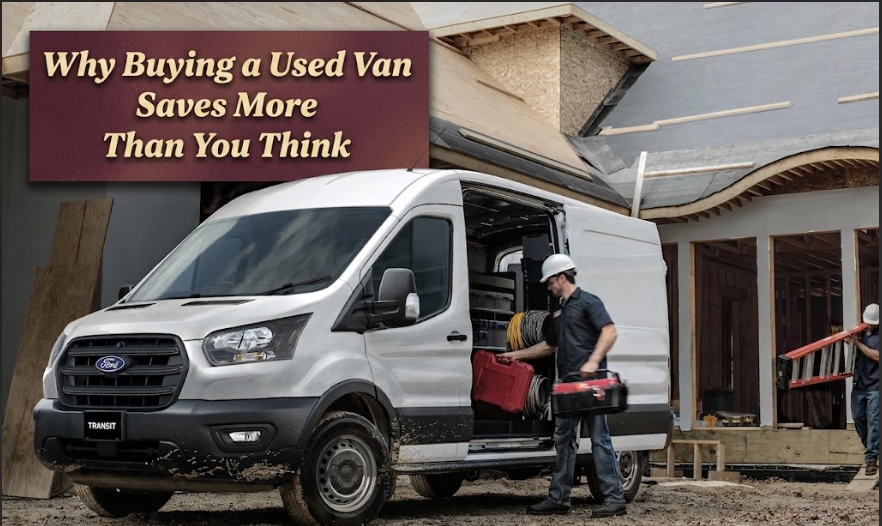
Something most first-time van buyers don’t know about the used van market: a significant portion of what’s available at any given moment comes from fleet operators running vehicles on fixed three to four year replacement schedules. Courier companies, utility providers, local authorities, they retire working vans when the lease term expires, not when the vehicle stops functioning. These aren’t tired runarounds. They’re vans that have been serviced to documented schedules, often at main dealers, because fleet operators have insurance liability structures and accountancy requirements that demand proper maintenance records.
A three-year-old Mercedes Sprinter L2H2 coming off a fleet contract with around 90,000 miles typically sells at trade auction for somewhere between 55 and 65 percent of its original list price. The operator absorbs the depreciation as a business expense. You get a van that has, in the most literal sense, demonstrated its ability to work hard without breaking down, and you pay roughly half what the original buyer paid three years earlier.
Most people treat this as a simple purchase price gap. It isn’t. The purchase price is just where the saving starts.
1. What the Full Financial Saving Actually Looks Like
Take a mid-spec Mercedes Sprinter 314 CDI L2H2, one of the most popular base vans for UK conversions. New in 2024, you’re looking at a list price somewhere around £40,000 to £45,000. A 2021 equivalent with 80,000 to 100,000 miles and a complete service history sits currently around £18,000 to £24,000, depending on specification and source. That gap, somewhere between £16,000 and £27,000, is not a marginal saving. It’s a completely different set of options about what else you do with your money.
That figure doesn’t sit in a vacuum either. The insurance saving compounds the difference further over time. Insurers calculate premiums partly against the agreed value of the vehicle. A £20,000 used van costs considerably less to insure than a £43,000 new one for the same category of cover. Anyone who’s read through the real van life monthly cost numbers on Budget Van Journeys will know that insurance is one of those recurring costs that quietly adds up, and choosing used reduces it from the moment you take out the first policy.
Then there’s what the saved money actually buys. A realistic full van conversion, insulated, wired with solar, fitted with a bed platform and storage, done properly, can be completed for £3,000 to £8,000 if you’re working to a budget and sourcing materials carefully. That’s a fraction of the gap between new and used. The remaining money becomes your emergency fund, your first year of fuel and site fees, or the reason you can afford to stop somewhere for a month instead of driving constantly to justify the cost. You can look at the van build under £5,000 breakdown for a practical sense of what’s realistic on that side.
And then there’s the aspect of used-van ownership that doesn’t appear in any financial calculator: you cut into it, bolt things to it, and scratch the floor loading gear without the low-level anxiety that follows a new vehicle purchase around for the first two years. That matters more than people expect, and it’s worth naming.

2. The Reliability Question, and Why the Concern Is Usually Aimed at the Wrong Thing
Here’s where most people get stuck. And where the pull toward new feels strongest, because the logic seems simple: used vans have more miles, more wear, more chances for something to go wrong. A new van comes with a manufacturer warranty. It hasn’t been through anything yet.
Both of those points are true. Neither of them means what people think they mean.
Commercial diesel engines like the Mercedes OM651 fitted to post-2010 Sprinters, or the Ford Duratorq used in the Transit range, are built to a specification that private buyers rarely experience. Fleet duty cycles are brutal by comparison to private use. A courier van covering 60,000 miles a year on motorway and urban routes is working its drivetrain harder on a daily basis than a conversion van will ever be asked to do. A three-year-old fleet vehicle with 90,000 miles hasn’t been pushed near the mechanical limits of what these platforms are designed to handle. Both the Sprinter and the Transit have documented examples running cleanly past 250,000 miles on standard maintenance schedules.
The unreliable used van is a specific thing. It’s one bought from a private seller who can’t account for two or three years of ownership. It’s one where the service intervals were stretched or skipped, or where a warning light was cleared rather than diagnosed. It’s one without a history folder, bought on trust from someone you can’t go back to.
That version is a real risk. It’s also entirely avoidable if you know what you’re looking for. And that’s a different problem from “used vans are unreliable,” which is too broad to be useful.
3. Where to Actually Find the Right Vehicle
The mental image most people have of used van buying is a classified ad, a handshake, and a bank transfer. The actual market has several distinct tiers, and knowing where they are matters for finding the best combination of price, condition, and documentation.
Fleet disposal auctions run by BCA (British Car Auctions) and Manheim are where a large proportion of ex-fleet vans first enter the used market. Both run regular commercial vehicle sales that are increasingly accessible to private buyers who register in advance. The vehicles sell with buyer’s fees on top, which you need to account for in your budget, but the documentation standards at auction tend to be more consistent than the private sale market. You can often review the vehicle’s basic history information before bidding.
Direct from fleet operators is a route that most private buyers never pursue, and some fleet managers welcome it because it removes the auction fee from their calculation. Housing associations, telecoms infrastructure companies, and local authority motor pools all cycle vehicles regularly. This takes more persistence to access, but when it works, you’re often getting a well-documented vehicle directly from the people who maintained it.
Reputable van dealers are the most straightforward option for most buyers. A dealer will have done a basic mechanical inspection, HPI-checked the vehicle, and can offer a short warranty. The price reflects that service. For buyers who want simplicity and a degree of recourse if something turns out to be wrong, this is usually worth the premium over private sale or auction.
Whatever route you use, run an HPI check yourself before committing. Outstanding finance on a vehicle is a genuine legal risk, because if the original finance hasn’t been settled, the lender has a claim on the asset regardless of what you paid the seller. This is not theoretical. It catches buyers every year.
For a broader look at how your spending decisions during the build compound over time, the piece on why most first-time van builders overspend is worth reading before you start pricing materials. The point about the vehicle purchase decision flows directly into that.
4. What to Check Before You Sign Anything
Not everything on a used van needs to be in perfect condition, but some things genuinely aren’t negotiable if you want to avoid expensive surprises within the first six months.
Service history is the single most important document. Not “I had it serviced” as a verbal statement. The actual folder, or the main dealer service record, with stamps and dates and mileage entries that form a coherent sequence. Gaps of more than a year or significant mileage jumps without corresponding service entries are worth asking specific questions about. A seller who gets defensive about a service history question is telling you something.
Structural rust is the other category that changes the whole decision. Surface rust on panels is cosmetic. Rust on the chassis rails, the sills, the rear crossmember, or around the rear door hinges is structural, and depending on severity, it ranges from expensive to fix to a legal roadworthiness issue. Get underneath the van, or pay a mechanic to do it, before committing.
For the Ford Transit range specifically, the 2.2 TDCi engine used in pre-2015 models had documented timing belt service requirements that were often stretched in private ownership. Confirm the belt replacement history directly, not just the service intervals generally.
Before you sign: plain-text checklist
VAN PURCHASE CHECKLIST

Documentation:
[ ] HPI check completed and returned clear
[ ] Finance clear confirmed on HPI certificate
[ ] No write-off marker on HPI (Cat N and Cat S history disclosed and priced accordingly)
[ ] Service history folder reviewed - stamps, receipts, or dealer records covering full ownership
[ ] V5C ownership document matches seller's details

Physical inspection:
[ ] Chassis rails inspected for structural rust (underneath)
[ ] Sills and rear crossmember visually checked
[ ] All doors, sliding door, and rear doors operate correctly
[ ] Roof seams and guttering checked for rust or sealant failure
[ ] Test drive completed with no warning lights on return

Engine and drivetrain:
[ ] Timing belt/chain history confirmed with documentation
[ ] No visible oil leaks from rocker cover or sump
[ ] Smooth idle without rough running or excess smoke on startup
[ ] Clutch engagement point normal (not very high = near end of life)

Pricing:
[ ] Compared against current market listings for equivalent year/mileage
[ ] Any disclosed faults factored into offer price
The comparison between cheap and expensive van builds is relevant here too, because once you’ve got a solid used van at a good price, the decisions about where to spend and where to save on the build side follow a similar logic.

Pros and Cons: Used Van vs New Van for Conversion
| Used Van | New Van | |
|---|---|---|
| Purchase price | Significantly lower (often 40-60% of new list) | Full list price, plus finance interest if not cash |
| Depreciation risk | Largely absorbed before you buy | Steepest drop happens in year 1 on your watch |
| Service history | Variable; fleet history often excellent | Clean slate, but no proven track record yet |
| Insurance cost | Lower agreed value = lower annual premium | Higher insured value, higher premium |
| Conversion freedom | Easier to modify without financial anxiety | Psychologically harder to cut into and drill |
| Build budget freed up | Substantial (potentially £15k-£25k available) | Minimal; most funds committed to the vehicle |
| Warranty coverage | Limited or none (short dealer warranty sometimes) | Full manufacturer warranty, typically 2-3 years |
| Reliability evidence | Proven if history is clean and mileage is reasonable | Untested in real-world conditions |
FAQs
What’s too many miles on a used van for a long-term conversion? For commercial diesel engines like the Sprinter OM651 or Transit Duratorq, 150,000 miles with a complete service history is not a dealbreaker. These platforms are engineered for fleet duty, which is significantly more demanding than van life use. The history quality matters more than the odometer reading. A van with 130,000 documented miles and every service receipt is a safer mechanical choice than one with 70,000 miles and a three-year service gap.
Can I get a warranty when buying a used van privately? No, private sales come with no warranty obligation in the UK beyond the basic consumer rights around description accuracy. Dealers are required to offer a minimum of 30 days warranty on used vehicles sold to private buyers under UK consumer law, though this varies. Some dealers offer longer terms. If warranty coverage matters to your decision, buying from a dealer is the only route that provides it.
Is it better to buy a diesel van or look at newer Euro 6 alternatives? For a budget build, diesel remains the most practical choice for several reasons: the infrastructure for diesel is more widely available than electric charging suitable for a van that also needs to power habitation loads, and Euro 5 and Euro 6 diesel vans are both currently accessible at reasonable used prices. Pure electric vans are improving but carry range considerations that make extended touring more logistically complex. If the majority of your travel is urban and within a consistent home region, the electric option becomes more worth exploring.
Do I need a Category B driving licence to drive a panel van conversion? For most standard panel van conversions in the UK, yes, a standard Category B licence covers vehicles up to 3,500kg maximum authorised mass. Most Sprinter and Transit conversions fall within this limit if you’re sensible about what you load. Once a vehicle is converted and registered as a motorhome, or if the loaded weight approaches or exceeds 3,500kg, you enter different licence categories. If you’re planning a heavy build with a large battery bank, water tank, and significant furniture, weigh the finished vehicle before driving it on a Category B licence and check the plate.
Where is the best place to search for used vans in the UK? AutoTrader and eBay motors both carry large used van inventories. Honest John Vans is useful for more detailed history checks and aggregated listings. For fleet disposals, BCA’s commercial vehicle section and Manheim’s online auction portal both allow browsing upcoming sales, and registering as a private buyer is straightforward. Facebook Marketplace has a large and undervalued van-specific market, particularly for ex-tradespeople selling their own vehicles directly, which sometimes offers good history knowledge alongside the vehicle.
The money you didn’t spend on a new van doesn’t sit idle once you’ve signed the paperwork on a solid used one. It’s the reason you can insulate properly instead of cutting corners. It’s the reason you can stop in a place that costs money to stop in, because you have the margin to do it. Budget Van Journeys runs on the idea that a smaller vehicle budget doesn’t mean a smaller experience, and buying used rather than new is usually where that extra margin actually comes from.
Find the right van, verify its history properly, and the rest of the budget gets to do the interesting work.