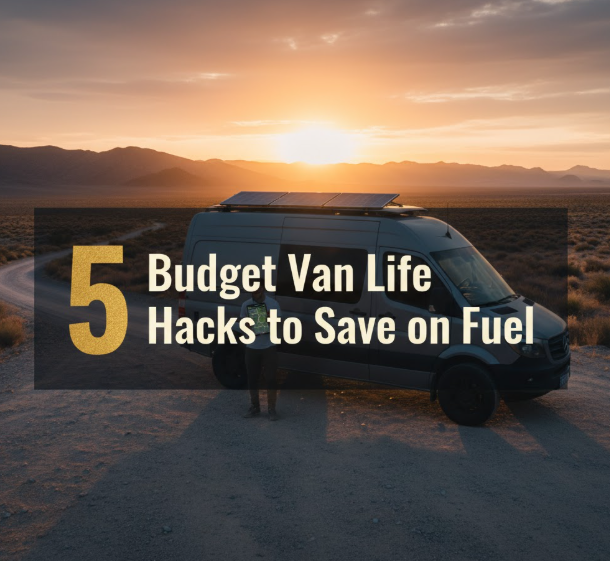
Fuel and food. These two will devour your cash quicker than anything else on the road.
If you’ve ever filled up at a gas station and gritted your teeth when the total appeared, or picked up a fast food meal because cooking seemed like too much effort — you know the problem already. These small, so-called little expenses add up to something big in a month.
And here is the good news: fuel and food costs are highly controllable. You don’t need a newer van. You just need to spend less than you earn. You just need smart habits and a handful of practical tricks that experienced van lifers have tested over thousands of miles.
This article outlines 5 rapid, fluff-free solutions to trim your largest traveling costs. All of these strategies are simple enough to start implementing today. And collectively, they will save you hundreds of dollars each and every month on your budget van journeys.
Let’s get into it.
Fuel and Food Are Your Two Biggest Budget Killers on the Road
Before we get into solutions, it’s helpful to see the whole picture.
Most new van lifers concentrate on the big one-off costs — buying the van, building it out, purchasing gear. But the costs that really empty bank accounts over time are the ongoing ones. Fuel and food top that list every single time.
Here’s how an average month breaks down for someone not managing these costs:
| Expense | Unmanaged Cost | Managed Cost | Monthly Savings |
|---|---|---|---|
| Fuel | $450–$600 | $200–$300 | $150–$300 |
| Food (eating out often) | $400–$700 | $150–$250 | $250–$450 |
| Total | $850–$1,300 | $350–$550 | $400–$750 |
That adds up to a possible savings of $400–$750 per month — simply from improving management of two categories.
That’s $4,800–$9,000 back in your pocket after a full year of budget van journeys.
Now let’s see exactly how to make that happen.
Way 1: Drive Smarter, Not Just Slower
To most people, saving on fuel means driving well below the speed limit on the highway. That helps — but it’s just one small piece of the puzzle.
Fuel efficiency is all about your full driving behavior. Over long distances, small adjustments can lead to big savings.
The Speed Sweet Spot for Vans
Vans are not aerodynamic vehicles. They’re big, boxy and have a high profile that creates plenty of wind resistance. That wind resistance increases dramatically as speeds climb.
Full-size vans achieve the best fuel economy in the 55–65 mph range. Drive at 75 mph and you lose 10–15% of your fuel economy right there.
Here’s a quick comparison:
| Speed | Approximate MPG (Full-Size Van) | Fuel Cost Per 100 Miles (at $3.50/gal) |
|---|---|---|
| 55 mph | 18–20 mpg | $17.50–$19.44 |
| 65 mph | 15–17 mpg | $20.59–$23.33 |
| 75 mph | 12–14 mpg | $25.00–$29.17 |
Running at a constant 75 mph instead of 55 mph may add $7–$10 per 100 miles to your fuel bill. On a 3,000-mile drive, that’s an additional $210–$300 on fuel from speed alone.
Daily Habits to Improve Fuel Efficiency
These driving habits make a real difference on budget van journeys:
Accelerate gently. Nothing burns more fuel than hard acceleration. Ease into speed like you’re trying not to spill a boiling drink in your lap.
Coast to stops. When you notice a red light or a slowdown ahead, ease your foot off the gas early. Let the van slow naturally before braking. This recovers energy and saves fuel.
Avoid idling. Sitting with the engine running burns about 0.5–1 gallon of fuel per hour. If you’re parked for more than two minutes, turn the engine off.
Reduce rooftop cargo. A rooftop cargo box or bike rack creates significant drag. Remove anything on top of the van when it’s not in use.
Check tire pressure weekly. Under-inflated tires increase rolling resistance and can reduce fuel economy by 0.5–3%. It’s a free fix that takes two minutes.
Find the Cheapest Fuel With Gas Price Apps
Don’t just pull into the first gas station you spot. Gas prices can vary by $0.30–$0.60 per gallon within just a few miles of each other.
Use these apps to find the cheapest fuel nearby:
- GasBuddy — Crowdsourced price data, most popular
- Waze — Displays gas prices along your route
- Google Maps — Shows prices of nearby gas stations
- AAA TripTik — Great for planning longer routes
Even saving $0.30 per gallon makes a difference. If you fill a 25-gallon tank twice a week, that’s $15 per week saved — or $60 per month just from filling up at cheaper stations.
Way 2: Plan Your Driving Days Around Real Destinations
This one is underrated. One big source of fuel waste on budget van journeys is driving without purpose.
Driving without a plan means backtracking. It means driving 40 miles to a spot, deciding you don’t like it, and driving 40 miles back. It means missing a free campsite and scrambling for an alternative 20 miles in the wrong direction.
All that wandering adds up to a lot of wasted fuel.
The One-Week Route Planning Method
Instead of planning day by day, sit down once a week and map out your next 5–7 days of travel. Here’s how:
Step 1 — Choose an anchor point. Choose one primary destination to focus on for the week. This is the place you most want to visit or experience.
Step 2 — Search for free camps within 30 miles of that anchor. Use apps like iOverlander, Freecampsites.net or the BLM land map to find three to five free overnight spots nearby.
Step 3 — Plot a logical driving loop. Connect your stops in a circular or linear route that avoids backtracking. Think of it like connecting dots in the most efficient order.
Step 4 — Set a daily mileage limit. Many seasoned van lifers advise against driving more than 150–200 miles per day. It saves fuel, reduces wear on the van and leaves time to actually enjoy where you are.
Drive on Weekdays, Not Weekends
Traffic is the enemy of fuel efficiency. Stop-and-go driving in congested traffic can reduce your fuel economy by up to 20–30% compared to driving on open roads.
If your schedule is flexible — and most van lifers have flexible schedules — shift your driving days to Tuesday, Wednesday or Thursday. Avoid driving on Friday afternoons and Sunday evenings when traffic is at its worst.
This simple change can significantly cut down both fuel expenses and travel stress.
Way 3: Build a Road-Proof Food System That Feeds You Well for $10 a Day
Here’s a number that may surprise you: the average American spends about $166 per week on food. That’s roughly $24 per day.
On budget van journeys, you can eat well — very well — for $8–$12 a day. That’s with real, wholesome, home-cooked food. Not sad crackers and instant noodles.
The secret is a system. Not willpower. Not extreme frugality. Just a repeatable process.
The Three-Tier Van Food System
Think of your food strategy in three tiers:
Tier 1 — Pantry staples (stock up monthly) These are low-cost, calorie-dense, long-lasting foods that form the backbone of every meal:
- Rice (white or brown)
- Dried lentils and beans
- Rolled oats
- Pasta
- Canned tomatoes, chickpeas and tuna
- Peanut butter
- Olive oil, salt, pepper and basic spices
These items are cheap in bulk and last for months without refrigeration. Always have them on hand.
Tier 2 — Weekly fresh produce (buy locally when possible) Each week, pick up a small selection of fresh vegetables and fruit. Choose items that last without refrigeration — cabbage, carrots, onions, apples, oranges and potatoes are perfect.
Buy from farmer’s markets, roadside stands or discount grocery chains. Fresh local produce is almost always less expensive and tastier than supermarket produce.
Tier 3 — Protein boosters (buy as needed) Eggs, canned fish, tofu and legumes will keep your meals satisfying and nutritious without breaking the bank. A dozen eggs costs $2–$4 and can anchor five or six meals.
A Full Week of Van Meals Under $70
| Day | Breakfast | Lunch | Dinner | Est. Cost |
|---|---|---|---|---|
| Monday | Oatmeal + banana | Peanut butter wrap | Lentil soup + bread | $8 |
| Tuesday | Scrambled eggs + toast | Leftover lentil soup | Rice + canned tuna stir-fry | $9 |
| Wednesday | Yogurt + granola | Veggie wrap with hummus | Pasta with tomato sauce | $8 |
| Thursday | Oatmeal + apple | Pasta leftovers | Black bean tacos | $10 |
| Friday | Eggs + fried potato | Bean wrap | Veggie fried rice | $9 |
| Saturday | Granola + milk | Canned sardines + crackers | Chickpea curry + rice | $11 |
| Sunday | Pancakes (basic mix) | Leftovers | Simple noodle soup | $9 |
| Total | ~$64 |
That’s about $9 per day, per person — well below the national average of $24.
Cook Once, Eat Three Times
Batch cooking is the most powerful food habit for van life. Cook a big pot of rice, lentils or soup and you’ve got the base for two to three meals.
This saves you:
- Propane (less cooking time)
- Time and effort
- Grocery costs (buying bulk ingredients instead of single-serve items)
- Mental energy (fewer decisions about what to eat)
Cook a big batch every two to three days. Reheat as needed.
Way 4: Shop Like a Pro — Where and When You Buy Food Matters Hugely
The same groceries can cost dramatically different amounts depending on where you shop, when you shop and how you shop.
This is one of the most underused strategies on budget van journeys. Most people just pull into whatever grocery store is nearby. That habit alone can cost you $50–$100 extra per month.
The Best Grocery Stores for Van Lifers in the USA
| Store | Why It’s Great for Van Lifers |
|---|---|
| Aldi | Consistently 20–30% cheaper than mainstream stores |
| Lidl | European-style discount grocery, excellent fresh produce |
| WinCo Foods | Bulk bins, very low prices, great for staples |
| Grocery Outlet | Discounted overstock — major savings on name brands |
| Trader Joe’s | Good quality at reasonable prices for specialty items |
| Walmart Supercenter | Wide availability, useful for remote areas |
Whenever possible, plan your big grocery run around Aldi or WinCo. Reserve Walmart for places where better options aren’t available.
The Flashfood and Too Good To Go Strategy
Two apps are becoming game-changers for budget van lifers:
Flashfood — Partners with grocery stores to sell food close to its best-before date at 50–80% off. You order through the app and pick up at the store. Perfect for stocking up on discounted produce, meat and dairy.
Too Good To Go — Restaurants and cafés sell their leftover food in “magic bags” at heavily discounted prices. A $10–$15 bag often contains $30–$40 worth of food.
Using both apps together just two or three times per week can cut your food budget by an additional $30–$60 per month.
Shop the Perimeter, Avoid the Middle
In most grocery stores, the cheapest whole foods — produce, eggs, dairy and canned goods — are positioned around the perimeter and outer aisles. The expensive processed foods and snacks live in the center aisles.
Stick to the perimeter. Go into the center only for specific staples like pasta, rice and canned beans. This habit alone tends to reduce the average grocery bill by 15–25%.
Farmer’s Markets on Sunday Afternoon
Here’s a tip most travelers don’t know: arrive at a farmer’s market 30–45 minutes before closing time on the last day of the week. Vendors don’t want to pack their produce back up. Many will offer deep discounts — sometimes 50–70% off — just to sell the remaining stock.
Fresh, local food at near-giveaway prices. That’s budget van journeys living at its smartest.
Way 5: Combine Fuel and Food Stops for Maximum Efficiency
This final strategy pulls it all together. It’s about thinking in systems, not making individual decisions one at a time.
Most van lifers make separate trips for fuel, groceries, water, showers and laundry. Each trip takes time and often costs extra fuel. But with a little planning, you can consolidate multiple errands into one efficient stop.
The Smart Stop Strategy
When planning your driving day, identify towns or areas where you can take care of multiple tasks at once:
The Full Resupply Stop:
- Fuel up (use GasBuddy to pre-identify the cheapest station)
- Grocery shop at a nearby Aldi or WinCo
- Fill water jugs at a water refill station (usually inside grocery stores, $0.25–$0.35 per gallon)
- Do laundry at a nearby laundromat if needed
- Take a shower at a Planet Fitness if one is in the area
By combining all of this into one planned stop every three to four days, you eliminate the small, unplanned detours that quietly drain your fuel tank.
Keep a Running Shopping List
One of the most common money-wasting habits is making multiple small grocery runs instead of one planned shop.
Keep a running list somewhere visible in the van — a notepad on the dash, a whiteboard or a notes app on your phone. Every time you finish something or run low, add it to the list immediately. When you arrive at the grocery store, you buy exactly what’s needed. No impulse buys. No forgotten items. No wasted trips back.
For more tips on building smart van life systems from the ground up, Budget Van Journeys is a solid resource packed with practical road living advice.
Know Your Van’s Range and Fuel Up Before You Leave
Being low on fuel in a remote area is stressful and expensive. Rural gas stations can charge $0.40–$0.80 more per gallon than highway or city stations.
Know your van’s fuel range at your normal driving speed. Most full-size vans achieve 12–18 mpg with a 25–35 gallon tank, giving a range of 300–500 miles per full tank.
Build a habit of refueling when you hit the 1/4 tank mark. Use GasBuddy to find the cheapest station in the next 50–100 miles. Never wait until you’re running on empty in an unfamiliar area.
The Weekly Fuel and Food Audit
Once a week — Sunday evenings work well — take 10 minutes to review your fuel and food spending from the past seven days.
Ask yourself these questions:
- How many miles did I drive? Was it necessary?
- Did I eat out? Why? How much did it cost?
- Did I shop strategically or just grab food out of convenience?
- Where did I waste money this week?
- What will I do differently next week?
This simple audit keeps your budget on track without becoming obsessive. Over time, you’ll spot patterns and eliminate your own cash leaks.
How Much Can You Really Save? A Full Numbers Breakdown
Let’s put it all together with real numbers. Here’s what a van lifer could save per month by applying all five strategies consistently:
| Strategy | Estimated Monthly Savings |
|---|---|
| Smarter driving habits (speed + behavior) | $80–$150 |
| Route planning to reduce aimless miles | $50–$100 |
| Home cooking with the three-tier food system | $200–$400 |
| Smarter grocery shopping (Aldi, apps, markets) | $50–$120 |
| Combining fuel and food stops efficiently | $30–$70 |
| Total Estimated Monthly Savings | $410–$840 |
Over 12 months, that could save you $4,920–$10,080.
That’s the cost of extra months of travel. Or a van upgrade. Or a genuine emergency fund. Every dollar saved on fuel and food is a dollar that buys you more freedom.
FAQs About Cutting Fuel and Food Costs on Budget Van Journeys
Q: What is the single biggest fuel-saving change I can make right away? A: Slow down. Dropping your highway cruising speed from 75 mph to 60 mph is the fastest, easiest way to immediately improve your fuel economy. You’ll feel the difference at your very next fill-up.
Q: Is it worth converting a van to run on propane or diesel to save on fuel? A: For long-term van lifers, a diesel van offers significantly better fuel economy than a petrol engine. Conversion to propane is complex and only worth doing in very high mileage situations. If you’re buying a new van, choosing diesel from the start is the smarter move.
Q: How do I keep fresh food from spoiling quickly in a van? A: A quality 12V compressor fridge (like an Iceco or BougeRV model) maintains reliable temperatures and is far more efficient than a cooler with ice. Keep it set at around 35–38°F. Store produce in breathable bags and check daily for anything starting to go soft.
Q: Can I really eat well on $8–$10 per day in a van? A: Yes, very comfortably. The key is building meals around cheap, nutritious staples like rice, lentils, eggs, oats and seasonal vegetables. These foods are filling, healthy and incredibly affordable. Add spices and you’ll be eating better than most people relying on takeout every night.
Q: What’s the best way to find cheap fuel in rural areas? A: Download GasBuddy before you enter a remote region and identify the cheapest stations in towns along your route. Also consider filling up fully in larger towns before heading into rural areas, where prices are almost always higher.
Q: Does cruise control actually save fuel? A: Yes. On flat highway stretches, cruise control maintains a more consistent speed than a human driver who tends to drift up and down. Use it on open freeways for measurable fuel savings.
Q: How often should I do a full grocery run versus top-up shops? A: Aim for one big planned shop every five to seven days. Keep a running shopping list in your van so you know exactly what to get. Steer clear of daily convenience stops — they’re always more expensive and lead to impulse purchases.
The Bottom Line
Fuel and food are the two expenses that will determine the success of your budget van journeys.
But here’s the thing — they’re also the two costs you have the most control over. Unlike van repairs or unexpected campground fees, your fuel and food spending is almost entirely shaped by the daily choices you make.
The five strategies in this article are not complicated. Drive smarter. Plan your routes. Cook real food. Shop at the right stores. Combine your errands.
None of this requires sacrifice. It doesn’t mean eating poorly or grinding through boring miles. It just means being a bit more intentional about the decisions you make every day.
Try out one strategy this week. Pick the one that feels most relevant to where you’re leaking money right now. Get that dialed in, then add the next one.
Before long, you’ll be saving hundreds of dollars a month — and spending that money on more of the things that actually make the road worth traveling.
The journey is yours. Make it last.