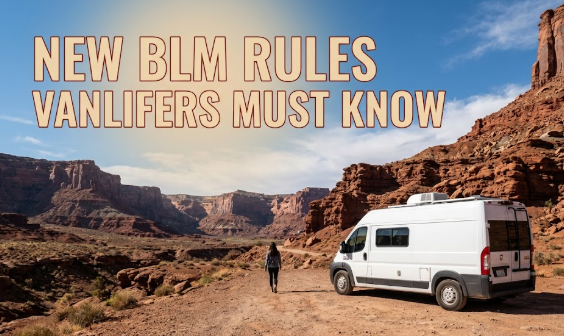
The 14-day rule isn’t the rule anymore. Not everywhere, anyway.
For years, vanlifers treated dispersed camping on BLM land like a known quantity. Fourteen days, move 25 miles, repeat. That number got repeated so often in Facebook groups and YouTube videos that it started to feel like federal law carved in stone. It still applies in most places. But over the last eighteen months, a handful of field offices and ranger districts quietly rewrote what “dispersed camping” actually means on the ground, and a lot of people are still planning trips around rules that no longer match reality in those specific spots.
This isn’t a doom-and-gloom piece about public land disappearing. It mostly hasn’t. What’s changed is that the rules now vary a lot more by location than they used to, and the gap between what people assume and what’s actually posted on a kiosk sign has gotten wider. That gap is where citations happen.
1. The Federal Default Hasn’t Moved, But It’s Not the Whole Story
The baseline is still the same one BLM has used for decades. Dispersed camping is generally capped at 14 days within any 28-day period, and after that you’re expected to relocate, typically 25 to 30 miles, before returning to the same general area. No permit, no fee, no reservation. That’s still accurate for most BLM land in Nevada, Utah, Wyoming, and a good chunk of Arizona and California.
Where it gets complicated is that “most” isn’t “all,” and individual field offices have always had the authority to layer on supplementary rules. That authority hasn’t changed. What’s changed is how many offices are actually using it now, because visitor numbers in popular boondocking corridors have climbed fast enough that the old first-come, first-served system started breaking down in specific pockets.
So the federal default is your starting assumption. It’s not your only assumption anymore.
2. Where the Rules Have Actually Tightened
A few examples are worth knowing by name, because they show the pattern other offices are likely to follow.
Tahoe National Forest changed its dispersed camping limit to 14 days per calendar year, per ranger district, not 14 days per stay. That’s a meaningful difference. Under the old framework, you could theoretically camp 14 days, move on, and come back later in the season for another 14. Under the new framework, once you’ve used your 14 days in that district for the year, you’re done until January.
Angeles National Forest went further. Camping outside developed campgrounds is capped at seven consecutive days, there’s a 300-foot no-camping buffer from any road, and there’s an annual cap on total camping days in the forest. The 300-foot rule sounds minor until you remember that most informal boondocking spots exist precisely because they’re easy to reach from a road. That buffer quietly eliminates a large share of the pullouts people have used for years.
Mittry Lake Wildlife Area near Yuma, Arizona shifted from a flat 10 days per calendar year to the more standard 14 days within a 28-day period, which is actually a loosening, not a tightening, but it’s a good example of how these changes go in both directions depending on the office.
Sedona has closed several dispersed camping areas outright due to overcrowding and resource damage, with active enforcement rather than just signage. And a federal court order closed more than 2,000 miles of off-highway vehicle routes in the Mojave Desert, which cuts off access to a lot of remote camping spots that depended on those routes to reach them.
None of this is a nationwide shutdown. It’s closer to a patchwork, and the patchwork is getting denser.
| Location | Old Rule | Current Rule (2026) |
|---|---|---|
| Standard BLM land (most western states) | 14 days / 28-day period | Unchanged |
| Tahoe National Forest | 14 days per stay | 14 days per calendar year, per district |
| Angeles National Forest | General dispersed camping | 7 consecutive days, 300-ft road buffer, annual cap |
| Mittry Lake Wildlife Area (Yuma, AZ) | 10 days / calendar year | 14 days / 28-day period |
| Select Sedona dispersed sites | Open dispersed camping | Closed, actively enforced |
We pulled this from official field office orders and BLM.gov listings while researching for Budget Van Journeys, and it’s worth saying plainly: this table will be out of date faster than we’d like. Treat it as a snapshot, not a permanent reference.
3. Here’s Where People Usually Get This Wrong
The biggest misconception isn’t about the rules themselves. It’s the assumption that “dispersed camping is still allowed here” means the same thing it meant five years ago. Technically, in a lot of these tightened areas, dispersed camping IS still allowed. But what counts as compliant has narrowed so much that the practical experience is completely different. You can follow the letter of “dispersed camping is permitted” and still be in violation of the specific limit, buffer, or annual cap that applies to that exact district.
The second mistake, and we see this constantly in vanlife groups, is the idea that moving a short distance resets your clock. Pull forward 100 yards, technically a new GPS pin, and people assume that counts as relocating. In districts with stricter enforcement this is increasingly being treated as the same stay, not a new one. Rangers aren’t naive about this trick, and citations for it have gone up in high-traffic areas.
And here’s a smaller one that trips up newer vanlifers specifically: assuming that because a spot showed up on Free Overnight Parking Apps That Actually Work or a similar app, it’s automatically current. Apps are built from crowdsourced data. A review from 2022 carries the same weight as one from last month unless you sort by date, and a lot of people don’t.
If there’s one habit worth building before any trip onto BLM or National Forest land, it’s calling or checking the specific field office page for that district before you go. Not the general BLM.gov overview. The local one.
4. How to Actually Plan Around This
Realistically, here’s what changes in your planning process.
First, identify which field office or ranger district you’re heading into, not just which state. Rules are set at that level, and two districts in the same state can have completely different limits.
Second, check for supplementary orders specific to that district, especially anything posted in the last 12 months. These often aren’t reflected yet in older blog posts or app reviews, which is exactly why so much outdated information is still floating around.
Third, build in backup spots. We’ve said this before on Budget Van Journeys and it’s becoming more true every season: never arrive with only one plan. Have a spot A, B, and C, especially in popular corridors near Sedona, Moab, or the Sierra foothills where closures have been most active.
Fourth, if you’re someone who treats specific BLM areas as a long-term base rather than a quick stop, this is worth reading alongside our piece on Best US States for Van Life 2026, since some of the states with the most available public land are also the ones seeing the least restriction so far.
One side note, and this is admittedly a tangent but it matters: a lot of the tightening we’re seeing isn’t really about vanlifers specifically. It’s about volume. Land managers aren’t singling out van-dwellers as a category, they’re responding to total visitor numbers, trash, and fire risk across all user types, RVs, tent campers, OHV riders, everyone. It just happens that the response lands hardest on people relying on dispersed camping as a primary lifestyle rather than an occasional weekend trip. Anyway. Back to planning.
Fifth, and this one’s easy to skip, read the actual posted signage at the site itself. Supplementary rules sometimes get implemented faster than they get updated online, and the kiosk at the trailhead is often more current than what you’ll find through a search engine.
5. If You’re Living in Your Van Full-Time, Not Just Visiting
This is where the stakes go up. A weekend camper who gets it wrong eats a warning or, worst case, a citation. Someone living full-time off dispersed camping who gets it wrong can lose their actual home base with very little notice, which is a different category of problem entirely.
If BLM land is your primary strategy rather than a backup option, it’s worth diversifying. Long-Term Visitor Areas in places like Quartzsite operate on a permit system specifically built for extended stays and are far less exposed to the kind of overnight rule changes we’ve covered here. We’ve also written about Where to Sleep in a Van for Free more broadly, covering options beyond BLM land specifically, which is worth a look if you’re trying to build redundancy into your routine rather than relying on one type of land entirely.
The honest answer is that full-time dispersed camping on BLM land is getting harder to do casually. It’s not getting impossible. It’s getting more like a skill that requires actual upkeep, checking field office bulletins the way you’d check weather before a storm.
Vanlife was never really about ignoring the rules. It was about knowing them well enough to use the space you’re legally allowed to use, fully. That hasn’t changed. What’s changed is how often you need to check.
FAQs
Is the 14-day rule gone? No. It’s still the standard default on most BLM dispersed camping land. What’s changed is that a growing number of National Forest ranger districts and specific BLM field offices have replaced it with stricter local rules, so the 14-day figure can no longer be assumed to apply everywhere.
Can I just move a short distance and reset my stay? In districts with active enforcement, no, or at least not safely. Moving 100 yards within the same general area is increasingly treated as the same stay rather than a new one. The 25 to 30 mile relocation standard is the safer benchmark.
Are these changes specific to van lifers? Not directly. The tightening is mostly a response to total visitor volume, trash, and wildfire risk across all types of users. Vanlifers and full-timers just tend to feel the impact more because dispersed camping is often their primary housing strategy rather than an occasional trip.
How do I find out if my destination has new restrictions? Check the specific field office or ranger district page, not the general BLM overview page. Supplementary orders are posted there first and often don’t make it into apps or older blog posts for months.
Is BLM land still worth relying on for budget van living? Yes, for most of the West. The core system hasn’t collapsed. It just rewards people who check local rules before arriving rather than relying on what worked last year.
For the most current district-specific orders before any trip, the BLM’s own camping page at blm.gov is still the best place to start, even with all the local variation we’ve covered here.