
The Sprinter has its own mythology in van life circles. Its own Instagram aesthetic, its own subreddit, its own sort of gravitational pull on people who are just starting to think about a build. And honestly, for a budget build, a lot of people have no business buying one.
That’s not a criticism of the van. As a piece of engineering it’s well-suited to life on the road. But the cargo van vs Sprinter debate gets muddied badly when nobody properly accounts for what these vehicles actually cost, not just to buy, but to run, to fix, and to build out. So let’s work through it properly.
1. The Purchase Price Gap Nobody Actually Prepares For
A used Mercedes Sprinter with under 150,000 miles and a clean-ish service history is going to cost you somewhere between $18,000 and $30,000 right now. Yes, you can find cheaper. A 2007 with 220k miles might come in at $10,000 or $11,000, but then you’re also buying a van with a complicated history and a diesel emissions system that may already be tired.
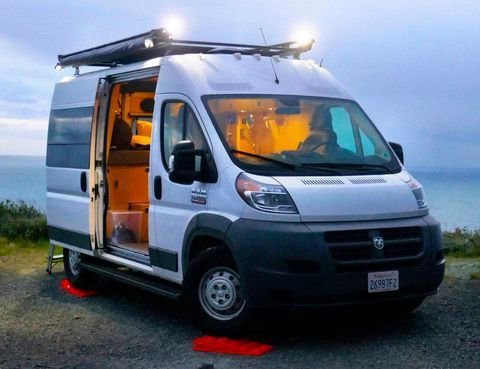
Cargo vans play in an entirely different bracket. A 2016 Ford Transit 250 high-roof with 120,000 miles sits in the $12,000-$16,000 range. A Ram ProMaster 2500 from around 2014-2015 with similar mileage regularly turns up between $7,000 and $11,000. Go back a few more years on the ProMaster and you’re finding solid examples in the $5,000-$7,000 range, which changes the whole calculation.
The Chevy Express, often overlooked in these discussions, can be bought for $4,000-$8,000 in usable condition. Any mechanic in any mid-sized town will know that platform inside and out.
The gap between a cargo van and a Sprinter purchase price is frequently $10,000 to $15,000. That’s not a rounding error. That’s your entire build budget. Over at Budget Van Journeys, the consistent pattern among people who’ve actually done this is that what you spend acquiring the van directly determines how good your living space ends up. Spend the whole budget on the vehicle, and you’re doing a compromised conversion forever.
2. What You Actually Get Inside Each Van
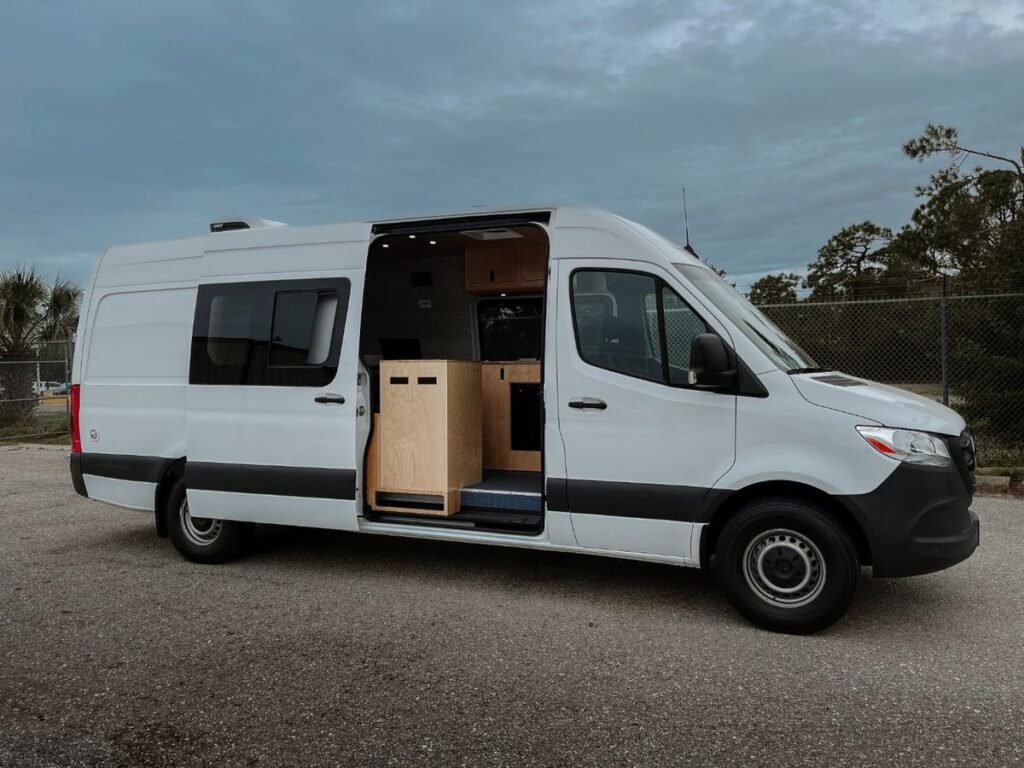
The Sprinter’s biggest selling point is headroom. A high-roof Sprinter gives you roughly 73 inches of interior clearance, which is real standing room for most adults. This is the argument that gets made constantly, and it’s fair. But it’s less decisive than it used to be.
The Ford Transit 250 high-roof comes in at around 72.4 inches of interior height. That’s less than an inch less than the Sprinter. The Ram ProMaster high-roof lands at around 65 inches, a genuine step down, but still enough that most people can stand without ducking. If standing room is the primary reason you’re looking at a Sprinter, the Transit closes that gap almost entirely.
Width is more interesting. The Sprinter has rear wheel wells that eat into the floor space, leaving roughly 55.5 inches of usable width between them. The Ford Transit is similar at about 56.4 inches. The Ram ProMaster is noticeably different: around 60.1 inches between wheel wells, one of the widest flat floors in this class. That translates directly to sleeping width when you’re building a crossways bed platform.
| Feature | Mercedes Sprinter (High Roof) | Ford Transit 250 (High Roof) | Ram ProMaster 2500 (High Roof) |
|---|---|---|---|
| Interior height | ~73″ | ~72″ | ~65″ |
| Floor width (between wheel wells) | ~55.5″ | ~56.4″ | ~60.1″ |
| Used purchase price (100k miles) | $18,000-$30,000 | $12,000-$16,000 | $7,000-$12,000 |
| Engine type | Diesel | Gasoline | Gasoline |
| Mechanic availability | Specialist often needed | Most shops | Most shops |
| Common problem areas | DEF system, NOx sensors | Timing belt (3.5L), rust | Transmission, front axle |
| Drive configuration | Rear-wheel drive | Rear-wheel drive | Front-wheel drive |
The ProMaster also has a fully flat cargo floor with no rear wheel humps, which the Sprinter shares. The Transit does not: those wheel wells punch up into the floor on both sides, and you’ll be building around them. For platform beds and under-bed storage, it’s a real practical difference.
3. Running Costs Once You’re Actually on the Road
The Sprinter is a diesel, and that matters more than most budget build guides acknowledge.
Diesel efficiency is real. A Sprinter on a long highway stretch can return 18-22 mpg depending on load and conditions. A gas Transit or ProMaster is more likely to come in at 14-17 mpg. Over 20,000 miles of road travel, that’s a meaningful fuel saving, maybe $700-$1,000 depending on where diesel and gas prices sit.
But then there’s the DEF system.
Diesel Exhaust Fluid is the emissions management system on modern Sprinters, and it has a documented failure pattern that catches budget builders completely off guard. The NOx sensor, the DEF heater, the SCR catalyst: any of these can fail on a higher-mileage van, and repairs run between $1,500 and $4,000 at a shop that knows the platform. On pre-2018 models especially, this is well-documented in owner communities and not a rare outlier.
A gas Transit or ProMaster with a standard V6 can be serviced at almost any independent shop in the country. Parts are abundant and priced accordingly. If you break down in rural New Mexico or a small Georgia town, a garage that can handle your cargo van is far easier to find than one with Sprinter diesel diagnostic experience and the relevant parts on the shelf.
The real monthly cost numbers for van life in 2026 include maintenance contingency, and that contingency is noticeably higher for a diesel Sprinter than for a gasoline cargo van. Factor that in before you get seduced by the mpg figures.
4. Where Budget Builds Go Wrong (This One’s Worth Sitting With)
Van life content skews Sprinter. The builds that photograph beautifully, that get a million views on YouTube, that define the visual language of the lifestyle, almost always happen in high-roof Sprinters with white oak shelving and pendant lighting. They look brilliant. They also frequently cost $40,000-$80,000 all in, sometimes more.
They are not budget builds.
The problem is that people absorb this aesthetic before they’ve run any numbers, fall in love with the Sprinter specifically, then try to retrofit a budget onto a non-budget starting point. What happens is predictable: the van purchase leaves so little for the conversion that the build gets cut down, corners get rounded off, and the person ends up in a more expensive vehicle with a worse interior than they’d have had if they’d bought a ProMaster for $8,000 and spent $4,000 on the build.
This is the single most common pattern in the reason most first-time van builders overspend. The vehicle becomes the statement piece instead of a practical shell to build a home inside.
A cargo van with a properly planned conversion, decent insulation (the kind that actually works in cold weather, not just Instagram-approved sheep wool on the walls), a solid bed platform, and a thought-through electrical setup will be a more liveable space than a Sprinter with a rushed $3,000 conversion done after spending $24,000 on the van. That’s just the arithmetic.
A DIY solar setup under $300 is entirely achievable in a cargo van build. So is a proper insulated panel setup, a real kitchen configuration, and comfortable storage. None of that requires a Sprinter.
5. Which Van Actually Makes Sense for a Budget Build
The honest answer is situational, but the ranges are clear enough to be useful.
If your total budget (van plus conversion) is under $15,000, buy a cargo van. There’s no version of the math where buying a Sprinter leaves you with enough for a functional build at this budget level. A Ford Transit high-roof or Ram ProMaster in the $8,000-$11,000 range leaves $4,000-$7,000 for the conversion, which is workable if you’re methodical.
If your total budget is closer to $25,000-$30,000 and you can find a genuinely well-maintained Sprinter in the $15,000-$18,000 range, with a documented service history and no current DEF issues, the calculation shifts. You’d have $10,000-$15,000 for a build, which is real budget. At that point the Sprinter’s strengths, particularly the headroom and established parts ecosystem for specific issues, become more relevant. But that budget also isn’t really a budget build in the Budget Van Journeys sense of the term; it’s mid-range.
The Chevy Express is worth a dedicated mention because it barely appears in this conversation despite being a genuine option. Old, simple, cheap to buy, and serviced by any shop in the country. The standard-roof interior height is limiting (you won’t stand up), but for someone doing a primarily weekend or seasonal build, or building a stealth setup in a vehicle that looks entirely unremarkable, an Express in the $5,000-$7,000 range with $3,000-$4,000 in build materials can produce a perfectly good result.
The complete beginner build guide on Budget Van Journeys goes through the specific questions to ask when you’re buying used, regardless of which platform you choose. It’s worth working through before you commit.
FAQs
Can you actually stand up in a cargo van?
In a high-roof version, yes for most people. The Ford Transit high-roof has about 72 inches of interior clearance, which works for adults under 6’1″ or so. The Ram ProMaster high-roof sits around 65 inches, a step down. Standard roof cargo vans, including the standard Transit and most Chevy Express models, give you roughly 51-54 inches, so crouching is the reality there.
Is a Sprinter worth the price premium for a budget build?
Not if the van purchase leaves you with under $5,000 for the conversion. The interior of your van, the insulation, the bed, the electrical, the kitchen, is what you actually live in every day. A Sprinter shell with a cut-down build because the money ran out is a worse living situation than a ProMaster with a complete, properly planned conversion. The vehicle is a means to an end.
What’s the cheapest cargo van to buy and maintain long-term?
The Chevy Express G2500 and G3500 consistently come up in this category. Parts are inexpensive, mechanics everywhere know the platform, and the 6.0L Vortec V8 that powers the later models has a well-regarded reputation for longevity when maintained. You’re sacrificing headroom in exchange for simplicity and cost, which is a real trade-off to weigh against your priorities.
How serious are the DEF system issues on used Sprinters?
Serious enough to budget for specifically. On pre-2018 models especially, failures in the NOx sensor, DEF heater, or SCR catalyst are documented and not rare on higher-mileage examples. These aren’t $200 fixes. If you’re buying a used Sprinter, either have the emissions system inspected thoroughly beforehand or set aside $2,000-$3,000 in contingency for it. Some buyers specifically look for Sprinters with recent DEF work completed as a condition of purchase.
Can the Ram ProMaster genuinely compete with a Sprinter for full-time van life?
More than it gets credit for. The ProMaster has the widest flat floor in its class, a reliable Pentastar V6 (or available diesel) that any garage can service, and a high-roof option that gives real standing room. The front-wheel-drive setup is the main criticism, and it’s fair for anyone planning serious off-pavement travel or winter driving in difficult conditions. For most people staying on paved roads, it’s a non-issue, and the purchase price difference over a comparable Sprinter frequently covers months of living expenses on the road.
The math on this is fairly clear from a budget standpoint. The Sprinter earns its reputation in certain contexts, and for a well-funded build it’s a capable and well-suited platform. But if the vehicle purchase is going to compromise the quality of what you build inside it, the comparison isn’t really Sprinter versus cargo van. It’s a half-finished build versus a complete one.