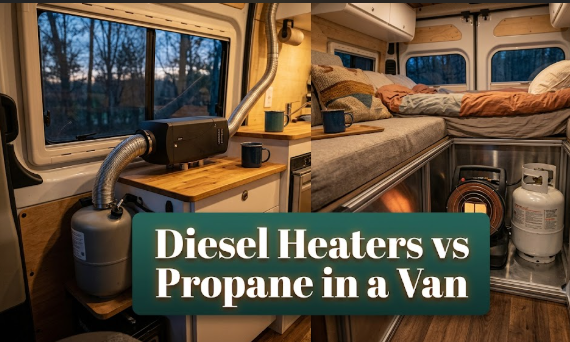
The misconception I kept seeing in van life groups, and it comes up constantly, is that propane is a perfectly reasonable heating choice for full-time winter van living as long as you “crack a window.” That’s the advice that gets passed around like it settles the debate. Crack a window, you’re fine.
The people saying it aren’t wrong about ventilation being necessary. They’re wrong about what ventilation actually fixes, and what it doesn’t.
This comparison matters more than most people realise when they’re planning a build, because the heating decision shapes the entire cold-weather experience. Get it right and winter van life is genuinely comfortable. Get it wrong and you’re spending every night doing arithmetic about whether you’re warm enough, damp enough, and safe enough, all at the same time.
1. What Each System Is Actually Doing
The core difference between a diesel heater and a propane heater in a van isn’t price or fuel type. It’s where the combustion happens.
A diesel parking heater, whether that’s a budget Vevor or Hcalory unit, an Autoterm, or a Webasto at the higher end, draws air in from outside, combusts the diesel in a sealed chamber, and exhausts all the combustion gases back outside through a dedicated exhaust pipe. The warm air that circulates through your van is completely separate from the combustion process. It never touches the exhaust gases. A properly installed diesel heater produces no carbon monoxide inside your living space, and, critically, no moisture either.
A propane heater like the Mr. Heater Big Buddy burns fuel inside the van. The combustion happens in the same space you sleep in. Modern catalytic propane heaters are designed to minimise carbon monoxide output, and they’re reasonably good at it, but CO is only one combustion byproduct. The other is water vapour, and nothing about the catalytic process reduces that.
So the “crack a window” advice is partly addressing CO risk. What it’s not addressing, or not adequately, is the moisture those combustion byproducts release into your living space every hour the heater runs.
Here’s how the two systems compare across the things that actually matter for van use:
| Feature | Diesel Heater | Propane (Unvented Catalytic) |
|---|---|---|
| Combustion location | Sealed chamber; exhaust exits van | Inside the van’s living space |
| CO risk inside van | Minimal when correctly installed | Low but present; requires ventilation |
| Moisture output | None | High (water vapour from combustion) |
| Electrical requirement | Yes, 10 to 30W continuous | No (ignition only on most models) |
| Upfront cost | $80 to $400 (budget), $800+ (premium) | $50 to $150 |
| Ongoing fuel cost | Low (diesel, tapped from main tank or aux) | Moderate to high (canisters or bulk propane) |
| Installation complexity | High (fuel line, exhaust pipe, intake) | Very low (connect and use) |
| Best suited for | Full-time cold-weather van living | Weekend use, shoulder season |
2. The Fuel and Cost Reality
On the surface, propane wins on upfront cost. A Mr. Heater Big Buddy sits around $80 to $100. A budget Chinese diesel unit is $150 to $250 by the time you’ve got the heater, controller, and basic install kit.
But the ongoing fuel maths work the other way.
A 1lb disposable propane canister lasts roughly three to six hours at moderate output. On a properly cold night, you’ll burn through at least one and a half canisters just to stay comfortable through to morning. At around $6 per 1lb canister from most outdoor stores, that’s $9 a night, which starts to feel significant after a week or two. Running a 20lb bulk tank through an adaptor hose cuts the per-BTU cost considerably, and anyone using propane for heating regularly should make that switch, but it still doesn’t match diesel.
A budget diesel heater on a medium setting burns roughly 0.1 to 0.2 litres of diesel per hour. Eight hours overnight is 0.8 to 1.5 litres. At current diesel prices that’s $1.50 to $2.50, and often less if you’re filling from the van’s main tank. The savings across a three-week winter trip are real. The kind of slow-drip spending that adds up quietly is exactly what the 5 van life budget mistakes that cost you more guide covers, and heating fuel is a textbook example of it.
There’s one cost people consistently miss on the diesel side: the electrical draw. The glow plug, fuel pump, fan, and control board run continuously while the heater is on. A budget unit draws between 10 and 30 watts, meaning an overnight run costs 80 to 150 watt-hours from your battery bank. In summer with long solar days that’s trivial. In winter with four hours of weak sun and cloud cover, that’s a real consideration. If your battery bank is modest, it’s worth running the numbers through the DIY van solar setup for under $300 calculator before committing to a diesel heater as your primary system.
3. The Moisture Problem That Gets Underestimated
This is where propane loses its case for full-time winter use, and it’s consistently underexplained in the communities where newer van lifers look for advice.
Propane combustion produces water. For every kilogram of propane burned, the combustion process releases roughly 1.6 kilograms of water vapour into the air. In a small, insulated van, that’s a meaningful humidity load every single hour the heater runs. The air feels warm. It also feels fine, because the body doesn’t read humidity as a problem until it condenses. And condensation happens the moment that warm, humid air hits a cold surface.
In a well-ventilated van with a roof vent actively running, some of that moisture gets pulled out. But “some” is the key word. On a winter night when it’s -5°C outside and you’re trying to stay warm, the exchange rate between ventilated-out moisture and combusted-in moisture tilts against you.
The visible condensation on the windows is only part of it. The moisture that isn’t on the glass goes somewhere else. It finds the cold metal ribs behind your wall panels. It settles on the insulation inside your cavities. It works its way under your floor ply. Mould follows, slowly, in places you won’t see for months.
And here’s where I’ll admit I’ve watched people do everything technically right with propane, a roof vent running all night, windows cracked an inch on both sides, even a small dehumidifier on the bench, and still come back from a long winter trip with mould behind the panels. The combustion throughput on a catalytic heater running overnight is just that high. There are workarounds. Diesel removes the problem entirely.
The Budget Van Journeys community hears this story more often than any other heating-related one. Beautiful first builds, a winter’s worth of propane heating, and black mould found when the panels come off in spring. It’s not a build failure. It’s a heat source mismatch.
4. Where Diesel Installations Go Wrong
Diesel heaters are not immune to problems. The budget units especially have failure modes, and most of them trace back to the installation rather than the unit itself.
Fuel line routing is the most common issue. The silicone tubing in cheaper install kits isn’t rated for the same conditions as copper or reinforced line. Routed near a heat source, crimped at a sharp bend, or left unsupported near moving parts, it’ll degrade or leak eventually. Diesel leaking onto a hot exhaust surface is not a good situation. This isn’t a reason to avoid budget units, but it is a reason to spend an extra thirty minutes on the fuel line installation and use quality fittings.
Exhaust clearance matters too. The exhaust pipe on a diesel heater gets genuinely hot, and it needs to exit the van with clearance from painted bodywork, rubber seals, and composite surfaces. A lot of DIY installs route it through the floor, which is a clean solution, but the exit point where the pipe passes through the van body needs a proper heat shield or it’ll scorch the surrounding material over time.
Startup failures are the other one. A diesel heater that throws an error code on its first or second cold start in winter isn’t necessarily faulty. It’s a system that needs time to prime in cold conditions, particularly at higher altitudes where the fuel pump has to work harder. The fix is almost always a second or third startup attempt with the glow plug getting more time to work. People panic and assume they’ve bought a dud, return the unit, and then repeat the experience with the replacement. Running the first couple of startups somewhere low and warm, at sea level in mild temperatures if possible, avoids most of those early issues.
If you’re still working out where heating fits into your overall build budget, the van build under $5,000 guide has a realistic breakdown of how heating costs stack against everything else in a first budget build.

5. Which One Actually Makes Sense for Your Setup
Propane makes sense for van lifers who are out for weekends, shoulder-season trips, and situations where temperatures aren’t consistently below freezing. If you’re in the van forty nights a year between April and October, and you’re not regularly camping at altitude in genuinely cold air, a Mr. Heater and a couple of bulk propane tanks with an adaptor hose is a practical, low-effort setup. The moisture accumulation isn’t building across enough consecutive nights to cause real structural damage.
Diesel makes sense for anyone spending real time in the van through winter. Full-timers, extended road trippers, people who like cold-weather camping in the mountains: the elimination of the moisture problem alone justifies the installation effort. The fuel savings over a full season make it cheaper than propane fairly quickly. And the comfort difference, the ability to run the heater overnight without thinking about it, without cracking windows in freezing temperatures, without CO sensor checks, is significant.
Actually, a brief aside here: I’ve spoken to people who bought used camper vans with diesel heaters already fitted and considered swapping to propane because they found the diesel unit noisy at certain settings. That’s a different conversation entirely, because it’s about unit selection rather than fuel type, but it’s worth knowing that modern budget diesel heaters are quieter than they used to be, and the noise at idle is close to a gentle hum rather than anything that disturbs sleep.
The thing that holds people back from diesel, consistently, is that the installation feels permanent. You’re cutting into the van floor or undercarriage for the exhaust, routing fuel lines, mounting a unit. But most people who’ve done it describe it as a four to six hour job on a weekend, and it’s genuinely one of those things that feels more intimidating in the planning than in the doing.
For an honest account of what winter van life actually feels like, including the heating side of it, van life in winter: what cold really feels like is worth reading before you commit to either system.
FAQs
Is it safe to use a propane heater overnight in a van?
Catalytic propane heaters are designed for use with ventilation, and modern ones include CO auto-shutoff features. That said, overnight use in a sealed van relies entirely on that sensor working correctly, your ventilation staying effective throughout the night, and the catalytic element remaining efficient. Most experienced full-timers don’t use unvented propane as a primary overnight heat source in genuinely cold conditions, and the moisture problem on extended trips is reason enough to reconsider regardless of the CO question.
Do cheap Chinese diesel heaters actually work reliably?
Yes, with a proper installation. Brands like Vevor, Hcalory, and unbranded “diesel parking heater” units from online marketplaces use comparable internals to some more established names. They’re not Webasto quality, the controller software can be quirky and error codes are more common, but they produce real heat reliably for most of their lifespan. The failure rate is higher than premium units, but at a quarter of the cost the risk-to-reward ratio is reasonable for budget builds.
How much diesel does a van heater use overnight?
On a medium setting, roughly 0.1 to 0.2 litres per hour. A full overnight run of eight hours uses between 0.8 and 1.5 litres of diesel. In a week of winter camping that’s somewhere between 6 and 10 litres, which at current diesel prices comes to $9 to $15. Across a full winter season of regular use the total adds up, but it’s substantially less per BTU than propane canisters.
How bad is the moisture from propane combustion in a small van?
Worse than most people expect before they experience it. One hour of moderate catalytic propane combustion can release close to half a litre of water vapour into the van’s air. With a good roof vent running you’re managing it, not eliminating it. Over a multi-week winter trip with the heater running every night, the moisture that doesn’t exit through the vent accumulates in wall cavities and insulation layers where it becomes a mould problem months before you can see it.
What’s a realistic total cost for a diesel heater installation in a van?
Budget $150 to $250 for the heater unit if going with a budget brand. Add $30 to $50 for quality fuel line and fittings (worth not skimping on), $30 to $60 for a small auxiliary fuel tank if you’d rather not tap the main fuel line, and around $15 to $25 for exhaust hardware and grommets if they’re not included in the kit. A solid budget diesel installation can be completed for $200 to $350 all in. Premium brands like Webasto or Espar start at $800 to $1,000 for the unit alone, before installation labour.