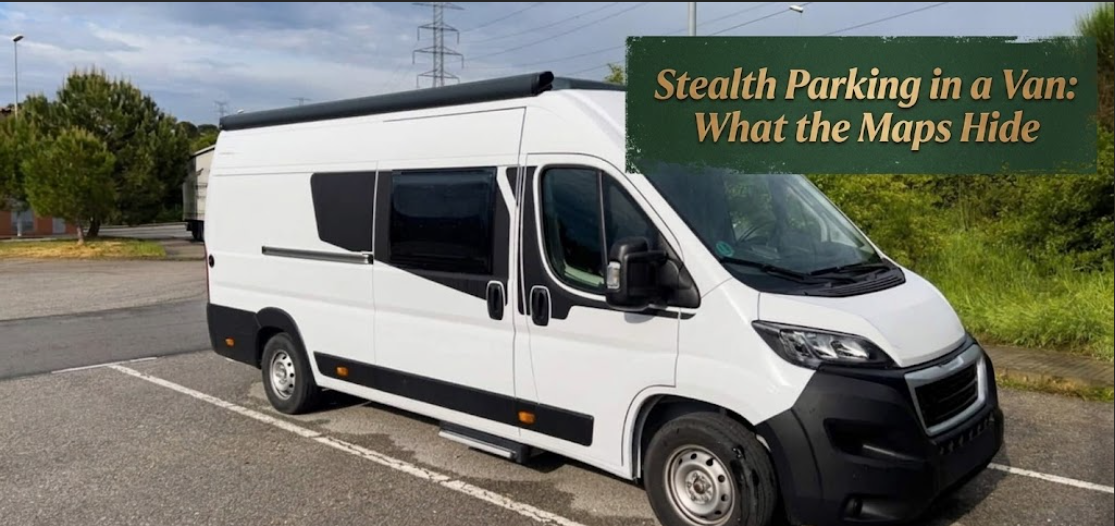
The pin says “good stealth spot, used three times, no issues.” You arrive at 10:45pm, kill the engine, wait a few minutes. At 6:08am there’s a security guard tapping your windscreen.
The spot was fine. Last summer. Before the office park next door extended its patrol hours.
That’s the core problem with stealth parking maps: they record the past. Every pin, every crowdsourced check-in, every “highly recommend” posted in a van life forum is a snapshot of how one location behaved on one night, in one season, probably months before you got there. The physical street is the same. The context surrounding it is not necessarily the same at all.
1. What Mapping Apps Can and Can’t Actually Tell You
Good apps do real work. Freecampsites, iOverlander, and the four free camping apps that Budget Van Journeys tested in detail all surface spots that are genuinely useful, and if a location has thirty positive check-ins across eighteen months, that’s meaningful signal. Not a guarantee. But meaningful.
The problem is structural. Maps record fixed data about dynamic situations. A spot can have excellent reviews from April and be completely unusable in December because a seasonal business opens nearby. A Walmart that quietly allowed overnight parking for years can change its national enforcement policy overnight with no public announcement. The apps won’t catch up for months, sometimes longer.
What the maps cannot show you:
What mapping apps cannot capture:
- Permits or restrictions added since the last review
- Business hours changes for nearby premises
- Seasonal security patterns at office parks and commercial areas
- Whether a neighbourhood watch has become more active
- Garbage and delivery vehicle schedules (often 5am)
- Lighting conditions at 2am versus when the reviewer arrived at 10pm
- Whether the "quiet" street is quiet most nights or just the three nights someone checked in
There’s a subtler issue too. The people who review stealth spots are self-selecting. Vanlifers who had a bad experience often don’t return to the app to leave a note. They moved on, stressed. So the average rating for crowdsourced spots tends to overstate reliability. The database skews positive not because people are dishonest, but because the people who’d balance it out rarely come back.
2. The Residential Street Assumption
The most repeated stealth parking advice in van life circles is to find quiet residential streets, park like you belong, keep lights off, and be gone by 7am. It’s not wrong. But it’s incomplete in ways that actually matter.
Residential streets vary enormously in how they handle unknown vehicles overnight. Some neighbourhoods barely register it. Others have active neighbourhood watch schemes where an unfamiliar van parked two nights running will generate a welfare check or a low-level complaint call before the third morning. You don’t always know which type of street you’re on until you’ve already committed.
Permit zones are the thing most residential street advice glosses over. In many cities across the US, increasingly in parts of Europe, and extensively across the UK, residential overnight parking requires a zone permit during certain hours. These restrictions aren’t always obvious from street signage, especially in low light. Getting it wrong means either a ticket or a knock from a warden at 7am, depending on how the area is enforced. Checking the city’s parking authority website before you arrive in a new area takes about four minutes and saves a lot of unpleasant surprises.
And then there’s simple pattern recognition from residents. One night is a visitor. Three nights in the same spot is something a neighbour notices and wonders about. Moving on after one night on any residential street, regardless of how welcoming it seems, is a habit worth building early. Knowing which states have the most van-friendly overnight policies overall helps you make smarter location choices long before you’re trying to read a specific street at midnight.
3. Vehicle Stealth vs. Behavioural Stealth
Most van life stealth content focuses on the vehicle itself. Blacked-out windows, no van life stickers, unmarked white or grey panels. These things help. They’re worth doing.
But behaviour is what actually gives people away far more than appearance.
Lights visible inside at 11pm through a tiny gap in the blackout curtain. Running the engine for twenty minutes at 1am because it’s cold and the diesel heater fuel level wasn’t checked. Using the side door repeatedly during the night. Staying in the same residential spot for four days. These are the signals that generate curiosity or concern, not the fact that the vehicle is a Ford Transit.
Nobody calls in a plain white cargo van for being white. They call it in because there’s been a visible light on inside every night for a week and it hasn’t moved.
The practical version of this rule is simple: once you park, you’re done for the night. No unnecessary going in and out, no visible interior lighting, no engine running unless absolutely necessary. If your build has reliable off-grid solar and a heating setup that doesn’t require you to run the engine, this becomes considerably easier to manage across different seasons. But it’s the behaviour side that most stealth guides treat as secondary, and that’s consistently backwards. A well-converted van with poor habits will attract attention faster than a rough build with good ones.
4. Reading a Spot Before You Commit
This is the actual skill. The one no map can give you.
Before committing to a spot, do one slow drive-through first. Not a satellite image pulled up on the app. A physical pass down the street at normal driving speed. You’re looking for things that don’t show up in any database.
How are other vehicles arranged? Parking within a full row of vehicles is far less obvious than being the only one on an otherwise empty stretch. Is there commercial activity nearby that might operate at unexpected hours? A restaurant that looks closed at 10pm might have delivery arrivals at 4:45am. What’s the actual lighting like when you drive through, not what the satellite image suggested? A brightly lit spot may feel safer but draws more attention to any movement.
Read the signs properly. “No overnight parking 2am-6am” signs are genuinely easy to miss in the dark, and they’re common in cities that want to discourage vehicle habitation without banning parking entirely. East-facing spots mean direct sun on the windscreen from early morning, which is useful if you need to wake early and miserable if you want to sleep past 7. Churches, gyms, hospitals, school buildings: all have unusual early patterns that a quiet exterior at 11pm won’t reveal.
The other thing experienced vanlifers do is visit a potential spot in daylight before using it at night, even if it’s only a brief drive-past on an earlier leg of the day’s route. Satellite maps show the layout. They don’t show the context.
Here’s a practical checklist to run before settling any stealth spot:
QUICK STEALTH SPOT ASSESSMENT

Before you park for the night:
[ ] Done a slow physical drive-through (not just the app pin)
[ ] Read all visible parking signs, including small overnight restriction notices
[ ] Noted nearby commercial premises and likely activity hours
[ ] Checked whether van would be isolated or among other parked vehicles
[ ] Assessed lighting level - note any motion-sensor lights in range
[ ] Identified an exit route that doesn't require reversing or tight turning
[ ] Checked review recency on any app data you're relying on

Walk away if:
[ ] Only vehicle on the street
[ ] Signs with restriction hours that aren't fully legible in low light
[ ] Spot directly in front of a residential driveway or gate
[ ] Active construction or new residential development nearby
[ ] Any "private property" signage you cannot fully confirm as off-limits elsewhere
A lot of this becomes automatic after a few weeks. But in the first month, running through it deliberately prevents most of the situations that make stealth parking feel unreliable.
The maps are a starting point worth using, and Budget Van Journeys has covered the decision framework in detail, particularly when looking at the real cost difference between free and paid camping on an actual route. But crowdsourced pins are historical records, not live intelligence. The moment you start treating them as the latter, you’re relying on information that may be months out of date, written by someone whose situation differed from yours, and rated by a community that unconsciously under-reports bad experiences.
Learning to read a location for yourself is slower at first. It becomes the faster method.

Frequently Asked Questions
Someone knocked on my van at 2am. What should I do?
Stay calm, be polite, and have a simple explanation ready before you need it. “I was too tired to keep driving safely and pulled over” is honest, non-confrontational, and covers most situations. If it’s a law enforcement officer, comply fully, ask whether you need to move, and move without argument if asked. Most knocks at that hour are concerned residents or routine welfare checks, not enforcement actions, and they tend to resolve in under two minutes if you’re cooperative.
Are residential streets legally okay for overnight sleeping in a van?
In most US states, parking on a public residential street overnight is legal unless signage specifically prohibits it. But legal and untroubled are not the same thing. Some cities have vehicle habitation ordinances that sit on top of normal parking law and vary significantly by municipality, which means city-level research matters more than knowing the state-level position. The UK and much of Europe have considerably stricter rules in urban areas, so location-specific research applies there too.
How do you find spots that aren’t in any app?
Industrial areas on the edge of small towns are consistently underused. Business parks that close at 5pm with no overnight security. Streets immediately adjacent to popular camping areas, rather than the areas themselves, which tend to be obvious and watched. Quieter side roads near coastal or recreational zones where vanlifers cluster, but one level removed from the main spots. Looking just off the obvious locations gives you places with far less scrutiny and often more reliable access.
Does the van type make a meaningful difference to stealth?
Less than most people think. An unmarked cargo van in white, grey, or silver blends into most urban environments reasonably well because white cargo vans are everywhere in most cities for delivery and trades reasons. Window blackout coverage matters more than colour, and a maintained, clean exterior matters more than either. What genuinely undermines vehicle stealth is not the make or model but the visible accessories: roof racks, solar panels mounted externally, van life-branded products in the windscreen, or stickers that announce what the vehicle is used for.
How many nights can you stay in a stealth spot before it becomes a problem?
One night is the default for residential areas. Two nights maximum for commercial or industrial spots if you’re leaving early and the setup is clean. The principle is that you become more visible the longer you stay, and that the people who notice are more likely to act the longer the pattern continues. Dispersed camping land and national forest areas operate under different rules entirely and can allow stays of up to fourteen days in the same spot in many locations. For everything else, the practical guide is: move before anyone is certain you were there.