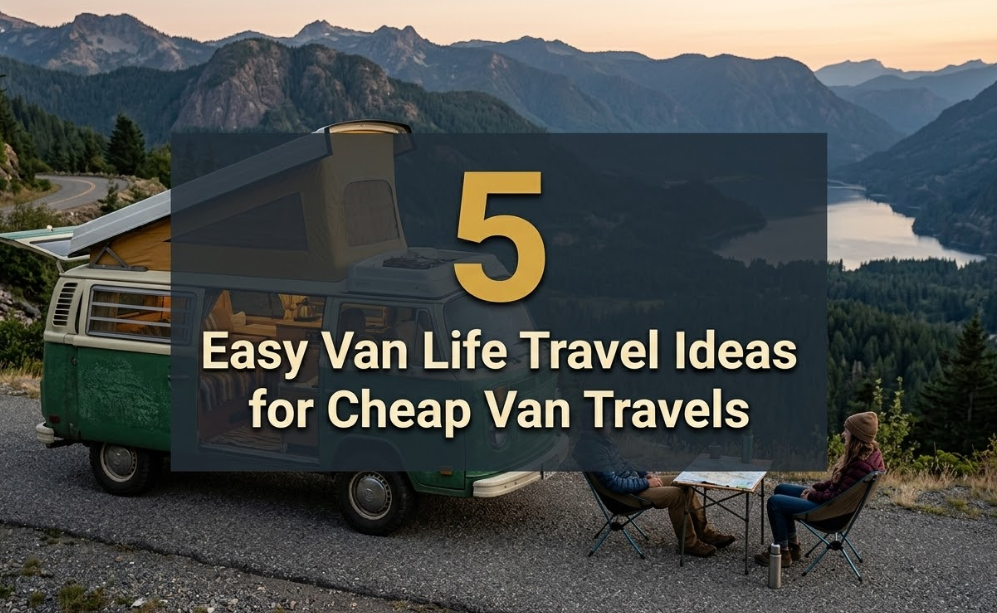
Waking up to a different view each day is a deeply liberating experience. No rent due. No alarm clock screaming. You and your van and the open road.
But here’s what everyone gets wrong about vanlife — they think it’s expensive. The truth? You can take some sweet van journeys on a budget of less than the price of a monthly Netflix subscription.
We’ve compiled five genuine, road-tested ideas for van journeys that leave your wallet satisfied and your spirit even more so. Whether you’re just getting started or have been living on wheels for some time, these ideas will inspire your next adventure.
Why Simple Vanlife Is Having a Major Moment Now
People are burned out. Housing is expensive. And more people are learning that a well-planned van rig can come with more freedom than 10 years of saving for a home.
Simple vanlife doesn’t mean living out of a luxury sprinter with a rooftop deck. For many, it’s about paring down — fewer possessions, less money needed to live, more experiences.
The appeal is real:
- Low overhead — no rent or mortgage
- Flexibility — relocate as you wish, and remain in locations you love
- Community — the vanlife community really is surprisingly welcoming
- Psychological reset — taking time away from routines alters your thought process
And when it comes to budget van journeys, you don’t need a trust fund to make them happen. You just need a plan.
What Constitutes a “Budget-Friendly” Van Journey?
Before we dig into the five journey ideas, let’s establish a baseline.
A budget van journey usually means:
| Category | Budget Target |
|---|---|
| Daily fuel cost | $10–$25 |
| Food per day | $10–$20 |
| Campsite or parking | $0–$15 |
| Activities | Mostly free or under $10 |
| Total daily spend | $30–$60/day |
That’s $900–$1,800 a month — usually less than the cost of a one-bedroom apartment in most U.S. cities.
The trick is to select routes and destinations that lend themselves to free camping, inexpensive fuel stops, and activities that don’t demand tickets or reservations.
Enough with the pleasantries — on to the meat and potatoes.
Journey 1 — The Pacific Coast Highway Slow Roll
Why This Route Isn’t Like Most on a Budget
The Pacific Coast Highway (PCH) from Northern California all the way down into Southern California is one of, if not THE most beautiful road trip in the world. The average person busts it out in a week. Vanlifers do it correctly — slowly, liberally, and affordably.
The best part about this route for budget van travel is the number of free or dirt-cheap places to camp along the way. California also has a surprisingly robust network of dispersed camping, Bureau of Land Management (BLM) land, and state beach campgrounds with low nightly fees.
Cheap Must-Stop Spots
Point Reyes National Seashore — Admission is free. Campgrounds with drive-in campsites less than $25 a night, and the coastline views are worth every penny.
Big Sur — Yes, it’s famous. Yes, it can be crowded. But pull off on a weekday morning and hike into the redwoods, and you’ll feel as though you have the whole place to yourselves. Many trailheads are free.
Jalama Beach — Lompoc’s little secret. A small county campground, not crowded at all, and the sunsets here will spoil you for anything else.
PCH Budget Breakdown (10-Day Trip Cost Estimation)
| Expense | Estimated Cost |
|---|---|
| Fuel (for ~600 miles) | $90–$130 |
| Campsites (free & paid mix) | $80–$150 |
| Food (cooking in the van) | $150–$200 |
| Activities & entrance fees | $30–$60 |
| Total Estimate | $350–$540 |
PCH on a Budget: Quick Tips
- Steer clear of weekends at popular attractions — you’ll pay top dollar and compete for space
- Stock up on groceries in larger towns before venturing into scenic stretches
- If you’re planning several national park visits, get a free America the Beautiful Pass — it pays for itself quickly
- To find free overnight camping spots, use free apps such as iOverlander and Campendium
Journey 2 — The Southern Utah Red Rock Loop
A Desert Is the Greatest Free Campground on Earth
If you’ve never driven through southern Utah, prepare to have your jaw permanently dropped. This part of the country has some of the most bizarre and alien-looking terrain on earth — and a massive amount of it is open Bureau of Land Management land that you can camp on for free.
The red rock loop generally includes Moab, Canyonlands, Capitol Reef, Grand Staircase-Escalante, and Bryce Canyon. You don’t need to tackle all of them, but each touches on a different aspect of your trip.
This is one of the best budget van trips in the U.S. because other than national park entrance fees, most of your time can be spent on free land with no hookups needed and no reservations required.
How to Structure This Loop
A 10–14 day loop works well. Begin and end in Moab or St. George. Go counterclockwise or clockwise depending on weather — spring and fall are optimum. Summer can get brutally hot; winter roads may close.
Moab Area — The entrance to Arches and Canyonlands. There is free BLM camping just outside of town. Arches National Park now requires timed entry reservations and costs less than $35 for a vehicle pass valid for seven days.
Grand Staircase-Escalante — This is where budget vanlifers really thrive. Huge BLM monument, miles of dirt roads, and free camping just about anywhere. The hiking is wild and unguided — all the better for it.
Capitol Reef — Most people skip it because it’s sandwiched between the more famous parks. Less crowded, more affordable, and few people know about the orchard (yes, an actual orchard) where you can pick fresh produce in season.
Desert Van Living Checklist
Living in a desert environment requires a bit more prep than coastal or forest travel.
- Water storage — Bring a minimum of 10–15 gallons. Water sources are sparse.
- Shade setup — Summer requires a reflective windshield cover
- Tire condition — The dirt roads in this area can be punishing. Check your tread.
- Extra fuel — Some legs have 60+ miles between stations
- Sunrise timing — Desert mornings are unreal. Set an alarm once.
Journey 3 — The Appalachian Highlands Budget Tour
The Adorable, Underexplored, and Underrated East Coast Vanlife
The bulk of vanlife content is about the West. But the Appalachian region — running from Georgia on up through Virginia, West Virginia, Tennessee, and North Carolina — is one of the most underserved destinations for budget van trips in the entire country.
The mountains here are ancient, weathered smooth by time, cloaked in forest. The towns are small, the people are friendly, and the costs are rock-bottom.
The Blue Ridge Parkway — The Slow Road Through the Mountains
The Blue Ridge Parkway is 469 miles of pure scenery, no commercial vehicles permitted, and a forced 45 mph speed limit that requires you to actually look around. It’s free to drive. Campgrounds en route are $20 or less per night.
Pull over at any overlook and you’re staring at layers of blue-tinged mountains fading into the distance. It’s the sort of view that induces amnesia about what day it is.
Hidden Gems Along the Appalachian Corridor
Pisgah National Forest (NC) — Huge national forest with tons of dispersed camping, waterfalls everywhere, and trail systems that range from easy walks to full-day ridge hikes.
Gauley River Area (WV) — West Virginia is wildly undervisited. There is plenty of public land, the Gauley and New Rivers provide free swimming and fishing, and the cost of living in nearby towns is incredibly low.
Shenandoah National Park (VA) — Skyline Drive runs through the park and overlaps with the southern end of the Appalachian Trail. Entrance is $35 per vehicle, but campsites here are well-kept and relatively affordable.
East vs. West Vanlife Cost Comparison
| Factor | East (Appalachian) | West (Desert/PCH) |
|---|---|---|
| Availability of free camping | Moderate | Very High |
| Fuel costs | Lower (shorter distances) | Higher (bigger gaps) |
| Crowds | Low–Moderate | Moderate–High |
| Predictability in weather | Variable | More stable |
| Food/supply towns | Frequent | Less frequent |
| General budget friendliness | ⭐⭐⭐⭐ | ⭐⭐⭐⭐ |
Journey 4 — The Gulf Coast Beach Hop
Salt Air, Warm Water, and Nearly Free Campsites
The Gulf Coast doesn’t receive the Instagram coverage that the Pacific does, but for budget vanlifers, it’s one of the best decisions you can make. The water is warm, the beaches are wide, and camp fees can be dramatically lower than those in California.
This journey travels along the Gulf of Mexico, from Texas through Louisiana, Mississippi, and Alabama to Florida’s panhandle. It’s flat, it’s easy driving, and the vibe is completely different from mountain or desert travel.
Best Stops on the Gulf Coast Van Route
Padre Island National Seashore (TX) — The longest stretch of undeveloped barrier island in the United States. You can drive your van onto the beach (with proper tire inflation and a permit), camp right on the sand, and wake up to waves. The entrance and camping fees are quite minimal.
Gulf Islands National Seashore (MS/FL) — Spans Mississippi and Florida. Gorgeous white sand, calm Gulf water, and truly affordable camping. Off-season rates drop even lower.
Grayton Beach State Park (FL) — Many times rated one of the best beaches in the country. Campsites fill up quickly in summer, but shoulder season (March–May, September–October) is ideal and much cheaper.
Budget Beach Vanlife Tips
Living near saltwater requires a few extra habits:
- Wash your van’s undercarriage whenever possible — salt air causes rust over time
- Beach parking can be tricky — always check local ordinances if you are considering sleeping overnight in a parking lot
- Solar panels are your best friend here — long sunny days equal free power
- Shade structures become necessities — a basic tarp awning off the side of your van costs under $30 and makes midday tolerable
Gulf Coast 7-Day Budget Estimate
| Category | Cost |
|---|---|
| Fuel | $60–$90 |
| Campsites | $40–$105 |
| Food (cooking in van) | $100–$140 |
| Misc. (permits, ice, supplies) | $20–$40 |
| Total | $220–$375 |
That’s a week on the beach for less than most people pay for one hotel night in Miami.
Journey 5 — The Pacific Northwest Forest and Coast Mix
Where Rainforests Meet the Ocean on a Shoestring
The Pacific Northwest is one of the most brilliantly beautiful regions in North America. Towering old-growth forests, dramatic coastline, volcanic peaks, and some of the most hospitable vanlife communities you’ll encounter anywhere.
Oregon and Washington have vast tracts of national forest land where dispersed camping is free or costs very little. Add in the dramatic Oregon Coast — one of the few coastlines in the United States that’s nearly all accessible to the public — and you’ve got the recipe for a legendary budget van trip.
The Oregon Coast — Free to Walk and Explore
Oregon has a special law: every beach in the state is public. All 363 miles of coastline. No private beaches. That means you can simply pull off, walk down to the water, and breathe in the Pacific at any spot of your choosing.
State park campsites are inexpensive, and there are areas where you can beach camp for free with a permit. Must-see stops include the Oregon Dunes, Cannon Beach, Cape Perpetua, and Samuel H. Boardman Scenic Corridor.
Olympic Peninsula, Washington — A Vanlifer’s Dream
Over the Columbia River into Washington, the Olympic Peninsula offers a combination that’s nearly impossible to find anywhere else: real rainforest inside a national park and wild Pacific coastline in close proximity to each other.
Olympic National Park is so big you could spend a full week there without feeling rushed. The Hoh Rainforest receives over 140 inches of rain per year — the result is a mossy, otherworldly landscape straight out of a fantasy. According to the National Park Service, Olympic National Park protects over 922,650 acres of diverse ecosystems, making it one of the most ecologically varied parks in the country.
Dispersed camping within the surrounding Olympic National Forest (outside of the park) is free. Inside the park, backcountry permits are inexpensive.
What to Pack for the PNW Van Journey
The Pacific Northwest is wet. Rainfall is frequent, even in summer. Prep accordingly:
- Moisture-resistant bedding — Condensation in vans can be a real issue in humid environments
- Ventilation fan — A Maxxair or Fan-Tastic fan makes a huge difference in reducing moisture buildup
- Waterproof layers — A good rain jacket is worth more here than anywhere else
- Mud mats — You will be walking through muddy trails and forest floors regularly
How to Plan Any Budget Van Journey — The Simple Framework
No matter which route calls to you, the planning process is largely the same.
Step 1 — Know Your Daily Number
Determine what you can actually afford to spend per day. Most budget vanlifers aim for $30–$60. Work backward from that to plan fuel stops, food budgets, and overnight choices.
Step 2 — Map Your Free Camping First
First, find the free or cheap overnight spots along your route. Apps like:
- Freecampsites.net
- iOverlander
- Campendium
- The Dyrt
These tools let you see user-reviewed spots with details on cell service, road conditions, and noise levels.
Step 3 — Grocery Over Restaurants
Eating in the van is the single biggest cost-cutting move in vanlife. A $40 grocery run can sustain a week’s worth of solid meals. Eating at restaurants even a few times can double your daily spend overnight.
Step 4 — Slow Down
The biggest budget killer in van travel is covering too many miles too fast. Fuel is your biggest variable cost. The slower you go, the less you pay — and ironically, the more you actually see.
5 Budget Van Journeys at a Glance
| Journey | Best Season | Est. Daily Cost | Free Camping? | Difficulty Level |
|---|---|---|---|---|
| Pacific Coast Highway | Spring/Fall | $40–$60 | Moderate | Easy |
| Southern Utah Red Rock | Spring/Fall | $30–$50 | Very High | Moderate |
| Appalachian Highlands | Summer/Fall | $30–$50 | Moderate | Easy |
| Gulf Coast Beach Hop | Fall/Winter/Spring | $30–$55 | Moderate | Easy |
| Pacific Northwest | Summer | $35–$55 | High | Easy–Moderate |
FAQs About Budget Van Journeys
How much money do I need to start vanlife? You can start basic vanlife for as little as $2,000–$5,000 for a used van with a simple setup. Most people begin with just a mattress, a cooler, and a storage system before adding more later.
Is it safe to sleep in a van alone? Generally yes, especially on established BLM land, national forest areas, or campgrounds. Research your specific spots, trust your gut, and park in well-lit areas when in urban settings.
Do I need a special license to drive a conversion van? In most cases, no. Standard class B or cargo vans don’t require a special license in the U.S. or Canada. Only larger Class A motorhomes may require different licensing.
What’s the best van for budget vanlife? The three most popular are the Ford Transit, Ram ProMaster, and Mercedes Sprinter. For tighter budgets, older Ford Econoline and Chevy Express vans can sometimes be found for under $5,000 and are very reliable when properly maintained.
Can I work remotely while doing budget van journeys? Absolutely. Many vanlifers work remote jobs, freelance, or run online businesses. Cell signal boosters and campgrounds with WiFi make it fairly manageable on most of these routes.
What about showering and bathroom needs? Solar showers (a bag you fill with water and leave in the sun) work great in warm climates. Planet Fitness memberships ($25/month) are popular for access to showers nationwide. Most campgrounds also have bathrooms and shower facilities.
Wrapping It Up — The Open Road Costs Less Than You Think
A budget van journey is not a compromise. It’s a choice — an intentional decision to spend less on possessions and more on experiences.
The five routes described here are only a tiny sliver of what’s possible. The Pacific Coast Highway, the Utah red rock desert, the Appalachian highlands, the Gulf Coast beaches, and the Pacific Northwest forests all offer something different. But one thing they all have in common is that you can do them cheaply, slowly, and entirely on your own terms.
The time to start planning is today. Pick a route. Download a free camping app. Stock your van with groceries and a good sleeping bag. Then go.
The road is calling — and it doesn’t cost nearly as much as you’d think.
Good travels — and may your fuel costs always be low and your sunsets always be beautiful.