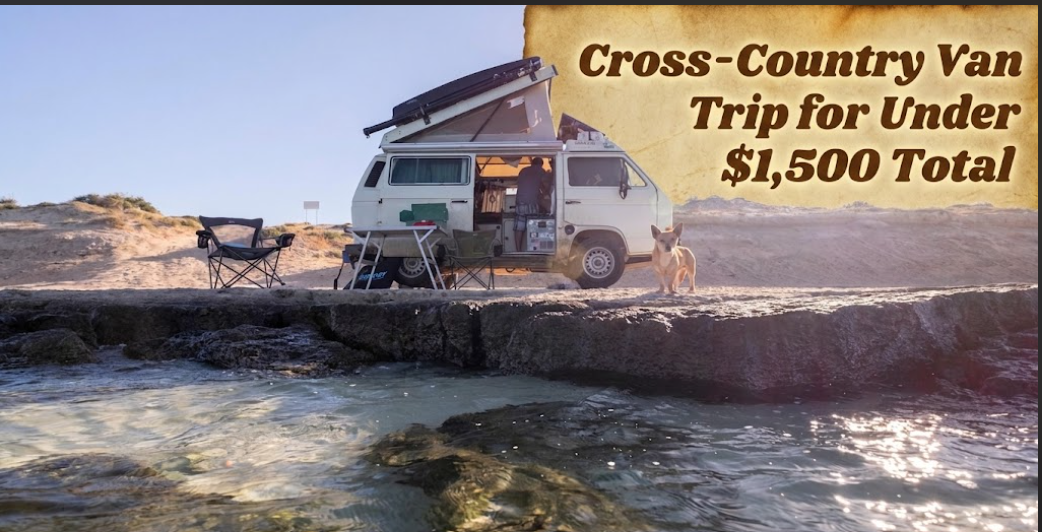
Someone messaged Budget Van Journeys a while back asking whether a US coast-to-coast van trip for under $1,500 was genuinely possible. Not per week. Not per person. Total. My first instinct was to say probably not, and then I sat down and actually ran the numbers properly, and the answer turned out to be yes, with specific decisions in about four areas.
What I find interesting about this budget question is that most people assume it breaks down on fuel. It doesn’t. The fuel math is more forgiving than expected. The places where $1,500 trips actually fall apart are smaller and more avoidable.
1. The Fuel Cost Is More Forgiving Than You Think
The assumption is that gas alone will devour most of a tight budget on a 3,000-mile trip. Let’s actually do the math rather than guess at it.
A van averaging 20mpg over 3,000 miles burns 150 gallons. At somewhere around $3.60 to $3.80 per gallon (which reflects roughly where national averages have landed outside of price spike periods), that’s $540 to $570. An older van running 16mpg on the same distance burns 187 gallons: $673 to $710.
Even at the higher end, you’ve spent $700 on fuel. That leaves $800 for everything else over 14 to 21 days of travel. Which is $38 to $57 per day for all non-fuel costs. That number is workable, and I think the reason people don’t believe it is that they don’t split the budget out like this before they go.
Speed matters here too. Running at 65mph rather than 75mph on a van measurably reduces fuel consumption, and across 3,000 miles that difference adds up to a noticeable number of gallons. The trips where I’ve pushed speeds were always slightly more expensive and slightly less enjoyable, which is a correlation I’ve noticed enough times to trust.
The immediate fix that costs nothing: use GasBuddy or a similar app to avoid filling up at interstate travel plazas and highway rest stops, which consistently charge above the regional average. Over multiple fill-ups across the country, this habit alone saves $40 to $70.
2. Free Camping Exists, and There’s a Lot of It
The belief that you’ll be paying $30 to $40 per campsite night across a 16-day trip is where most $1,500 budget calculations collapse. That belief is wrong, specifically if your route passes through the western states.
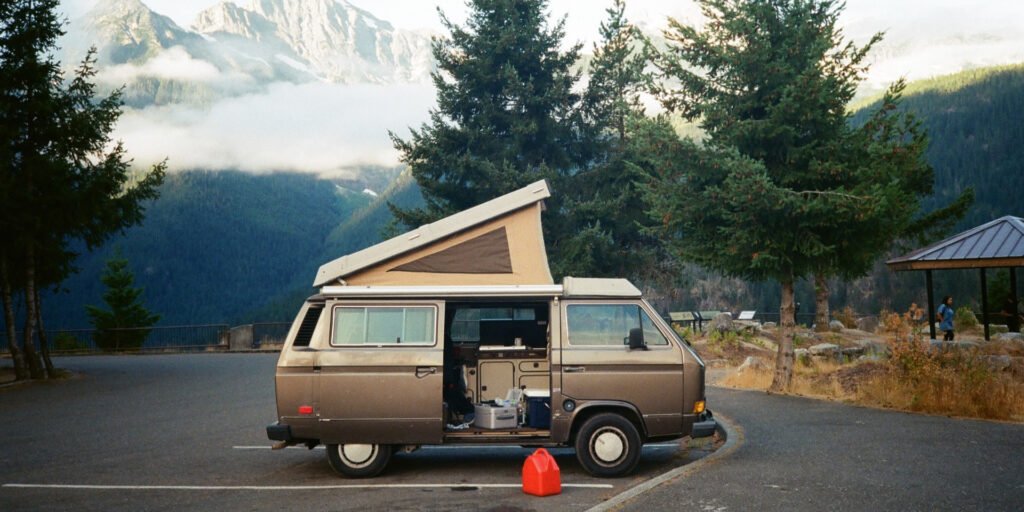
Bureau of Land Management land covers roughly 245 million acres in the western US. Most of it permits free dispersed camping for up to 14 consecutive days. Drive in, set up, leave no trace, leave no money. National Forest land follows similar rules across much of the west. These aren’t compromise options. Some of the best nights I’ve had on van trips were on BLM dispersed land with no one else for miles and views that paid campgrounds would charge twice as much to be adjacent to.
The honest limitation of this approach is geography. West of Kansas, free camping is abundant. East of Kansas, it thins significantly, the terrain changes, and you’re increasingly working with state parks and private campgrounds. For a true coast-to-coast trip, planning for mostly free camping on the western half and mostly paid camping on the eastern half is the realistic model.
A workable 16-day split: 10 free nights, 6 paid nights averaging $20 to $25 each. Total camping spend: $120 to $150 for the whole trip. That number surprises people, and I understand why, because it’s very different from what you’d spend if you booked paid sites every night without thinking about it.
Harvest Hosts comes up in these conversations. The annual membership is around $99, which gives you free overnight stays at farms, wineries, and breweries. I like the concept and the experiences are often genuinely memorable. But for a single cross-country trip, the membership fee eats the savings compared to free BLM camping. It makes sense for long-term van travelers, not quite as much for a one-trip budget calculation.
3. The America the Beautiful Pass Is $80 Well Spent
National park entry fees are cited constantly as a budget trip killer. They are, if you pay separately for each one. Entry to Zion, Arches, or the Grand Canyon runs $35 to $45 per vehicle. Three parks into a cross-country route and you’ve already spent more than the annual pass costs.
The America the Beautiful Annual Interagency Pass costs $80. It covers entrance fees for the pass holder and all occupants of their vehicle at every national park, national monument, national recreation area, and federally managed site that charges admission. Most sensible cross-country routes pass through three or more of these sites, at which point the pass has already paid for itself. Any additional ones are free.
Buy it before leaving rather than at the gate. Not because the gate is more expensive (it isn’t, same price) but because buying it at the gate of a busy national park while other vehicles queue behind you is an awkward situation that’s easily avoided.
One thing worth being clear about: the pass covers entrance fees, not camping fees at national park campgrounds, which run $20 to $35 per night at many sites. This is another reason the BLM dispersed camping strategy connects to the parks strategy. Free camping on nearby BLM land, day visit to the park on the annual pass, back out to free camping in the evening. That combination is both the cheapest and, genuinely, often the best experience.
4. Food Doesn’t Have to Be the Part That Suffers
The myth that a $1,500 total budget means subsisting on instant ramen and gas station pastries is one I want to push back on directly, because it’s not accurate and it sells budget van travel short.
Cooking in a van with a two-burner propane stove runs around $15 to $20 per person per day for three reasonable meals. Eggs and vegetables for breakfast. Wraps or sandwiches for lunch. Pasta with protein, or rice dishes, or tacos for dinner. That’s actual cooking, not deprivation. It’s also, in my experience, better food than whatever you’d order at the highway chain restaurant at the next exit.
On a 16-day trip at $18 per day per person, food costs $288. And honestly, most days come in lower than that when you’re buying staples in bulk at grocery stores every few days rather than purchasing individual meals at whatever’s convenient.
The thing that wrecks food budgets on van trips is convenience eating, and it’s worth being honest about how easily it happens. One fast food stop when you’re tired runs $10 to $14. A sit-down meal in a town that looks interesting is $25 to $40. These feel like small decisions but they accumulate across 16 days into a food budget that’s double what it needed to be.
Regional grocery chains save money in ways the big national chains don’t. Aldi locations are spread across the country. H-E-B in Texas, WinCo in the Mountain West and Pacific Northwest, Grocery Outlet on the west coast: these charge noticeably less for the same ingredients. Worth routing through them when possible rather than defaulting to whatever chain appears on the interstate exit sign.
THE BUDGET, BROKEN DOWN: 16 DAYS, ~3,000 MILES, SOLO
BEFORE DEPARTURE
America the Beautiful Annual Pass ........... $80
Emergency/repair fund (allocated, not spent) ... $150

ON THE ROAD
Fuel: 3,000 miles at 18mpg, avg $3.70/gal ...... $617
Food: 16 days at $18/day, cooking in van ........ $288
Camping: 10 free nights + 6 paid at $22 avg ..... $132
Propane refills, laundry, misc ................... $75

RUNNING TOTAL .................................. $1,192
REMAINING FROM $1,500 BUDGET .................. $308
That $308 buffer is real. It covers one roadside repair, a handful of paid experiences, or simply the financial comfort of not monitoring the budget daily. It also absorbs the variables: a higher-mpg van comes in lower on fuel; more paid camping nights or a fuel-inefficient van closes the gap. The model works.
5. Where This Budget Actually Gets Threatened
The big four categories rarely cause the breakdown. It’s the accumulated small things that nobody budgets for.
Souvenirs and roadside purchases are a genuine budget leak and I say that having been caught by them on more than one trip. A $14 local hot sauce set in New Mexico. A $28 piece of painted wood from a roadside stand in Utah. A $12 fridge magnet that seemed important at the time. Over 16 days, these add up to $150 to $200 for people who consider themselves careful spenders. Setting a specific allowance for this, something like $50 to $75, named and deliberate, is more effective than trying to resist individual purchases with willpower.
Paid activities are the other thing worth planning for rather than treating as surprises. A kayak rental, a guided slot canyon tour, a ferry crossing, a state park with a day use fee: these are real costs that belong in the budget. Budget Van Journeys covers van trip planning in more detail in other guides, but the principle is simple: two or three deliberately chosen paid experiences stay within budget; ten spontaneous ones don’t.
The pre-trip van condition question is the factor that determines whether the $150 emergency fund is sufficient or dangerously thin. A cross-country trip isn’t the moment to discover a slow oil leak, tyres at 3/32nds tread depth, or a questionable belt. A pre-trip mechanical inspection from a trusted mechanic costs $80 to $150. A tow from rural Nevada costs several hundred dollars minimum. The math on the inspection is obvious. It’s also the most commonly skipped pre-departure step, which is exactly why Budget Van Journeys puts it at the top of any pre-trip recommendation list.
FAQs
Is $1,500 realistic or only possible under perfect conditions? It’s realistic with a specific combination of choices: a van getting 16+ mpg, free camping concentration in western states, consistent cooking rather than eating out, and the America the Beautiful Pass for park entry. Under those conditions the budget finishes with money left. Under the opposite conditions (15mpg van, paid camping every night, frequent restaurant stops) it gets tight.
What’s the best US route for keeping trip costs down? Routes that pass through BLM-heavy states carry significantly lower camping costs. The Southwest and Mountain West (Nevada, Utah, Arizona, New Mexico, Colorado) offer the most free dispersed camping per mile traveled. A southern route along the I-10 corridor or a central Rockies route keeps you in free camping territory longer than a northern interstate route. Plan for paid camping once you move east of Kansas.
How does mpg vary between common van conversion types? Older V8 Ford Econolines and full-size Dodge/Ram vans typically get 14 to 16mpg on the highway. More recent Transit, Sprinter (diesel), and ProMaster-based conversions can reach 20 to 25mpg on open road. The difference between 15mpg and 21mpg across 3,000 miles is approximately 95 gallons, which translates to roughly $350 at current average prices. It’s a significant variable in the budget.
Can two people share a $1,500 budget or does it double? Two people sharing costs for a cross-country trip don’t pay double. Fuel stays the same, camping stays the same, the parks pass covers all vehicle occupants. Food roughly doubles, adding around $280 to a solo food budget. Total trip costs for two people run somewhere in the $1,400 to $1,700 range depending on the route and food habits, making the per-person cost considerably lower than $1,500 each.
What happens if something breaks down mid-trip? A blown tyre runs $150 to $250 with roadside service. A dead battery is $100 to $180 replaced. A snapped serpentine belt is $80 to $150. These land within a $300 buffer. A failed alternator, cracked head gasket, or transmission problem does not. The pre-trip mechanical check is the most important single step before committing to a tight budget cross-country trip, and skipping it is the move that turns a $1,500 trip into a much more expensive one.
Running the numbers before you leave rather than hoping they work out is most of the difference between a $1,500 cross-country trip and one that costs twice that. The fuel cost is constrained by the van and the speed. The camping cost follows from the route and a little research into free options. Food follows from how often you use the kitchen.
The math is more forgiving than the assumption. It just requires doing the math.