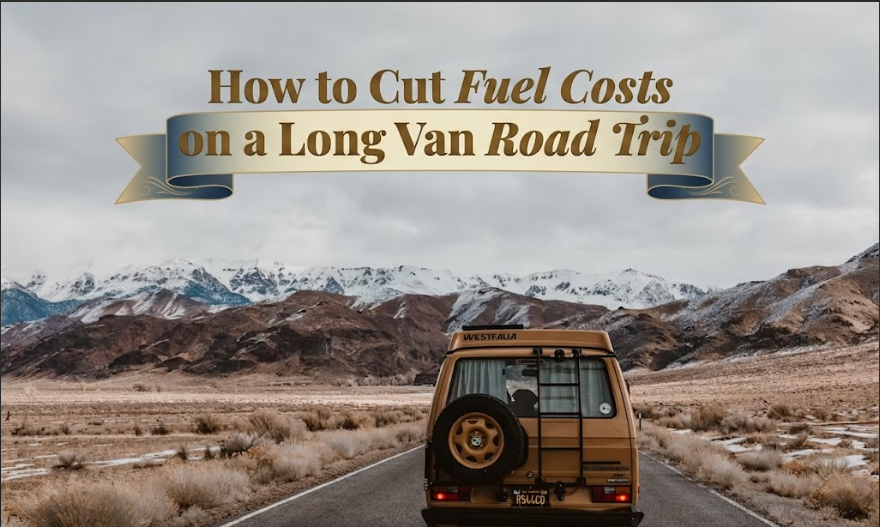
The thing that made the biggest difference to fuel costs on our last long trip wasn’t a route app, careful speed management, or turning off the air con. It was checking tyre pressure on the morning we left. Set to the laden figure on the door frame sticker rather than the default number most people use, our fuel average improved noticeably over the first two days compared to previous trips on the same roads. Nothing else had changed.
Fuel on a van road trip has a way of quietly bleeding a budget over days and weeks, and most of the common advice focuses on marginal gains while the bigger opportunities go unaddressed. What follows is what actually works.
1. Where the Money Is Actually Going
A fully fitted camper van conversion typically weighs 400 to 700kg more than the same van in factory spec. That extra weight costs fuel continuously, not just on hills. For every additional 100kg a vehicle carries, fuel consumption increases by roughly 0.3 to 0.6 litres per 100km depending on conditions. Across 2,500km of road trip driving, those numbers stop being abstract fairly fast.
Speed is the other major factor, and the relationship isn’t linear. Moving from 60mph to 70mph doesn’t add 17% to fuel use, it adds closer to 20 to 25% in a tall, loaded van because aerodynamic drag scales with the square of speed. High-profile panel vans feel this more acutely than lower car-derived vehicles. The difference is real and it’s measurable.
The third variable is where fuel gets bought. Motorway services in the UK charge between 10p and 20p more per litre than supermarket forecourts. On a long trip that involves multiple fill-ups, this becomes a meaningful cost, not a small inconvenience.
Most fuel waste on a van road trip comes from one or more of these three sources. Fixing driving habits while ignoring tyre pressure and fuel stop choices is fixing the wrong thing first.

2. The Driving Habits That Actually Move the Gauge
Speed reduction is the highest-impact single change most van drivers can make, and also the one that gets the most resistance. Dropping from 70mph to 60mph on motorway sections adds time to a journey. But on a road trip where the whole point is to be somewhere rather than arrive quickly, that tradeoff deserves more consideration than it usually gets. Budget Van Journeys tends to frame long-distance van travel around pace rather than efficiency anyway, and the fuel case supports that approach pretty solidly.
Smooth driving is underappreciated. Hard acceleration followed by coasting and braking is one of the most fuel-intensive ways to cover distance. Anticipating the road ahead, easing off before junctions rather than braking into them, using downhill momentum rather than fighting it with the accelerator: these habits together can shift fuel consumption by 10 to 15%. That’s a bigger gain than most people expect from something that costs nothing to implement.
Cruise control is useful on long flat motorway sections and less useful in rolling or hilly terrain, where a driver paying attention manages momentum more efficiently than an automated system. The temptation to run it everywhere is understandable, it reduces fatigue, but in variable terrain it often adds fuel use rather than cutting it.
Roof boxes and external racks are worth reconsidering before a long trip. A large filled roof box on a tall van at motorway speeds creates substantial drag. If the gear inside it can travel inside the van, that’s where it should be. And empty racks are still creating drag. It’s one of those things that becomes invisible once a rack has been on the van for a while, but it doesn’t stop affecting the fuel bill.
3. The Pre-Departure Audit That Most People Skip
Tyre pressure gets checked last, or not at all, on most departures. But for a loaded van on a long trip, running the laden inflation figure (listed on the door frame sticker, not the tyre sidewall number) rather than the unladen figure makes a genuine difference. Under-inflated tyres increase rolling resistance and fuel use. They also wear faster and handle worse at motorway speeds. Getting it right before leaving costs two minutes.
Weight is the other audit step that gets overlooked. Van conversions accumulate weight gradually and invisibly. Tools that haven’t been used in months, duplicate sets of things carried “just in case,” full gas canisters for equipment only used later in the trip, heavy chairs, a full water tank filled before the first stop rather than at it. None of it feels significant individually. But 50kg of avoidable weight removed before departure is 50kg you’re not carrying for the next 2,000 kilometres.
One thing that gets missed consistently: the cab itself. A passenger footwell full of bags, rear seating area loaded with gear that could go elsewhere, it all counts. Vans are not light vehicles to begin with. Every kilogram removed pays across the whole trip.
4. Fuel Buying Strategy
This is where a lot of money gets left on the forecourt. Most people react to the fuel gauge rather than planning stops, which means they pull in wherever is available, often a motorway service, and pay the premium price.
The alternative is straightforward. Apps like PetrolPrices or the fuel finder in Waze show nearby forecourt prices, and supermarket stations (Asda, Tesco, Sainsbury’s) consistently undercut branded stations and motorway services by a meaningful margin. Planning two or three fuel stops around supermarket locations, even when it means a short exit detour, recovers real money over a long trip without much effort.
Filling up around half-tank keeps options open. Running closer to empty forces decisions. Topped-up at around 50%, you can take the exit with the supermarket fuel rather than the services that are coming up in three miles.
On the question of supermarket fuel versus branded: UK supermarket fuel meets the same legal standards as branded fuel. The EN228 and EN590 specifications apply across all forecourts. Some drivers pay for premium Shell or BP fuels for the additive package, but standard supermarket diesel or petrol is not damaging to a van engine and there’s no economy case for paying more for it on a budget road trip.

5. The Pre-Departure Checklist
PRE-TRIP FUEL EFFICIENCY CHECKLIST
Tyres Inflate to laden pressure (door frame sticker, not tyre sidewall) Check for uneven wear before a long trip
Weight Remove tools and gear not needed on this specific trip Fill water tanks to first-leg needs only Clear cab floor and rear seating area of loose bags Roof box: is it needed, and is it empty on any legs of the route?
Fuel Plan Identify supermarket fuel stops along the route Note motorway services to avoid for fuel (use only for emergencies) Set rough fill-up intervals rather than responding to the gauge
Van Condition Check engine oil level and condition (dirty oil increases friction) Air filter last replaced (a blocked filter burns more fuel) Check for warning lights, including tyre pressure sensors if fitted
The tyre pressure and weight sections above account for the majority of recoverable fuel waste on most van trips. The mechanical checks matter more on older, higher-mileage vans. But none of them take long to run through the morning before a big departure.
Budget Van Journeys covers van maintenance timing in a separate guide if you want to go deeper on the mechanical side of keeping running costs low on long trips.
FAQs
Does 60mph versus 70mph really make a noticeable difference in a loaded van? Yes, and more so than in a car. A tall, loaded van has significant aerodynamic drag that increases sharply with speed. In real-world driving, 70mph versus 60mph in a Transit-sized van typically means 15 to 20% more fuel burned for the same distance. Over a full day of motorway driving, that’s a tangible cost difference.
Is supermarket diesel actually the same quality as branded? In the UK, yes. All forecourt fuel must meet EN228 (petrol) or EN590 (diesel) standards regardless of where it’s sold. Premium fuels from Shell V-Power or BP Ultimate contain additional detergents, which some drivers prefer for older engines or performance vehicles. For a van running on a road trip, standard supermarket diesel is fine and costs meaningfully less.
What has the biggest single impact on fuel costs without changing routes or driving style? Tyre pressure, set to the laden figure. It’s free, takes a few minutes, and under-inflated tyres on a loaded van are one of the most common sources of unnecessary fuel waste. Most people never check it against the laden specification.
Does turning off AC actually save fuel in a van? At motorway speeds, the compressor load from AC represents a smaller proportion of total fuel use, so the saving is modest. In slow traffic or urban driving, it’s more significant. Opening windows at motorway speeds also increases drag, which partially offsets the AC saving. Run the AC if you need it on fast roads; in town, it’s worth switching off.
How much does a loaded roof box actually affect fuel consumption? More than most people expect. A large roof box on a tall van at 65mph creates substantial aerodynamic drag. Over several hundred kilometres, the cumulative effect is noticeable. If the gear inside can travel inside the van, it should. An empty rack still creates drag. Taking it off before a long trip is one of those unglamorous decisions that genuinely pays off.
Fuel costs on a long van trip rarely arrive as a single large bill. They accumulate quietly, one fill-up at a time, one motorway service stop, one fully loaded roof at 70mph. The fixes are not complicated. But most of them require doing something before the trip starts, not during it, which is probably why they get skipped.
Check the tyres. Leave the unnecessary weight at home. Plan the fuel stops. That’s most of it, honestly.