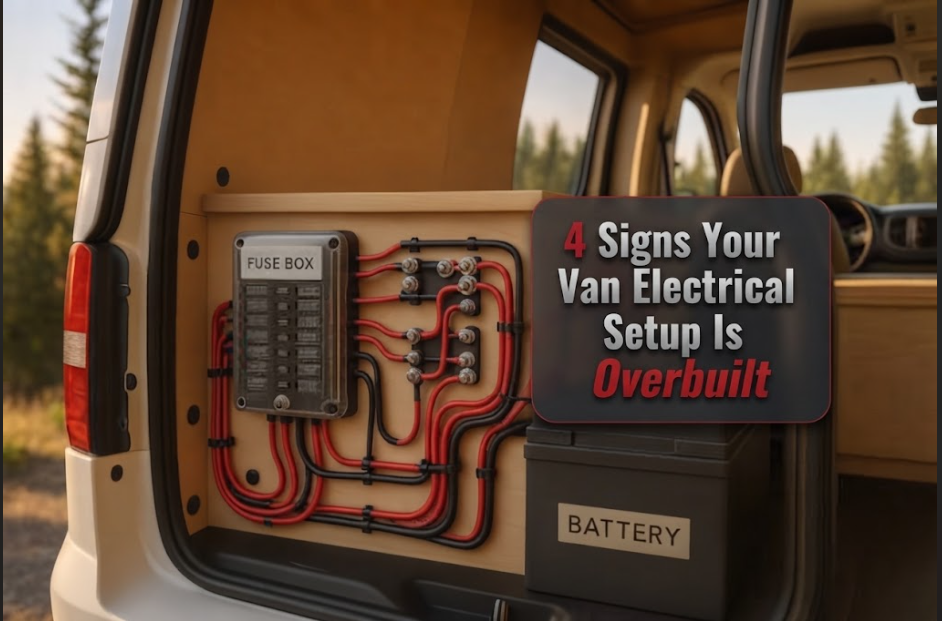
A guy at a van meetup in Moab once showed me his electrical bay like he was unveiling a car engine. Four 100Ah lithium batteries, a 3000-watt inverter, 600 watts of solar, a shunt-based monitoring system with an app, and a sub panel with more breakers than his actual house. He ran a mini fridge, a laptop, and some string lights. That was it. He’d spent close to five thousand dollars solving a problem that a single 100Ah battery and a 200-watt panel could have handled with room to spare.
This happens more than people admit. Van electrical systems have become a bit of a status symbol, and the forums reward complexity because complexity looks impressive in a photo. But an overbuilt system isn’t just wasted money sitting in your wall. It’s added weight you’re hauling up every mountain pass, more failure points, more things to troubleshoot on the side of the road, and often a system so complicated that the owner doesn’t actually understand their own setup anymore. Here are four signs yours might be one of them, and what to do about it.
1. Your Battery Bank Outlasts Your Actual Usage by a Wide Margin
If you’re regularly ending a day of dry camping with your battery bank still sitting above 70 or 80 percent, that’s not a safety margin. That’s oversizing.
A reasonable rule of thumb: track your daily draw for a week using whatever monitor you already have, then size your battery bank to cover two to three days of that draw without a full recharge. If your actual daily use is 40 to 60 amp-hours (fridge, lights, laptop charging, water pump, the usual) a single 100Ah lithium battery already gives you nearly two days of buffer. Going to 200Ah or beyond only makes sense if you’re running power tools, a big inverter for cooking, or you frequently go four-plus days without sun or driving.
The mistake people make here is buying for their imagined future setup rather than their current one. They picture themselves eventually running an induction cooktop or a CPAP and a fridge and a projector, so they buy the battery bank for that hypothetical life. Then they live with the actual, much smaller life, and haul around dead weight for years.
2. You Have Solar Panels You Never Actually Need in Overcast Weather
Solar capacity should be sized against your worst realistic charging day, not your best one. If you camp mostly in the Pacific Northwest or spend winters somewhere gray, 400+ watts of panel sitting mostly idle under cloud cover isn’t insurance, it’s excess.
Here’s a way to sanity check it. On a genuinely sunny day, a 200-watt panel in good conditions produces roughly 800 to 1000 watt-hours across a full day of exposure, accounting for angle and shading losses. If your daily consumption sits around 500-700 watt-hours, that panel alone covers you on any decent day, and your battery bank covers the gap on the bad ones. Beyond that, you’re paying for panels that mostly bake in the sun doing nothing, plus the added roof weight and wind drag that actually costs you fuel economy on the highway.
I made a version of this mistake early on, put too much panel on a rig that spent half its time parked under trees at campsites, and never once used the extra capacity. It just sat there, another mounting bracket to worry about on washboard roads.
3. Your Inverter Wattage Has Nothing to Do With What You Actually Plug In
This is probably the most common overbuild in the whole system. People buy a 3000-watt pure sine inverter because it feels like the “serious” choice, then run a laptop charger and a blender through it.
Walk through what you actually plug into AC power. A laptop charger pulls maybe 65-100 watts. A blender might spike to 800-1000 watts for a few seconds. A hair dryer, if you’re one of the rare van dwellers who runs one, can hit 1500 watts. Unless you’re running a space heater, an air conditioner, or power tools off the inverter, a 1000-1500 watt inverter covers nearly everyone’s real-world use with headroom for startup surges.
The problem with oversizing here isn’t just cost, though a 3000-watt inverter can run $400-800 more than a 1000-watt unit. It’s also idle draw. Bigger inverters pull more phantom power just sitting there in standby, quietly draining your battery bank overnight for nothing. If you’re seeing consumption you can’t account for, and you’ve got a large inverter left switched on, that’s often exactly where it’s going.
| Inverter Size | Realistic Use Case | Idle Draw (approx.) |
|---|---|---|
| 300-600W | Laptop, phone chargers, small appliances | 0.1-0.3A |
| 1000-1500W | Blender, coffee maker, most kitchen tools | 0.3-0.6A |
| 2000-3000W | Power tools, space heater, A/C | 0.6-1.2A+ |
If you’re not regularly using the top row of that middle or bottom category, you’re carrying an inverter built for a different van than the one you actually live in.
4. You Need a Manual (Or a YouTube Tutorial) to Explain Your Own Wiring
This one’s less about specs and more about a gut check. Can you explain your own system to another person in under two minutes, in plain language? Battery to charge controller to bus bar to fuse block to loads, with a couple of monitoring points along the way. That’s a system most people can sketch on a napkin.
If instead your system needs a laminated wiring diagram taped inside a cabinet door because even you forget how the sub panels route, that’s a sign the build outpaced the actual need. This matters more than it sounds like it should, because when something fails at 9pm in a gas station parking lot outside Flagstaff, you need to be able to troubleshoot it yourself. A simpler system with fewer components has fewer things that can break, and the things that do break are easier to isolate.
This is where people often go wrong: they treat complexity as a proxy for capability. A DC-DC charger, an alternator charge line, a separate solar charge controller, a battery-to-battery isolator, and a smart shunt all feeding into one system might genuinely be necessary for a heavy-use setup. For most people driving a few hours between camp spots and charging primarily from solar, it’s redundant hardware solving a problem they don’t have.
Anyone weighing their first build against a used one should read is van life actually cheaper than renting an apartment before sinking money into a system sized for a lifestyle they haven’t tested yet.
What to Actually Do If You Suspect Overbuild
Start by tracking real consumption for two weeks, not your guess at what you’ll need. A cheap Bluetooth battery monitor will tell you the truth your gut can’t. Compare that number against your current battery capacity and solar wattage. If you’re consistently ending days at 70 percent or higher charge, you have room to simplify, not expand.
Selling off excess panel capacity or a too-large inverter recoups real money, and simplifying a system is often cheaper than the original overbuild, since you’re removing components rather than adding them. It also tends to lighten the van by 30-80 pounds depending on how far you went, which matters more than most people expect once you’re climbing grades regularly.
If you’re still working out your baseline numbers before buying anything, it’s worth reading through setting a realistic van life budget for 2026, since electrical costs are one of the categories people misjudge most consistently before they’ve actually lived in the rig.
Most Budget Van Journeys readers who’ve gone through a rebuild say the same thing: the second system, the simpler one, ends up more reliable than the first. Not because less is inherently better, but because a system sized to actual use has less that can go wrong and less that sits unused.
None of this means big builds are wrong. Full-time off-grid workers running power tools or medical equipment have real reasons for a bigger bank and a bigger inverter. The point isn’t that bigger is bad. It’s that most people building for a weekend-warrior or part-time lifestyle end up buying for a full-time off-grid contractor’s rig, and paying for capacity they’ll never touch.
Frequently Asked Questions
How do I know if my battery bank is actually undersized instead of overbuilt? If you’re routinely dropping below 20-30 percent charge before you get a chance to recharge, or you’re rationing power use to make it through the night, that’s undersizing, not overbuilding. The signs above are specifically about excess capacity sitting unused, which is a different problem with a different fix.
Is it worth downsizing an existing system, or should I just live with what I have? It depends on what the excess is costing you. If the extra weight is affecting your fuel economy on long trips or the complexity is making troubleshooting harder, downsizing pays for itself over a year or two. If it’s just sitting there without causing practical problems, there’s no urgent need to rip it out.
What’s a reasonable starting point for someone building their first van electrical system? A single 100Ah lithium battery, a 100-200 watt solar panel, and a 1000-1500 watt inverter covers the vast majority of first-time builds running a fridge, lights, water pump, and device charging. You can always add capacity later once you know your actual usage pattern.
Does an overbuilt system actually cost me on gas mileage? Yes, though the effect is usually modest per pound. An extra 100 pounds of batteries and panels typically costs somewhere around 1-2 percent in fuel economy depending on the vehicle. It adds up more on long highway stretches and mountain routes than around town.
Should I trust the specs a dealer or installer recommends, or figure it out myself? Installers sometimes default to larger systems because it’s a safer sell and leaves less risk of complaints about insufficient power. It’s worth tracking your own consumption data for a couple of weeks before a build so you’re speccing against real numbers rather than a generic recommendation.
For anyone still in the planning stages, Budget Van Journeys’ guide to a realistic first month on the road is a good next stop before locking in any electrical component purchases.