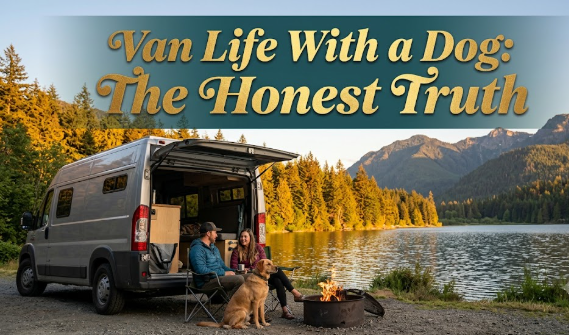
The photos are very convincing. Dog in the passenger seat, ears back in the wind, mountain backdrop, campfire nearby. I see them constantly and, if I catch them at the right moment, they almost have me. But spend any real time in the actual van life community and you start to hear a different story. Not a sad one, just a more complicated one than the highlight reel suggests.
Traveling with a dog in a van is genuinely wonderful in a lot of ways. And it is also genuinely hard in ways that almost nobody covers properly. I’ve been pulling together real numbers and real experience here at Budget Van Journeys for a while now, and I want to give you the version of this that helps you actually plan, rather than the one that makes a pretty Instagram post.
So here it is.
1. What Van Life With a Dog Actually Costs
This is the thing people most consistently underestimate, and honestly the gap between expected cost and real cost is bigger than almost any other surprise in van life. Dog ownership on the road is not cheap, and the costs don’t always look like you’d expect.
The most significant one is vet access. At home, you have a regular vet, a routine, a relationship with someone who knows your dog’s history. On the road, you have whoever is available in whatever town you happen to be passing through. Those walk-in appointments at unfamiliar clinics cost considerably more than your usual check-up, and an unexpected visit for something as routine as a cut paw or a bout of gastro can easily run $150 to $300 without pet insurance. The insurance itself is an ongoing monthly cost you need to factor in from the very start.
Then there are the campground pet fees. Most paid sites charge an additional $5 to $15 per night per dog. That sounds minor until you’re staying at paid sites for a full week and you’ve suddenly spent an extra $70 to $100 just for the privilege of bringing your dog along. Budget Van Journeys has a detailed breakdown of the real cost difference between free and paid camping, and for dog owners specifically, that gap widens noticeably.
Flea and tick prevention also becomes non-negotiable when you’re sleeping in forests, meadows and grassland most nights. Monthly prevention is not optional the way it might feel at home. Expect $20 to $40 per month depending on the product and the size of your dog, and build it into your budget from day one, not as an afterthought.
Here’s a rough breakdown of the additional monthly cost most van lifers with dogs report:
| Expense Category | Approximate Monthly Cost |
|---|---|
| Pet insurance | $30 to $60 |
| Flea and tick prevention | $20 to $40 |
| Extra campground pet fees | $40 to $120 (varies by site use) |
| Food (harder to buy in bulk on the road) | $60 to $100 |
| Occasional vet visits, averaged out | $30 to $80 |
| Approximate total additional per month | $180 to $400 |
These numbers will shift based on your dog’s size, their health and your camping habits. But the general message stands. If you’re already budgeting for van life without accounting for a dog, the real monthly cost breakdown we’ve covered for 2026 gives you a good base, and a dog is a meaningful variable on top of that.
2. Finding Overnight Spots Is More Restrictive Than You’d Expect
This one surprises a lot of people who are used to traveling solo or as a couple with no additional dependents. Free camping on BLM land is generally dog-friendly, and that’s genuinely good news. National forests too are usually fine with basic leash rules in place. But the restrictions stack up in ways that genuinely limit your options, and they stack up faster than you’d think.
National parks allow dogs in campgrounds and on paved roads, but most trails are off-limits or heavily restricted. If your vision of van life involved weeks of hiking national park trails with your dog beside you, that vision needs adjusting. Zion, the Grand Canyon, Yellowstone and most of the major parks have significant trail restrictions for dogs. The reasons are sensible enough, wildlife protection and the safety of the animals themselves, but it does mean you’ll be doing a lot of hiking without your dog or leaving them at camp, which creates its own problems (more on that shortly).
State parks are wildly inconsistent. Some welcome dogs on most trails with a leash. Others restrict them to campground loops only. There’s genuinely no universal rule, and it requires checking each specific location before you commit to driving two hours off your route to get there.
The apps that van lifers use to find overnight spots are helpful but imperfect. Budget Van Journeys tested four of the most popular free camping apps, and pet restrictions in particular are often community-reported rather than verified. That means you occasionally arrive somewhere only to discover dogs aren’t actually welcome, which is frustrating when you’ve driven to get there.
The states with the most dog-friendly free overnight options tend to be BLM-heavy western states. Nevada, Utah, Colorado, New Mexico and Montana all have significant stretches of public land where dogs are welcome without fees and without trail restrictions. That said, desert heat in several of those states creates its own complications, which brings me to the next section.
3. The Logistical Headaches Nobody Actually Mentions
The heat problem is serious, and I want to be really direct about this one. A parked van in direct summer sun can reach lethal temperatures within minutes, and this is not hyperbole. It means you cannot leave your dog in the van while you go into a shop, a restaurant, a coffee shop, a museum, anywhere without reliable shade and ventilation. This changes your day significantly.
Solo van lifers with dogs describe it as one of the most consistently limiting factors of the whole lifestyle. Your options are: bring the dog everywhere (and not everywhere allows dogs), plan your stops around dog-friendly locations exclusively, or find another van lifer you trust to watch them while you duck somewhere quickly. There’s no clean solution here. You just have to recalibrate your expectations about the kinds of stops and activities you’ll be doing.
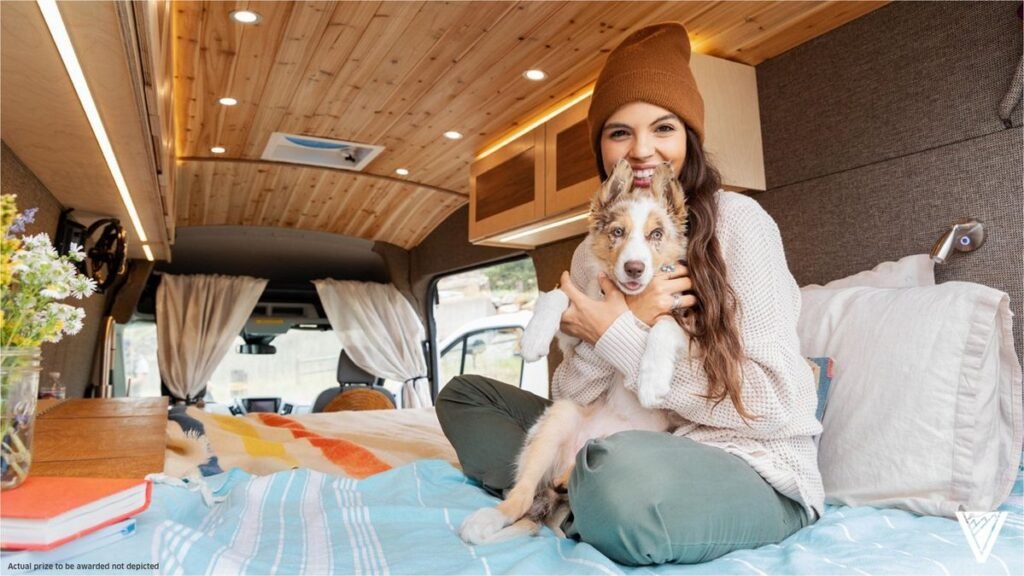
Space is the other logistical reality. A medium-sized dog in a standard cargo van takes up a meaningful portion of your living area. A large dog takes up more. People often build their vans with a human-sized sleeping platform and a few storage systems, then realize there’s nowhere comfortable for a 50-pound dog to actually settle. The setups that work best are the ones where the dog’s area was planned into the build from the very beginning. A defined sleeping spot, a water bowl location that doesn’t slide around on corners, enough floor space for the dog to stretch without being constantly underfoot.
And then there’s the issue of barking for anyone planning to stealth park in urban areas. The thing that makes stealth parking work is looking and sounding like any other parked vehicle. A dog that barks at strangers walking past at 11pm effectively ends that. It’s not insurmountable, but it does meaningfully narrow where you can park quietly without attracting attention.
There’s one more thing I want to mention, because people often overlook it when thinking about this romantically. Dog ownership forces you to care about someone else’s needs before your own comfort every single day, in conditions that are already a little demanding. Early morning walks when you’d rather sleep in, managing their anxiety in a thunderstorm when you’re parked in a field with no hookups, finding water sources for both of you in dry country. It’s not a reason not to do it, but it’s worth going in clear-eyed about what it asks of you.
4. Where Van Life With a Dog Is Actually Brilliant
Right, let me be equally clear about the good parts, because there are real, genuine ones and I don’t want this to read as purely a list of warnings.
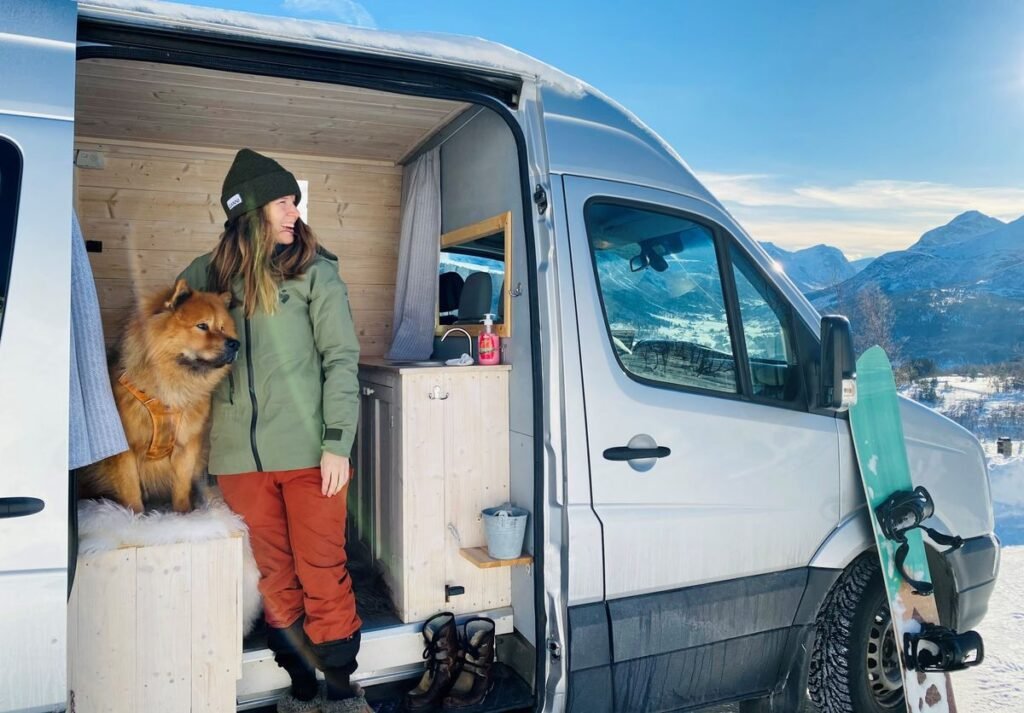
Dogs are exceptional outdoor companions. The whole point of van life for many people is access to wild, open spaces, and a dog matches that lifestyle in a way that almost nothing else does. Early morning walks, off-trail afternoons, long evenings at elevation. A dog loves all of it, and is frequently in better shape for it than you are.
There’s also a genuine security element to having a dog in a van. This varies by breed and temperament obviously, but for solo van lifers especially, having a dog that reacts to strangers approaching the vehicle at night is quietly reassuring. It’s not a substitute for sensible parking choices, but it’s not nothing.
The routine element is something people don’t expect to value until it’s there. Van life can become very unstructured very quickly, and a dog forces a schedule. Morning walk, feeding, evening walk. That rhythm keeps a lot of people grounded when the freedom of the road starts to feel a bit formless.
And the community aspect is real. Pull into almost any campsite with a dog and you’ll have a conversation with at least one other dog owner before the evening is done. Dogs are a social connector in a lifestyle that can sometimes feel quite solitary, especially on long drives through empty states.
Here’s a quick honest rundown of both sides:
| The Good Stuff | The Harder Stuff |
|---|---|
| Perfect outdoor and hiking companion | Cannot leave them in a hot van alone |
| Built-in routine and daily structure | Restricts access to trails and many attractions |
| Useful for van security (alert to strangers) | Barking is a problem for stealth parking |
| Great social connector with other van lifers | Adds roughly $180 to $400 per month |
| Loves the lifestyle you’re already living | Vet access is less reliable and more expensive |
| Keeps you active, especially on rest days | National park trail restrictions are significant |
FAQs
Is it actually cruel to keep a dog in a van full-time?
Not inherently, no. Dogs adapt to their environment well, and a dog that gets regular walks, consistent outdoor time and stable company can thrive in van life. The welfare concerns to take seriously are heat management, ensuring adequate exercise for the breed, and maintaining vet care. Anxious breeds that don’t handle changing environments easily will find it harder than adaptable, socially confident dogs. Know your dog before you commit.
What kind of dog handles van life best?
Adaptable, social and not particularly vocal breeds tend to do well. Labrador types, many hound mixes, cattle dogs and most medium-sized mutts handle the lifestyle without too much difficulty. Very territorial breeds, extremely high-energy dogs without an adequate outlet, or anxious dogs that struggle with new environments will find it more stressful. Size is practical too: in a small van build, a smaller dog simply gives you more room to function.
Can I take my dog into national parks?
Dogs are allowed in national park campgrounds, parking areas and on most paved roads. Most trails, however, are restricted or completely off-limits. Before planning a national park as a major stop on your route, look up that specific park’s dog policy. They vary. Some are reasonably accommodating. Others have very limited dog access beyond the campground.
What do I do with my dog when I need to go somewhere dog-unfriendly?
This is genuinely one of the trickier parts of the lifestyle. Options include parking in a well-shaded, ventilated spot with a solar fan running and a temperature monitor on your phone so you can track conditions remotely, connecting with other van lifers who can watch your dog for a bit, or simply designing your itinerary around outdoor and dog-friendly stops. Many van lifers with dogs end up gravitating toward breweries with outdoor seating, farmers markets and trailheads as their main social spots, which actually works quite nicely.
How do I keep my dog safe in a parked van during summer?
Not by cracking the windows. That’s the starting point. A parked van in direct sun reaches dangerous temperatures far faster than most people expect, even with windows partially open. The minimum setup you need if you’re going to step away from the vehicle is a roof vent fan on a thermostat and a wireless temperature monitor you can check from your phone. Even with that, the safe window of time is short in peak summer heat, and in some regions and some months, leaving a dog in a parked vehicle isn’t viable at all regardless of your equipment.
The van lifers who make it work with dogs tend to be the ones who planned for it honestly before they left, not the ones who assumed the dog would just figure it out. That means building with the dog in mind from the start, budgeting accurately, researching locations in advance and being genuinely realistic about what you’re willing to give up. With that groundwork in place, the rest of it, the good bits, the early mornings and the mountain tracks and the campfire evenings, are pretty hard to beat.