The hashtag people credit for turning van life into a movement wasn’t started by a marketer or a travel brand. A former fashion industry designer named Foster Huntington quit his job, bought a truck, and started posting photos with the tag #vanlife on Instagram around 2011, mostly for himself and a small circle of friends doing the same thing. Neither he nor anyone else involved had any idea it would eventually apply to a hundred million posts and an entire economy of solar kits, composting toilets, and YouTube channels. That’s the surprising part. The thing everyone assumes is a recent invention has roots that go back further than almost anyone doing it today realizes.
Long Before the Hashtag
The instinct to live mobile, stripped-down, and self-sufficient didn’t start with a Volkswagen. In 1855, a Scottish surgeon named William Stables commissioned what’s generally regarded as the first purpose-built recreational travel home, a horse-drawn wagon he named The Wanderer, and set off touring the countryside in it for reasons that had nothing to do with cost savings and everything to do with restlessness. That detail tends to surprise people who assume this whole idea started with hippies and a VW Bus.
It didn’t. It just found its most famous vehicle there.
1. The VW Bus Becomes a Symbol, Not the Start
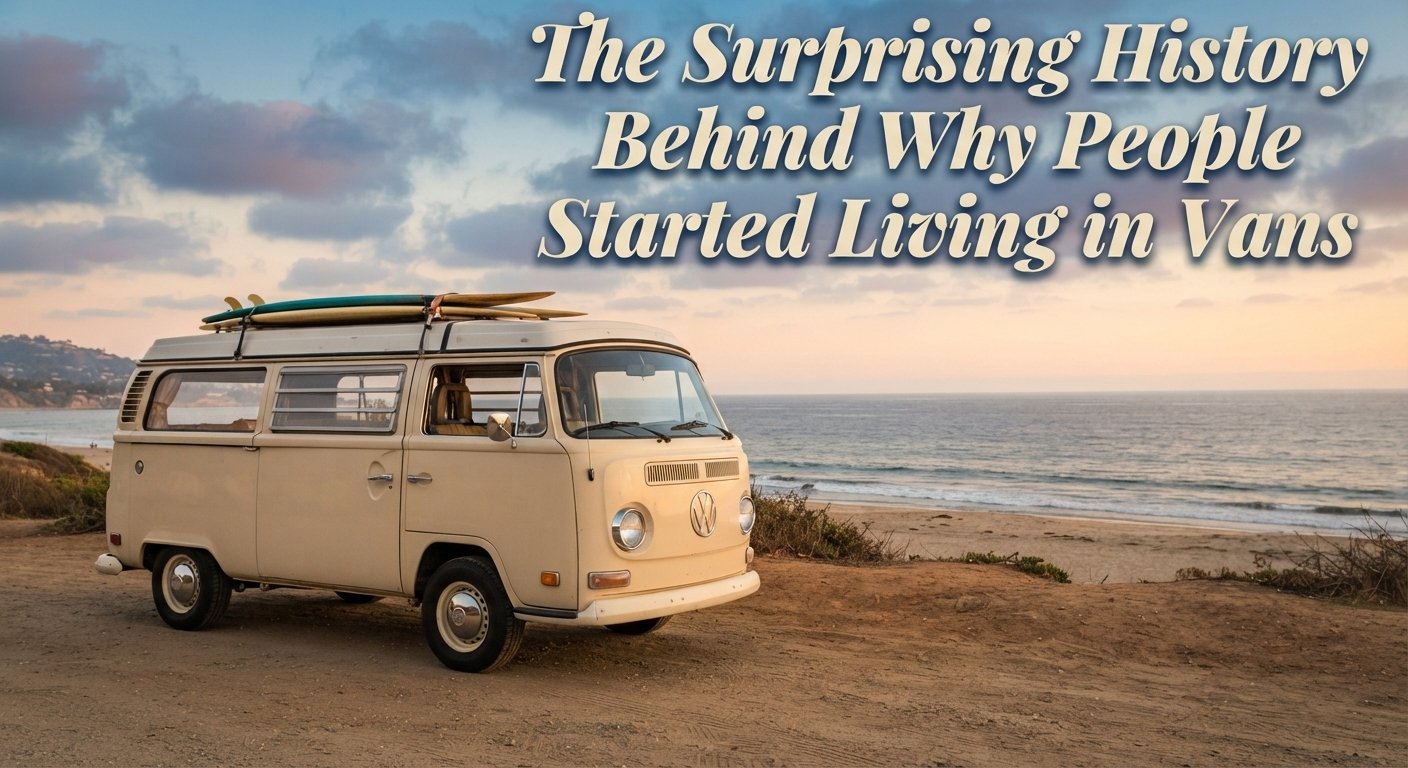
Volkswagen introduced its Type 2 van, eventually nicknamed the Microbus, in the early 1950s, and it took a decade or so to become the cultural shorthand for van living that most people picture today. Opposition to the Vietnam War pushed a generation of young people toward a countercultural identity built around rejecting fixed addresses, steady jobs, and the general machinery of conventional adult life. The Microbus, cheap, easy to customize, and roomy enough to sleep in, became the physical expression of that rejection. Painted with peace signs and flowers, it carried people to protests, festivals, and eventually to Woodstock, where its association with youth rebellion got cemented permanently in the public imagination.
Here’s where people usually get the history slightly wrong, though. The hippie van era wasn’t purely about escape and self-expression. Vans from that same period were also doing serious, unglamorous work. A Black couple in South Carolina, Esau and Janie Jenkins, used a 1966 VW Microbus alongside several repurposed city buses to drive people to voter registration and civil rights organizing throughout the 1960s. The same vehicle that showed up on album covers and at music festivals was also functioning as literal infrastructure for a movement with much higher stakes than personal freedom.
2. The Quiet Decades Nobody Talks About
Van living didn’t stay culturally visible after the 1970s wound down. For roughly two decades, people who lived in vehicles full time mostly did so without an audience, and often without much social approval either. The image shifted from countercultural adventurer to something closer to “drifter,” and that shift mattered. Full-time vehicle dwellers in the 1980s and 1990s were frequently assumed to be down on their luck rather than making a deliberate lifestyle choice, and the practical challenges (finding safe parking, staying under the radar, managing without today’s lightweight solar and lithium battery options) were genuinely harder than they are now.
This gap matters for anyone trying to understand why van life feels like it “suddenly” appeared again in the 2010s. It didn’t appear. It went underground for a while, practiced by a smaller and less visible population, while the technology and cultural narrative around it caught up.
Van Life Through the Decades, at a Glance
| Era | Defining Vehicle/Symbol | Cultural Framing |
|---|---|---|
| 1850s | Horse-drawn travel wagons | Wealthy eccentrics, novelty travel |
| 1950s-60s | Early VW Type 2 Microbus | Practical family and cargo vehicle |
| Late 1960s-70s | VW “Hippie Bus” | Counterculture, protest, festival travel |
| 1980s-90s | Converted cargo vans, older RVs | Largely invisible, often stigmatized |
| 2011-2015 | Sprinter and Transit conversions | Early #vanlife adopters, niche online community |
| 2016-present | Custom Sprinter, Transit, Promaster builds | Mainstream lifestyle brand, full media ecosystem |
3. What Actually Changed to Bring It Back
A handful of specific, practical shifts explain why van life resurfaced and stuck around this time instead of fading again. Lithium battery technology became affordable and reliable enough for a small vehicle to run a fridge and charge devices without a generator running constantly. Solar panels got cheaper and more efficient. Remote work, still a niche option in the 2000s, became a genuine career path for a meaningful slice of the workforce, which solved the biggest practical obstacle earlier generations of van dwellers faced: how do you actually earn money while moving constantly.
Social media did the rest of the work, but it’s worth being precise about what role it actually played. It didn’t invent the desire to live this way. It gave people who already had that instinct a way to find each other, learn from each other’s mistakes, and see that the lifestyle was survivable and even enjoyable, which lowered the barrier to actually trying it. Budget Van Journeys exists because of that same shift, informational content replacing trial-and-error learned the hard way, alone, with no community to ask.
4. The Economic Motivations Have Shifted Too
The 1960s version of van life was mostly about ideology, a rejection of systems people saw as corrupt or hollow. The version that’s dominant today carries a much heavier economic thread running through it. Rising rent, stagnant wages relative to housing costs, and a housing affordability crisis that’s hit younger generations especially hard have pushed a meaningful number of people toward vehicle living not as a countercultural statement but as a financially rational response to a system that no longer works for them the way it did for previous generations.
This is a genuinely different motivation than the one driving the Woodstock-era version of the movement, and it’s worth naming directly because a lot of casual van life content blurs the two together as if they’re the same impulse wearing different decade’s clothing. They’re related, but they’re not identical. Anyone drawn to this lifestyle purely for cost reasons should read why van life isn’t as cheap as Instagram shows before assuming the economic motivation guarantees economic success. It doesn’t, automatically. And is van life actually cheaper than renting an apartment runs the honest numbers on that comparison in detail.
5. The Part of the History That Gets Romanticized Away
Every era of this movement, going back to Stables and his horse-drawn Wanderer, has involved real hardship that tends to get edited out of the retelling. The hippie vans that look charming in photographs were often mechanically unreliable and physically uncomfortable in ways that period accounts describe far less romantically than modern nostalgia does. The invisible decades of van dwelling in the 80s and 90s involved genuine social stigma and legal risk that current van lifers, with their curated online communities and increasingly normalized public perception, mostly don’t have to contend with in the same way.
Modern van life carries its own version of that gap between image and reality, and it’s a pattern worth recognizing precisely because it isn’t new. If you’re weighing whether you’re actually ready for this lifestyle rather than just drawn to its current online aesthetic, 3 signs you’re not ready for full-time van living covers the gap between the romantic version and the daily reality in more practical detail than most van life history pieces bother to include.
There’s also a useful parallel worth drawing to a different small-space movement that’s been solving similar problems from a different angle. What tiny house living can teach van dwellers about space covers some of that overlap, and it’s a good reminder that the instinct to live small and mobile has been expressing itself through multiple parallel movements, not just one continuous van life lineage.
A more thorough, well-sourced timeline of the whole story, including details on Foster Huntington’s original posts and how the RV industry responded once the trend went mainstream, is worth reading in full at the San Francisco Chronicle’s history of #vanlife and RVing, which pulled together interviews and archival material that go deeper than most van life blogs bother to.
What This History Actually Tells Current Van Dwellers
Understanding where this all came from doesn’t change anyone’s electrical setup or their fuel budget. But it does put the current moment in a useful context. This isn’t a fad invented by an algorithm, and it’s not a permanently stable lifestyle destined to last forever in its current form either. It’s the latest expression of an instinct that’s resurfaced repeatedly for over a century and a half, shaped each time by whatever economic pressures, available technology, and cultural mood happened to be present.
Budget Van Journey exists in this specific moment of that longer story, one where the tools are better than they’ve ever been and the reasons people give for doing this have shifted from ideology toward economics, sometimes both at once. Neither framing is wrong. They’re just different chapters of the same underlying impulse.
Frequently Asked Questions
Who actually started the #vanlife hashtag? Foster Huntington, a former fashion designer, is widely credited with popularizing the tag around 2011 after he left his job and began documenting his life on the road, though the underlying lifestyle long predates any hashtag.
Was van life originally a hippie-only movement? Not entirely. While the VW Microbus became strongly associated with 1960s counterculture, vans from the same era were also used for civil rights organizing and other practical community purposes that had nothing to do with the countercultural image most people picture.
Why did van life seem to disappear between the 1970s and 2010s? It didn’t disappear, it went less visible. Full-time vehicle dwellers during those decades faced more social stigma, fewer technological conveniences like affordable lithium batteries and solar, and a much smaller support community than exists today.
Is modern van life mostly about lifestyle or about money? Both, in varying proportions depending on the person, but the balance has shifted meaningfully toward economic motivation compared to the ideology-driven version of the movement in the 1960s and 70s.
Did RV manufacturers always support the van life trend? Not initially. Established RV manufacturers were slower to recognize the shift toward smaller, more mobile van conversions, and much of the early build culture came from individuals customizing vans themselves rather than buying pre-built units from major manufacturers.
Understanding this longer arc is mostly useful for perspective, not practical planning, but it’s worth having in the back of your mind the next time someone claims van life is a brand new trend invented for social media. It’s closer to the newest costume on a much older idea.