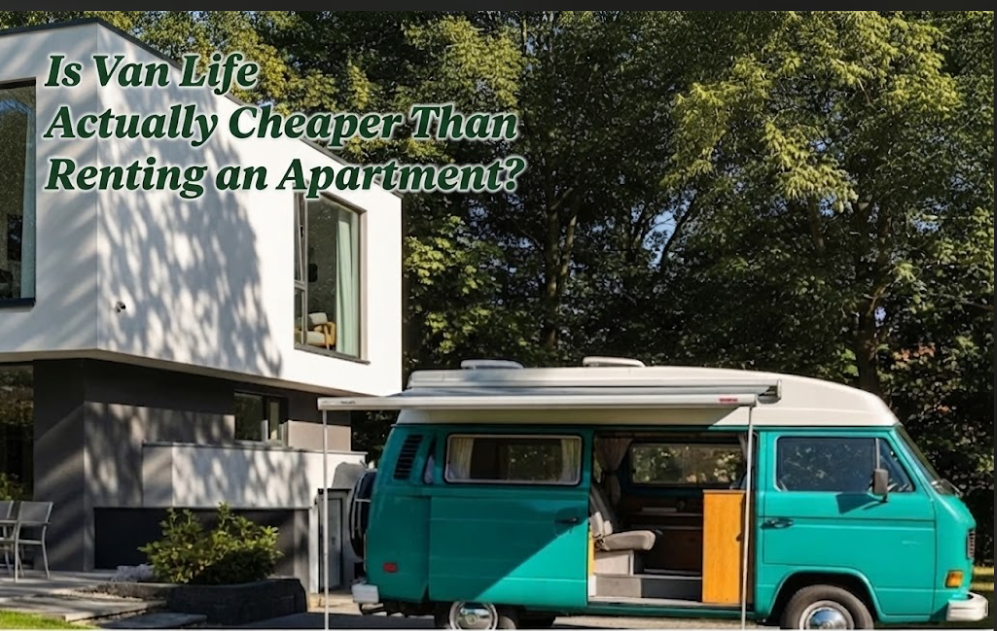
There’s a number that gets repeated so often in van life circles that people stop questioning it: live in a van, save thousands a year. I believed it too, for about the first four months. Then I actually sat down with a spreadsheet, my bank statements, and a friend’s apartment lease, and the picture got a lot messier than the YouTube thumbnails suggest.
That’s the misconception worth clearing up first. Van life isn’t automatically cheaper than renting. It’s cheaper in some categories, more expensive in others, and the answer changes depending on where you live, what you drive, and how honest you’re willing to be about the costs that don’t show up until month three.
1. What Renting Actually Costs You Beyond the Rent
Rent itself is the number everyone fixates on, and it’s a real one. As of mid-2026, the national median rent for a one-bedroom sits somewhere between $1,220 and $1,660 a month, depending on which report you’re reading and how tight the local market is. That’s already a wide range, and it’s before you add anything else.
But a lease drags a whole second budget behind it. Utilities. Renter’s insurance. A security deposit that’s gone the moment you sign. Parking, if your building charges for it. Internet. And the quiet one nobody budgets for: the stuff you buy to fill an apartment because an empty apartment feels wrong. A couch. Shelving. Curtains you didn’t know you needed until the sun came in at the wrong angle.
Add it up honestly and a $1,400 apartment is usually closer to $1,800 to $2,200 once utilities, insurance, and the inevitable Target run are factored in. Most people don’t do this math. They just look at the number on the listing.
2. What Van Life Actually Costs, Line by Line
Here’s where van life content usually gets sloppy. It talks about fuel and campsite fees and stops there, as if the van itself, the insurance, and the maintenance fund don’t exist.
They do. And they’re not small.
| Cost Category | Renting (1BR apartment) | Van Life (paid-off van) |
|---|---|---|
| Housing payment | $1,220–$1,660/mo | $0 (if van is paid off) |
| Insurance | $15–$30/mo (renter’s) | $80–$180/mo (vehicle) |
| Utilities / power | $100–$180/mo | $0–$40/mo (solar setup) |
| Fuel / commute | Varies, often low | $150–$500/mo (driving-dependent) |
| Maintenance | $0 (landlord’s problem) | $100–$250/mo (should be budgeted) |
| Parking / camping fees | Usually included | $0–$400/mo |
| Estimated monthly total | $1,800–$2,200 | $600–$1,500 |
That range on the van side is wide because it depends almost entirely on how much you move. A van parked in one spot for months, using free BLM land or a friend’s driveway, can run genuinely low. A van doing 2,000 miles a month chasing weather and views burns through fuel money fast enough to erase most of the savings.
I’ve seen the sailors’ approach to resource discipline pay off here too. In what sailors taught us about van living, the lesson was about water, but the same logic applies to fuel and power. People who plan routes and ration resources spend less than people who improvise daily. It’s not romantic, but it’s the difference between the low end of that range and the high end.
3. Where People Get the Math Wrong
The mistake nearly everyone makes when comparing the two is treating “no rent” as “no housing cost.” It isn’t. It’s a different housing cost, front-loaded and less visible.
The van itself is the biggest one. If you bought a used cargo van and built it out, that $2,000 to $8,000 didn’t disappear, it just moved from a monthly line item into an upfront one. Spread a $6,000 build over three years and you’re quietly paying $166 a month whether you think about it that way or not. The breakdown of what a sub-$5,000 build actually requires covers this in more detail, and it’s worth reading before anyone assumes van life starts at zero.
Insurance is the second blind spot. A lot of new van dwellers insure the vehicle like a commuter car and don’t realize that full-time occupancy can affect coverage, especially after an accident or a break-in. Get it wrong and a $150 monthly premium turns into a denied claim.
And then there’s depreciation, which nobody likes discussing because it feels abstract until the transmission goes at 140,000 miles and the resale value has already cratered.
4. The Costs Nobody Puts in the Spreadsheet
Some costs don’t show up in either column but shape the real answer.
Renters get stability. A fixed address makes healthcare, mail, banking, and even job applications simpler. That’s not nothing, and pricing it at zero understates what a lease actually buys.
Van dwellers get flexibility, but they also absorb risk that renters transfer to a landlord. A broken furnace is the landlord’s expense. A broken alternator, 200 miles from the nearest town with a mechanic who’ll work on your specific van, is yours, on your timeline, usually at the worst possible moment.
Laundry, showers, and gym memberships for hot water access add up too, often $40 to $100 a month that renters simply don’t pay. Meanwhile renters pay for a home gym, a full kitchen, and closet space that van dwellers go without. Neither lifestyle is free of these tradeoffs. They just distribute the costs differently.
5. So Which One Actually Wins?
For most people, in most markets, van life is cheaper, but by a smaller margin than the internet implies, and only if the vehicle costs are budgeted honestly rather than ignored. A paid-off van, parked mostly in one region, with a real maintenance fund, will usually land somewhere between $600 and $1,200 a month all-in. That beats a $1,800 to $2,200 apartment cost by a real amount, often $700 to $1,400 a month.
That gap shrinks fast, though, if the van needs a loan payment, if fuel costs climb because the lifestyle involves constant movement, or if a major repair lands in the same year as new tires. It can even flip in expensive-to-maintain older vehicles, which is part of why Budget Van Journeys keeps pushing readers toward realistic vehicle selection rather than the Instagram version of the build.
The honest answer isn’t “van life wins.” It’s “van life wins when the person running the numbers stops pretending the van is free.”
I still think it was the right call for me. But I stopped bragging about the savings until I’d tracked a full twelve months, and the number that finally felt true was smaller and more believable than the one I told people in year one.
Frequently Asked Questions
Is van life cheaper than renting in every city? No. In lower-cost regions where rent is already under $1,000, van life’s advantage narrows significantly, and factors like fuel prices or state vehicle taxes can close the gap entirely.
How much should I budget monthly for van maintenance? A reasonable range is $100 to $250 a month set aside, even in months nothing breaks. Vans that skip this end up with owners financing repairs on credit cards instead.
Does van insurance really cost more than renter’s insurance? Usually, yes. Renter’s insurance is often $15 to $30 a month, while insuring a van used as a full-time residence typically runs $80 to $180, depending on the vehicle, state, and coverage level.
What’s the single biggest van life cost people underestimate? Fuel, if the lifestyle involves frequent long-distance travel. A van getting 15 miles per gallon covering 1,500 miles a month can spend more on gas alone than some renters spend on their entire apartment.
Can van life ever end up more expensive than renting? Yes, particularly with vehicle loan payments, older vans with high repair frequency, or a travel style that racks up paid camping and fuel costs. The math depends entirely on the specific setup, not the lifestyle label.
For anyone weighing this seriously, the best van life YouTube channels worth following in 2026 are a good next stop, particularly the ones willing to show a real monthly ledger instead of just the coastline views.