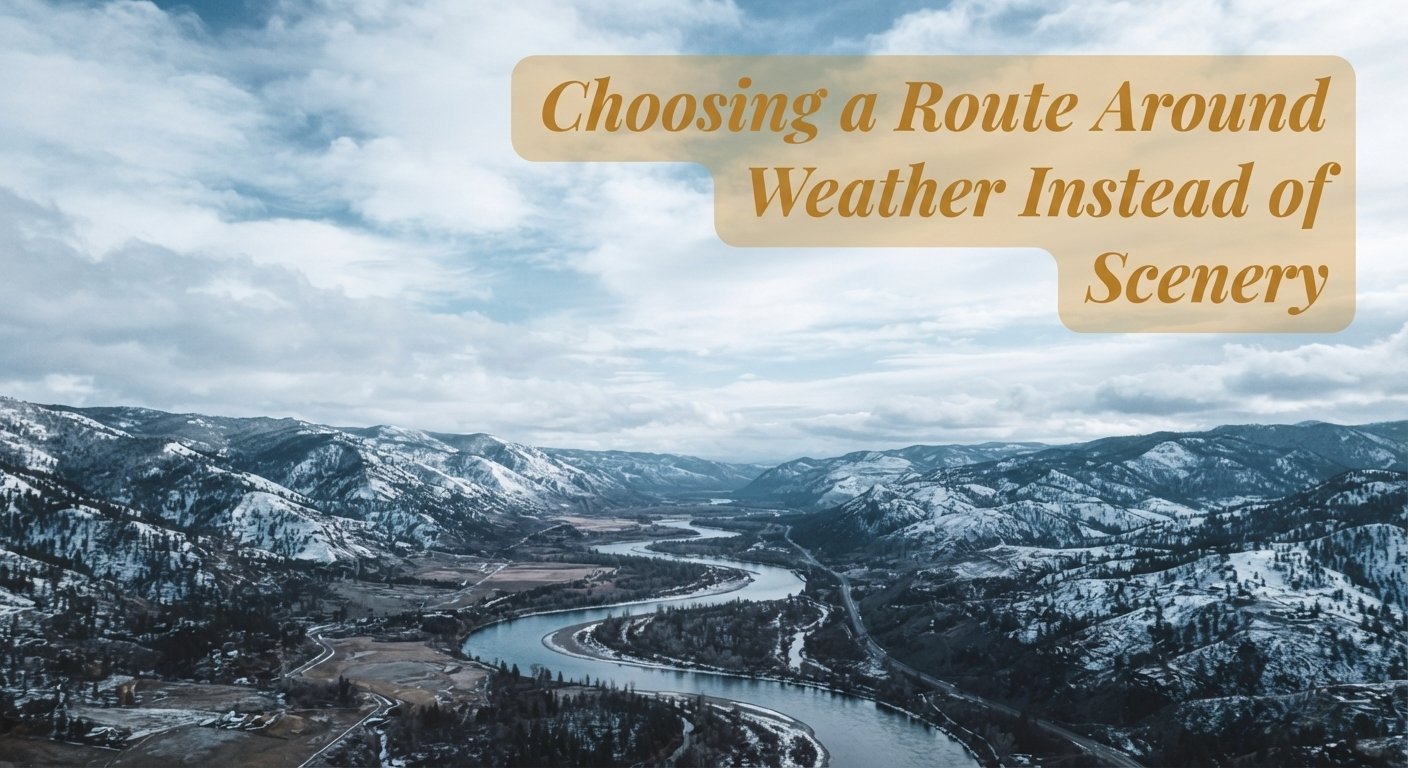
Somebody messaged us last spring asking a simple question: “How do you decide where to go next?” She meant it practically, not philosophically. She was staring at a map with six national parks circled and no idea which order to visit them in. Our answer surprised her, and it tends to surprise most new van dwellers the first time they hear it. Scenery comes second. Weather comes first.
That’s not the romantic answer. Nobody starts van life dreaming about checking barometric pressure trends before deciding where to sleep. But the people who actually stay on the road longer than a few months, the ones who aren’t constantly white-knuckling through storms or stuck waiting out a closure with a dwindling propane tank, are almost always the ones who flipped that priority early.
The Myth: Chase the Views, Adjust for Weather Later
This is the belief that gets repeated constantly in van life content, and it’s not entirely wrong, just incomplete. The idea goes: pick your dream destinations, build a rough route connecting them, and deal with weather as it comes up. Check the forecast a few days out, adjust if something looks bad, otherwise follow the plan.
The problem is that “adjust if something looks bad” assumes weather gives you clean warning and clean alternatives. It often doesn’t. A mountain pass can close with only hours of notice. A dispersed camping area can flood overnight from a storm two counties upstream. And once you’re routed toward a destination, with fuel, food, and mental momentum all pointed that direction, the actual adjustment tends to happen later and more reluctantly than people plan for.
Here’s where people usually go wrong specifically. They treat weather as an input to check, like glancing at a gas gauge, rather than a variable that should shape the whole route before it’s finalized. Those are very different planning processes, and only one of them prevents the 2 a.m. scramble.
What Actually Works Instead
Building a route around weather doesn’t mean giving up on scenery. It means sequencing destinations by season and climate window first, then filling in the specific stops within whatever weather-safe corridor that creates. Southwest desert routes in summer become a heat management problem. Mountain routes in shoulder season become a closure and mud problem. Coastal Pacific Northwest routes in winter become a rain and low-light-hours problem. Each region has a real window, and scenery inside that window is just as good as scenery outside it, minus the risk.
This is a bigger mental shift than it sounds like. And honestly, it took me longer than I’d like to admit to actually adopt it myself, because the instinct to chase a specific waterfall or canyon at a specific time of year is strong, even once you know better.
A resource worth bookmarking here is the National Weather Service’s route-based travel forecast tool, which lets you overlay actual point-to-point forecasts along a specific driving route rather than checking city-by-city forecasts and trying to mentally stitch them together. It’s not glamorous, but it’s the kind of tool that turns a vague weather worry into an actual decision.
Weighing the Two Approaches
| Scenery-First Planning | Weather-First Planning |
|---|---|
| Pro: Trip feels exciting to plan, destinations drive the schedule | Pro: Fewer forced detours, less scrambling for last-minute parking |
| Pro: Easier to plan around specific bucket-list stops | Pro: Fuel and time budgets hold up better with fewer surprises |
| Con: Higher chance of hitting a closure or dangerous stretch | Con: Requires checking regional climate patterns before committing |
| Con: Backup plans are usually improvised under stress | Con: Feels slower and less spontaneous when you’re planning |
| Con: Weather-driven detours often cost more in fuel and fees | Pro: Backup options identified calmly, ahead of time |
Neither column is universally right. A short weekend trip with flexible timing can absorb more scenery-first risk than a multi-week route where you’re relying on that timeline actually holding.
1. Build Your Route in Seasonal Blocks, Not a Straight Line
Instead of drawing one continuous line across a map, break the year into three or four climate windows and assign regions to each one. Desert Southwest from late fall through early spring. Mountain West and Pacific Northwest interior from late spring through early fall. Coastal routes almost anywhere are more forgiving year-round but come with their own rain patterns worth checking regionally.
This sounds obvious written out, but a surprising number of first-year van dwellers plan a single cross-country loop without accounting for the fact that the ideal window for the desert stretch and the ideal window for the mountain stretch don’t overlap, and one half of the trip ends up compromised.
2. Treat Fuel and Route Flexibility as Connected Decisions
A weather-first route usually means slightly more driving flexibility built in, which connects directly to how you budget fuel. If you’re planning tight mileage with no buffer, a forced detour around a storm system eats into a budget that had no room for it in the first place. Our breakdown of budgeting gas money for long, slow van trips covers this from the cost side, and it’s worth reading alongside your route planning rather than after the fact, since the two decisions genuinely feed each other.
3. Parking Plans Need a Weather Contingency, Not Just a Location
Here’s a mistake we made more than once early on: picking a great free camping spot for the night without checking what that spot becomes in bad weather. A gravel pullout that’s fine in dry conditions can turn into a mud trap that swallows tires after rain. A riverside spot that looks idyllic can flood with upstream snowmelt or a storm you never saw coming locally.
Our piece on why finding free parking never works out at first covers a lot of the legal and practical pitfalls of dispersed camping, and the weather angle deserves the same level of scrutiny. Before settling somewhere for the night, it’s worth asking not just “is this spot legal and quiet” but “what does this spot become if it rains six inches tonight.”
4. Borrow the Discipline Sailors Already Have
This isn’t the first time we’ve pointed to sailing culture for a lesson van life hasn’t fully absorbed yet. Sailors plan routes around weather windows as a matter of survival, not preference, and the same logic that governs how sailors ration water on small boats applies here too. A sailor doesn’t ask “is the destination good.” They ask “is the window safe to attempt it in,” and the destination only matters once that question is answered.
Van dwellers have more margin for error than sailors crossing open water, obviously. Nobody’s arguing otherwise. But the underlying planning order, safety window first, destination decision second, transfers cleanly, and it’s the exact reversal of how most people currently plan their routes.
5. Beginners Underestimate How Fast Conditions Change Along a Route
A common misconception worth naming directly: people assume that if the forecast looks fine at their starting point and fine at their destination, the drive between the two will be fine too. This ignores elevation changes, microclimates, and the simple fact that weather along a 300-mile stretch can vary enormously even when both endpoints look calm.
This is one of several patterns we’ve flagged before in van life myths that keep costing beginners money, and it belongs on that list even though it’s framed slightly differently here. Checking only your endpoints instead of the full corridor is exactly the kind of gap that turns a routine travel day into an expensive, stressful one.
If you’re still building your first month’s route and haven’t settled into a planning rhythm yet, our guide to your first month on the road touches on infrastructure-first routing generally, which is really the same instinct as weather-first routing applied one level broader.
Frequently Asked Questions
How far in advance should I actually plan around weather? For most routes, checking conditions five to seven days out gives a reasonably reliable picture, with a closer check two to three days before departure to catch anything that’s shifted. Mountain passes and anything above 7,000 feet deserve a tighter window since conditions there can change faster than lower-elevation forecasts suggest.
Does this mean I can’t ever chase a specific view or event? Not at all. It just means building in a backup date or backup route for anything time-sensitive, so a weather delay becomes an inconvenience rather than a scrapped plan. Flexibility around the specific day matters more than flexibility around the destination itself.
What’s the biggest weather-related mistake new van dwellers make? Underestimating how much elevation changes conditions along a single day’s drive. A route that starts warm and dry can climb into snow within an hour, and checking only the start and end points misses that entirely.
Is it worth paying for a premium weather app, or are free tools enough? Free tools, including the National Weather Service’s own route forecasting page, cover the vast majority of what most travelers need. Paid apps add convenience, like automatic rerouting suggestions, but they’re not covering information you couldn’t get for free with a little more manual checking.
How do I know when to just cancel a leg of the trip instead of pushing through? If a route requires a mountain pass and that pass has an active chain requirement or closure warning, treat it as a hard stop, not a challenge. The honest answer is that no scenic view is worth the risk calculus once conditions have crossed from inconvenient into genuinely hazardous.
Building a route this way takes longer at the planning stage and it’s genuinely less exciting to sit with a forecast map for twenty extra minutes instead of just circling pretty places on a map. But the version of this lifestyle that actually lasts past the first few months tends to belong to the people who made that trade early, and stuck with it even once the excitement of the first big trip wore off.