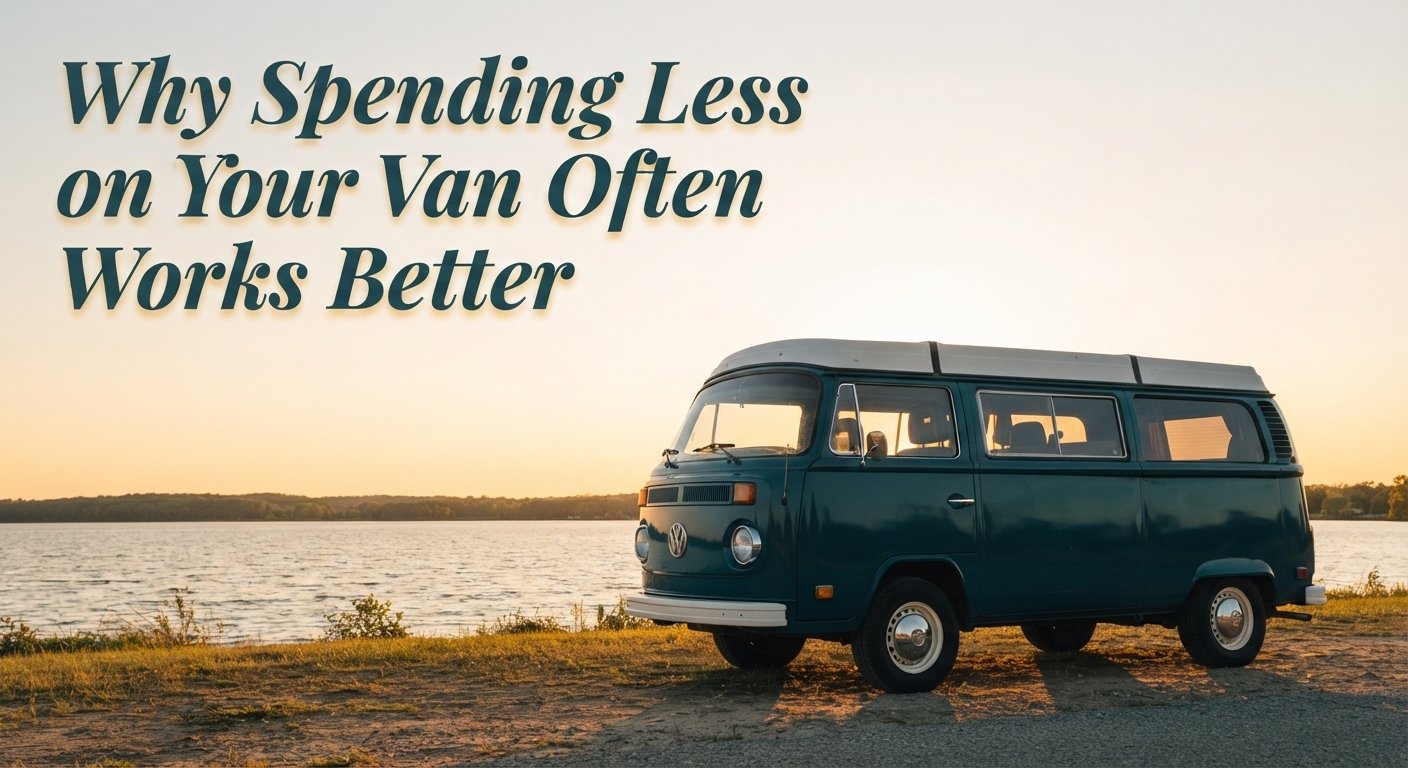
A guy pulled into a campground outside Moab last spring with a build that cost more than most people’s first house. Full off-grid solar, a composting toilet with a heated seat, cabinetry that looked like it belonged in a Manhattan kitchen. Three weeks later he was back on the road looking for cell signal to sell the whole thing. He’d spent so much on the van he couldn’t afford to actually live in it.
That’s the pattern nobody warns you about before you start building. Money spent on the rig isn’t the same as money spent on the life.
1. The Myth: More Equipment Means More Freedom
The assumption baked into most van build content is that capability equals comfort. Bigger battery bank, bigger fridge, bigger water tank, therefore bigger freedom. It sounds right. It’s also backwards for most people in their first year.
A $2,000 build tested and documented on this site held up fine through a full season of travel, and the owner never once wished for the $40,000 version parked two spots over. What that build had wasn’t luxury. It had reliability, because there was less to break.
Every added system is something that can fail two hundred miles from the nearest mechanic who knows what a Victron inverter even is. Complexity is a cost you pay twice: once at purchase, and again every time something stops working and you’re the one troubleshooting it in a parking lot.
2. Why It’s Wrong: The Overbuilt Trap
Here’s where people usually go wrong. They plan their build around the best possible day on the road instead of the average one. Best possible day, you’re boondocked in the desert for two weeks and need serious solar capacity. Average day, you’re driving to a job, parking near a friend’s place, or sitting in a grocery store lot doing email.
Sizing your entire system for the exceptional case means you’re carrying weight, cost, and maintenance burden for a scenario that happens maybe four times a year. Our piece on <a href=”https://budgetvanjourneys.com/4-signs-your-van-electrical-setup-is-overbuilt/”>signs your electrical setup is overbuilt</a> goes deeper into this, but the short version is: most vans on the road have double the solar capacity they use in a typical month.
And it’s not just electrical. Insulation gets the same treatment. People assume more insulation always equals more comfort, when the honest answer is more nuanced. Our comparison on <a href=”https://budgetvanjourneys.com/insulation-vs-no-insulation-does-it-really-change-comfort/”>insulation versus no insulation</a> found the difference matters enormously in shoulder-season climates and barely at all if you’re chasing 70-degree weather year round. Spend where it counts. Skip where it doesn’t.
3. What’s Actually True: Constraint Builds Better Habits
Vans with less capacity force better decisions. A smaller water tank means you actually track your usage instead of running the tap while you brush your teeth. A smaller fridge means you shop for what you’ll eat this week, not what might spoil in three.
There’s a version of this lesson that predates van life by centuries. Sailors crossing oceans with fixed water tanks developed rationing habits that modern van dwellers still borrow from, almost without knowing it. We wrote about this directly in <a href=”https://budgetvanjourneys.com/how-sailors-ration-water-on-small-boats-and-what-van-lifers-can-steal-from-it/”>how sailors ration water on small boats</a>, and the overlap is not a coincidence. Constraint teaches discipline that abundance never does.
This is also, frankly, where a lot of van life influencers lose credibility. They show up with the $40,000 build and call it minimalist. Budget Van Journeys exists partly because that gap between the aesthetic and the reality needed a counterweight.
| Approach | Upfront Cost | Monthly Maintenance Risk | Learning Curve |
|---|---|---|---|
| Minimal build (basic insulation, small solar, manual water) | Low | Low | Steep at first, flattens fast |
| Mid-tier build (moderate solar, small fridge, basic electrical) | Moderate | Moderate | Gradual |
| Full off-grid build (large solar, inverter, composting toilet, climate control) | High | High | Ongoing, often requires outside help |
4. Where the Money Should Actually Go
Not every dollar saved is a dollar well saved. There’s a difference between cutting cost and cutting corners, and the line matters. Insulation is not the place to go cheap, especially if you’re running the vehicle through anything colder than a mild coastal winter. Neither is your electrical wiring, since a bad connection there is a fire risk, not just an inconvenience.
Where you can genuinely save: furniture, finishes, and anything cosmetic. A plywood shelf does the same job as a custom hardwood one. Nobody’s Instagram engagement actually correlates with how nice your cabinet pulls are, though you’d think otherwise scrolling through some of these accounts.
If you’re still working out what the full picture costs, and it costs more than the build alone, our breakdown of <a href=”https://budgetvanjourneys.com/how-much-does-it-really-cost-to-live-in-a-van/”>what it really costs to live in a van</a> accounts for insurance, fuel, and the ongoing expenses nobody puts in their build video thumbnails.
And on that note. Insurance is one area where the cheap option can genuinely bite you, because coverage gaps show up exactly when you can least afford them. Worth reading before you assume the lowest quote is the smart one.
5. The Part Nobody Wants to Admit
A leaner van also means less to lose. That sounds obvious written out, but it changes how people actually behave on the road. Owners of expensive builds park further from town centers, avoid certain neighborhoods entirely, and spend real mental energy worrying about theft or damage. Owners of simpler builds tend to just park and go do the thing they came to do.
There’s a psychological cost to expensive gear that rarely gets counted alongside the financial one. And once you’ve lived it both ways, the tradeoff stops being theoretical.
Some people will read this and still want the full build, and that’s a legitimate choice if the budget genuinely supports it without strain. The problem isn’t spending money. The problem is spending it because the algorithm told you a stainless steel sink was non-negotiable.
Start small. Add what you actually find yourself needing, not what looked good in someone else’s walkthrough video. You can always upgrade later. Downgrading a build you already sank ten grand into is a much harder conversation to have with yourself.
Frequently Asked Questions
Is a cheap van build actually safe for full-time living? Yes, as long as insulation and electrical work are done properly. Cheap and unsafe are not the same thing. The corners worth cutting are cosmetic, not structural or electrical.
How much should a first-time build actually cost? Somewhere between $1,500 and $4,000 covers a functional, comfortable setup for most people, assuming you’re doing labor yourself and not paying for a professional conversion.
Will I regret not having a bigger solar system? Most people don’t, especially if their travel style involves regular stops in towns rather than long stretches fully off-grid. Start smaller and add panels later if you genuinely hit a wall.
Does a smaller build mean less comfort? Not necessarily. Comfort often comes down to insulation, mattress quality, and layout more than square footage or system size. A well-insulated small van beats a poorly insulated large one every time.
What’s the biggest mistake people make with their first build budget? Spending on visible, photographable features before locking down insulation, electrical safety, and a reliable water system. The unglamorous stuff is what actually determines whether the build works.
For anyone starting from scratch, the guide to your first month on the road is a good next stop before you finalize a single purchase.